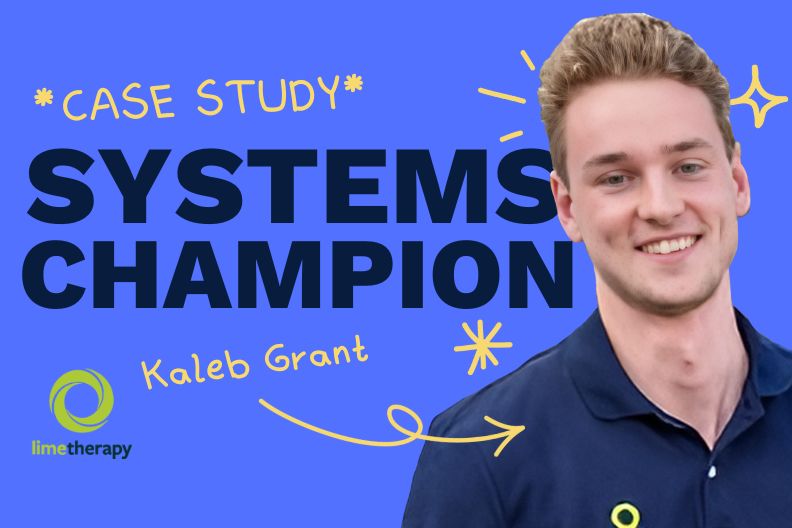
Ever feel overwhelmed starting a new job, wishing someone had just written down how things actually work? Kaleb Grant felt exactly that when he graduated as an occupational therapist two years ago. Today, he’s the Systems Champion at Lime Therapy in Mildura, Australia, documenting processes, training team members, and building the backbone of a multidisciplinary allied health practice.
His journey reveals something important: the Systems Champion role is essentially a junior business process manager position by another name. And it isn’t just good for businesses: it’s a career accelerator for junior professionals willing to get organized.
Whether you call it Systems Champion, Process Coordinator, or Business Process Manager, this career path offers unique advantages for early-career professionals across industries.
The New Graduate’s Challenge: Too Much to Learn, No Clear Path
Starting as an occupational therapist at Lime Therapy meant joining a complex multidisciplinary team. The practice includes OTs, physiotherapists, speech therapists, and other allied health professionals serving their local community. For a recent graduate, the learning curve was steep.
“There is such a breadth of knowledge and understanding around what we do and particularly the areas that we need to know to be able to do our job well and serve our clients in the best possible way we can,” Kaleb explains. “Being in that position of being relatively new and coming into a business where there is such a big understanding and learning curve to it, I think it really shows the benefit for me in terms of what systems can bring.”
Coming from that lived experience of information overload, Kaleb could see what other team members couldn’t: the urgent need for documented processes. When everything lives in people’s heads, new team members drown in questions, and busy experts get interrupted constantly.
Why Junior Professionals Make Better Business Process Managers Than You’d Think
When Lime Therapy owners Renee and Matt decided to implement SYSTEMology, they didn’t choose their most experienced clinician.
They chose Kaleb, the organized new graduate who liked his lists and wanted clear direction.
“I like things organized and I like my lists and I like to know what to do essentially,” Kaleb says. “I think just having that mindset made me a decent candidate to be a Systems Champion.” The business owners saw potential beyond his clinical experience. They gave him something equally valuable: protected time each week and the confidence to tackle the role.
What makes someone a good Systems Champion? Kaleb points to attention to detail and the ability to ask questions from a beginner’s perspective. “If you understand it, other people are going to understand it as well,” he notes. “Particularly for these types of things where I maybe haven’t done those tasks before, to then ask the right questions and really start from scratch. I think it’s a pretty good skill to have.”
Being a junior became an advantage. Kaleb wasn’t burdened by assumptions about how things should work. He could document processes exactly as they happened, asking clarifying questions that experienced team members might skip.
This pattern repeats across industries. Junior business process manager roles often succeed precisely because the person isn’t entrenched in “how we’ve always done it.” They bring fresh eyes, genuine curiosity, and the humility to ask clarifying questions that uncover hidden inefficiencies.
Learning to Think in Systems (Without a Background in Process Management)
Kaleb had no formal training in business process documentation. He learned by doing, supported by the right resources and structure.
What Kaleb Used to Get Started:
- The SYSTEMology book: His physical copy stays on his desk as a constant reference for methodology and Systems Champion guidance
- Business owner mentorship: Regular meetings with Renee and Matt to align on priorities and strategy
- Systems Champion Academy: Structured onboarding program with James, providing dedicated support throughout implementation
- Protected weekly time: Dedicated hours blocked off from client appointments to focus on systems work
- Direct access to experts: Scheduled extraction sessions with knowledgeable workers who perform each process best
The key was starting with Critical Client Flows (CCFs). “I think it starts with working with Matt and Renee as well as the senior members of the team and getting our CCFs identified,” he explains. “With the breadth of the business that we have here, it’s really important to know where to focus and try and be quite specific because it’s very easy to go off on tangents and focus on other things.”
This disciplined approach kept the project manageable. Instead of trying to document everything at once, Kaleb focused on the processes that directly impacted client outcomes and team efficiency.
Real Results: From Onboarding Chaos to Documented Excellence
The admin team transformation showed the clearest early wins. With recent staff changes, having documented processes became critical for continuity.
“I’ve been doing a lot of work with our admin team because there’s been a few changes recently,” Kaleb shares. “In terms of a win, it’s been nice to get that up and running in a way so that when new people come in, it’s that first point of contact.” Instead of overwhelming one busy person with constant questions, new team members now have documented systems in systemHUB as their starting point.
This shift matters beyond just convenience. “Having their systems set up for us really increases our timely work and making sure it’s the highest quality it can be,” Kaleb explains. “Meeting with the people who do it the best really then leads when we come to do it for the first time, or someone new steps in, that we’re really delivering the highest quality work in the time and manner that we can for these people.”
The documented processes also empower team members with confidence. Following step-by-step guides from experienced colleagues means junior staff can deliver quality care without constantly second-guessing themselves. Systems eliminate the key person dependency that bottlenecks so many allied health practices.


Five Insights Every Systems Champion (and Business Owner) Needs
Kaleb’s journey offers practical wisdom for anyone stepping into the Systems Champion role or considering creating one in their practice:
- “Don’t aim for perfection”: Document how things are done 80% of the time, then refine later. Perfectionism will stall your progress before you build momentum.
- Focus on the 80/20 rule: “Capturing and documenting what’s done 80% of the time” helps you avoid getting lost in edge cases. Narrow your focus to what happens most often.
- “If you understand it, other people are going to understand it”: Your beginner’s perspective is valuable. Ask basic questions without assuming knowledge. This ensures documented processes work for everyone.
- Systems empower teams: “If you feel empowered as a team member, you feel much more confident in what you’re doing.” Documented processes build confidence and reduce the anxiety of uncertainty.
- Keep it visible and collaborative: Kaleb uses team chat to share updates on what he’s working on and invites contributions. “Giving them the chance to contribute and come in with systems and any ideas they have around what they think could be really valuable” maintains buy-in and keeps systems front of mind.
The Business Process Management Career Path Forward
Six months into his Systems Champion journey, Kaleb sees the bigger picture clearly. “We’re both very excited about where this is going and we see how well it’s going to be implemented in 12 months time,” he shares about conversations with business owner Renee. “For us it’s just an exciting adventure that we’re on.”
That excitement comes from understanding something most new graduates miss: business process management work gives you insight into how businesses actually operate. Working closely with the most knowledgeable team members, understanding different departments, and solving problems that have frustrated leadership for years: these experiences accelerate career growth in ways clinical work alone cannot provide.
The skills Kaleb is building translate directly across industries. Process documentation, workflow optimization, change management, cross-functional collaboration, and systems thinking are foundational competencies for business process manager roles in healthcare, technology, finance, manufacturing, and beyond. Starting this career path as a junior professional means developing these strategic capabilities years ahead of peers who stay purely in technical or clinical roles.
Kaleb’s advice to potential Systems Champions?
“Just being open to it and being willing to take it on and give it a shot because once you get rolling with it, it’s very exciting. Be willing to interact with those people who have that knowledge and just dive into it.”
For Lime Therapy, investing in a junior Systems Champion has already paid dividends.
For Kaleb, the role has given him business insight and relationships that will serve his career for decades.
Ready to Build Your Systems Champion Role?
Allied health practices face unique challenges with multidisciplinary teams, complex client workflows, and high staff turnover. Documented processes aren’t optional anymore. They’re the foundation of quality care delivery and team confidence.
Whether you’re a practice owner looking to create a junior business process manager role or a junior professional who wants to make yourself invaluable, this career path is clear. Start with your Critical Client Flows, protect time for the work, and document processes from the perspective of someone learning them for the first time.
For junior professionals: This role offers business acumen, cross-functional relationships, and strategic thinking skills that position you for leadership faster than staying in a purely technical track.
For business owners: Hiring or developing a junior team member into this business process management career often works better than tasking senior staff who are already overwhelmed or set in their ways.
Explore the Systems Champion Academy to get the same structured support that guided Kaleb’s success or start your systemHUB trial to see how documented processes transform team onboarding and daily operations in allied health practices.