
For the Systems Champion
SYSTEMology Explained
Listen to this chapter · 14 min, narrated by David Jenyns
Before we get stuck into the meat and potatoes, I think it will be helpful for you to understand a little more about the foundations from which this book was written. Systems Champion builds upon a previous book I’ve written called SYSTEMology.
Now I know what you’re thinking, and the short answer is: no, you don’t need to read that book. The book you’re reading now stands on its own, but let me give you a quick crash course anyway.
SYSTEMology details my seven-stage system for systemising a business. At a high level the stages are:
- Define – Select the 10–15 systems to document first. This stage aims to answer the crucial question of where to start systemising your business.
- Assign – Identify who in your team already knows how to complete these tasks to a great standard.
- Extract – Quickly and easily get the knowledge out of team members’ heads and into documented form.
- Organise – Store this information centrally so that the entire team can access it.
- Integrate – Get your team on board and excited by the idea of systemisation.
- Scale – Identify what other systems are required to scale the business beyond what was identified in Stage 1.
- Optimise – Re-engineer your processes to get more done with less, continuously improving your business.
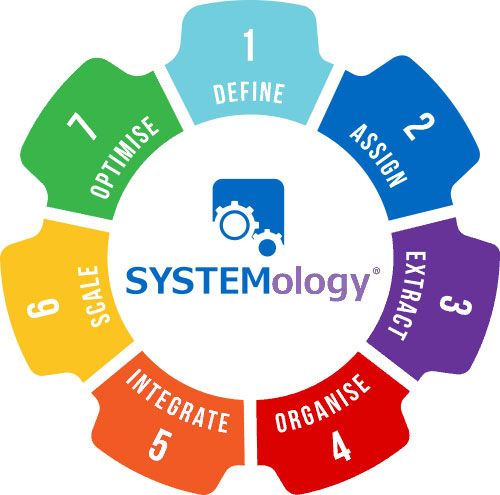
Of course, the book goes into much more detail than this, but you get the gist. When you hear me mention “rolling out SYSTEMology”, I simply mean applying these ideas for systemising to your business. This includes all my tools, tactics and strategies. Just be aware, while I’ve presented the seven stages in a logical sequence here, in reality that implementation isn’t always linear. Every business is different, with its own unique challenges, culture and starting point.
As a Systems Champion, you’ll learn to adapt the methodology to fit your specific situation. Sometimes you’ll work on multiple stages simultaneously. Sometimes you’ll need to circle back to earlier stages as you discover gaps. That’s perfectly normal and expected.
Your job as the Systems Champion is to make informed decisions about where to focus your efforts for maximum impact. I want you to have a much more active role and this is primarily why I changed the way I have delivered the ideas in this book. Everything still fits back into the original seven stages of SYSTEMology – it’s just displayed differently.
This means if you’ve already read SYSTEMology, you can always return to it and it will help you find where to focus next. And if you haven’t, that’s okay too! Toward the end of this book I will help you create your own customised action plan. That said, as long as you remember your core job is to build consistency and reliability through documentation … you’ll always find your way.
Consistency over perfection
Let me share a secret that took me years to fully understand. In business, consistency is far more important than perfection. This might sound counterintuitive. After all, don’t we all want to deliver the absolute best? But here’s the truth: your clients value reliability over occasional brilliance.
McDonald’s is the perfect example of this. No one claims they make the world’s greatest hamburger. They probably wouldn’t even make your top 10 list of favourite burgers. Yet they’ve built one of the most successful small businesses in history. Why? Because whether you’re in Sydney, Tokyo or New York, you know exactly what you’re going to get.
This predictability is incredibly powerful. When a customer walks into McDonald’s, they’re not hoping for a culinary masterpiece. They’re buying certainty. They know the Big Mac will taste the same as it did last time. The fries will be exactly how they remember them. The service will follow a familiar pattern.
Now, I’m not suggesting you turn your business into McDonald’s. In fact, I believe blindly following McDonald’s’ way of doing business can do more harm than good. But there’s a profound lesson here about what clients truly value: they want consistency.
Consider this. Would your clients prefer a service that’s brilliant 20 percent of the time and merely okay 80 percent of the time, or one that’s consistently good 100 percent of the time? In almost every case, they’ll choose consistency. Why? Because consistency builds trust, and trust is the foundation of every successful business relationship.
This is where systems come in. A well-designed system is simply a series of steps that, when followed, deliver a consistent outcome. It’s not about achieving perfection but about reliability. Every time someone in your business follows a system, they should achieve a similar result. This repeatability is what allows you to scale, to train new team members and to deliver reliable results even when you’re not personally involved.
And this is precisely where SYSTEMology shines. By following the seven-stage framework I outlined earlier, you’re not just creating random systems; you’re approaching systemisation itself systematically. There’s beautiful consistency in using a proven methodology to build your systems. Your team learns that there’s a specific way to document, store and improve processes. This meta-consistency (being consistent about how you create consistency) compounds the benefits.
McDonald’s took this to the extreme, documenting every minute detail of their operation. But for most businesses, that level of documentation isn’t necessary or practical. This is why SYSTEMology focuses on the critical few rather than the trivial many. Consistency should come first, and complexity can follow later when you’re ready.
Measuring success
How will you know if your SYSTEMology implementation is successful? There are several key indicators to watch for.
Business owner freedom is the most obvious sign, meaning the owner can step away from day-to-day operations without everything falling apart. This pairs with reduced key person dependency, as no single individual becomes essential for the business to function.
Team confidence emerges as members know exactly what’s expected of them, resulting in a consistent client experience where customers receive the same high-quality service regardless of which team member they interact with.
Improved metrics provide quantifiable evidence of success as systems reduce errors and increase efficiency. A cultural shift occurs when “this is how we do things here” becomes a common saying throughout the organisation.
Clearly the rewards are worth it. That’s why the business owner wants to make this a priority. Now, I will do my best to give you everything you need in this book, but should you wish to go deeper, you may also wish to check out the original SYSTEMology book. I will leave this to you to decide.