
For the Systems Champion
Three Pillars
Listen to this chapter · 19 min, narrated by David Jenyns
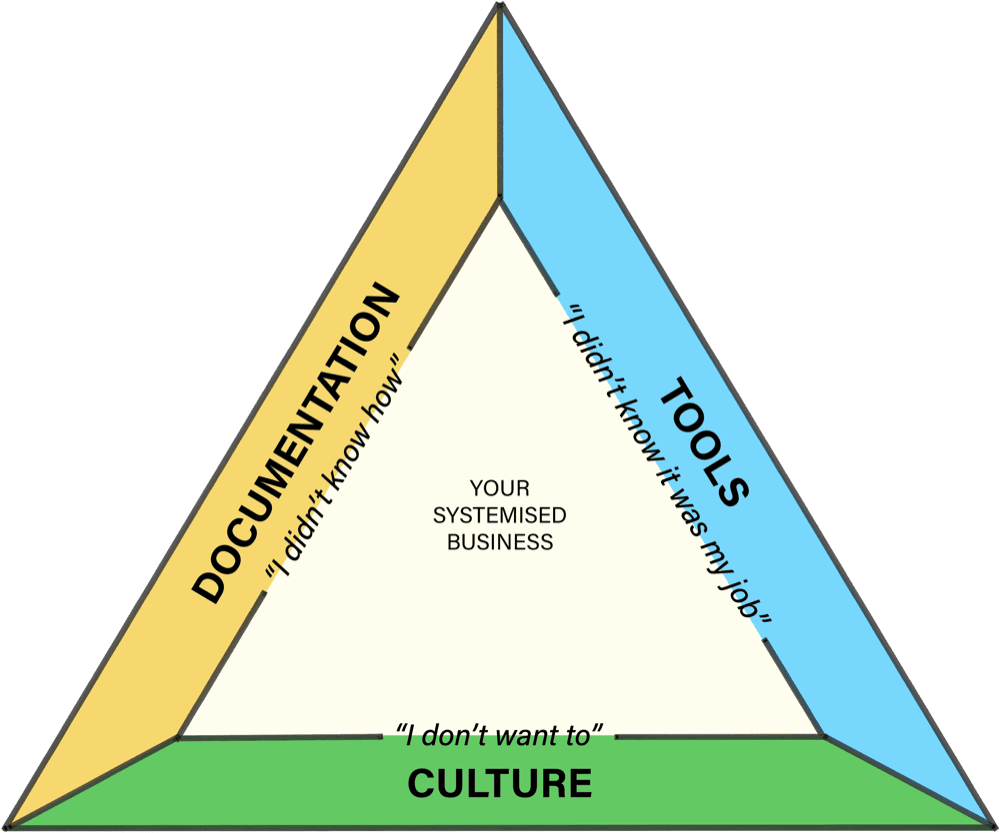
In the following chapters we’ll further explore these excuses and how to prevent them using three interconnected pillars. Think of these pillars as the legs of a stool: each one is essential, and they work together to create stability. Master these and you’ll dramatically reduce resistance while creating a foundation for lasting change.
They hold the key to building your systemised business.
Pillar 1: Documentation
Documentation is your foundation and abolishes the “I didn’t know how” excuse. It transforms tribal knowledge into clear, actionable guidance: crystal-clear systems that leave no room for confusion. When your documentation is accessible and well-structured, managers can confidently point to any process and say, “This is how we do it here.”
The goal isn’t just to document. It’s to create instructions clear enough that anyone with a basic understanding of your business can follow them and achieve consistent results. If a team member with relevant skills is struggling to understand a process, that’s usually a sign your system needs refinement. Remember, we’re aiming for clarity that enables competent team members to succeed, not trying to oversimplify complex work.
Pillar 2: Tools
Tools create the infrastructure for success and remove the “I didn’t know it was my job” excuse. It’s not just about software but about creating accountable transparency. Your tech stack should make it crystal clear who’s doing what by when. It should make responsibilities visible to all and track progress in real time.
The goal is to ensure the team is always able to seek out the most efficient ways to get tasks done and autocorrect when team members fall off track.
Pillar 3: Culture
Culture is where your systems come alive. It’s not enough to just have great documentation and tools. You need to build an environment where systems thinking becomes second nature. Make continuous improvement part of your daily conversations. Celebrate system wins. Create spaces where suggesting improvements feels natural and welcome.
Getting this third pillar right will help to dissolve the “I don’t want to” excuse. Once systems become embedded in your company’s DNA, resistance fades and your new culture begins to take hold.
The truth is, people will do far more to fit in with their peers than for any other motivator. By transforming “how we do things here”, you’ll make it easier for others to join in. Changing existing culture can be challenging at first – you’re asking people to shift how they view their work and the business. But this gets easier over time, especially as new team members join who are naturally aligned with your systems approach.
The power of integration
Here’s one important thing to understand: these pillars don’t work in isolation. They’re deeply interconnected, each supporting and enhancing the others.
The best documentation in the world is useless if your tools make it hard to access. The finest tools become shelfware if your culture doesn’t embrace using them. And trying to build a systems culture without proper documentation and tools is a bit like trying to run a restaurant with no recipes or kitchen equipment.
In the following chapters, I’ll provide you with a range of powerful tactics and strategies to strengthen each of these pillars. In truth, there are many different approaches you could take, but I’ve applied the 80/20 rule to give you only the most powerful techniques I’ve discovered that will deliver the greatest results. You don’t need to implement everything at once. Focus on reinforcing the weakest pillars first, then build from there.
Later in this book, you’ll develop a detailed action plan with clear, linear steps. But where you begin with these three pillars (and the precise order you tackle them) will depend on your specific situation. Your approach should be strategic – sometimes you’ll need to strengthen your documentation first, other times your tools need immediate attention and in many cases your culture may require the primary focus.
The beauty of this framework is its flexibility and focus. Rather than trying to systemise everything at once, you’ll develop a plan that targets your specific needs. When you approach implementation this way, your business transformation becomes not just possible but inevitable.
Remember: you don’t need to have all the answers yet. Your job is to start building a foundation for success. The journey of a thousand miles begins with a single documented process!