
Stage 2 of 7
Assign
Myth busted: The business owner is the only one who can create the systems.
Listen to this chapter — 24 min, narrated by David Jenyns
Many business owners believe that for something to be done ‘right’ they must do it themselves. The truth is, if you’re the only person who can do a task, there’s something wrong with the way your business is built, and you have fallen into a trap. You must keep pushing yourself to evolve through this trap. I still occasionally fall into it myself.
I freely admit that I’m a recovering micromanager. In my old business (the digital agency), I learned to put good people in charge and let go… but with my newest business, it’s become easy to slip into old habits (especially when it’s something I’m passionate about).

Case in point: I was preparing a workshop for some of my clients, and I decided to check over the room that we’d booked. I just wanted to get a feel for the room and visualise how everything would come together. Now, when I arrived, I started to panic that the space we’d been assigned was too small for the number of people we were expecting.
Bear in mind that it was a Friday and the event was taking place the following Wednesday. The venue had told me that all other rooms were booked and I’d have to wait until Monday to chat with our events contact.
Guess what I did? I went into full-on stress mode. I was calling different team members, sending emails, sending text messages …
“Things aren’t right!” “It’s going to be too crowded.” “We’re not going to be able to seat everyone.” When I got home, my wife tried to reassure me that we would find a way to make it work, but I’d already sent out all the messages and worked myself up.
Monday morning rolled around, and I got an email from the team member managing the event on my behalf. Even before I’d sent my panicky emails, they’d already spotted the large attendee numbers and had arranged for us to be moved into a bigger room.
All the while I was getting myself worked up, sending emails and messages to my team and interrupting their Friday evening, everything was already taken care of.
This isn’t me saying that the answer is to stop caring and paying attention to the details. This is me sharing how often business owners can get in the way of good team members and processes, and unnecessarily complicate things.
Once you get to the point where you’re no longer the heart of the business, interfering with the daily operations is rarely a good idea.
With the benefit of hindsight, what I should have done was send one text to the person on our team in charge of the event and let them handle it. In this case, they would have let me know they had already taken care of it. Case closed.
How about you? Do you believe that for things to be done right you need to be involved? It’s okay to admit it – that’s the first step to recovery. Take it from one who’s already wrestled with this over the years.
You might not be the best person for this job
When systemising businesses, it’s a common misconception that it’s the business owner who will need to be the one creating the systems because they know how they want things done. One of the many problems with this way of thinking is that we all know systems are important … but they’re never urgent. So, like all ‘non-urgent’ tasks, no one ever gets to them.
The truth is the business owner is typically the worst person to be documenting systems.
Phew! Breathe a sigh of relief! This is good news for just about every small business owner on the planet. Let’s break this habit, right now, of thinking we need to be the one doing everything ourselves.
There are plenty of knowledgeable people you work with who might (at the very least) be able to start the process. So, let me ask you, what would you do if you had to systemise your business without heavy involvement from the business owner?
It’s time to identify the key departments, the key team members within those departments and where the knowledge already resides within your business. Once we know who has the knowledge (avoiding the business owner where possible), it’s simply a matter of capturing what they’re already doing.
Your business is already functioning, so we’re not looking to reinvent the wheel or craft a perfect process right from day one. We simply want to capture what is already being done well. Huge wins can be gained by creating consistency within your team.
To do this we need to create your Departments, Responsibilities & Team Chart™ (DRTC). It’s a little bit like creating an organisation chart, except not really. If you already have an organisation chart, you can use it to help, but we’re creating something simpler. The purposes of the CCF and the DRTC are to give you some focus and pin down who we need to work with to extract the knowledge we need.
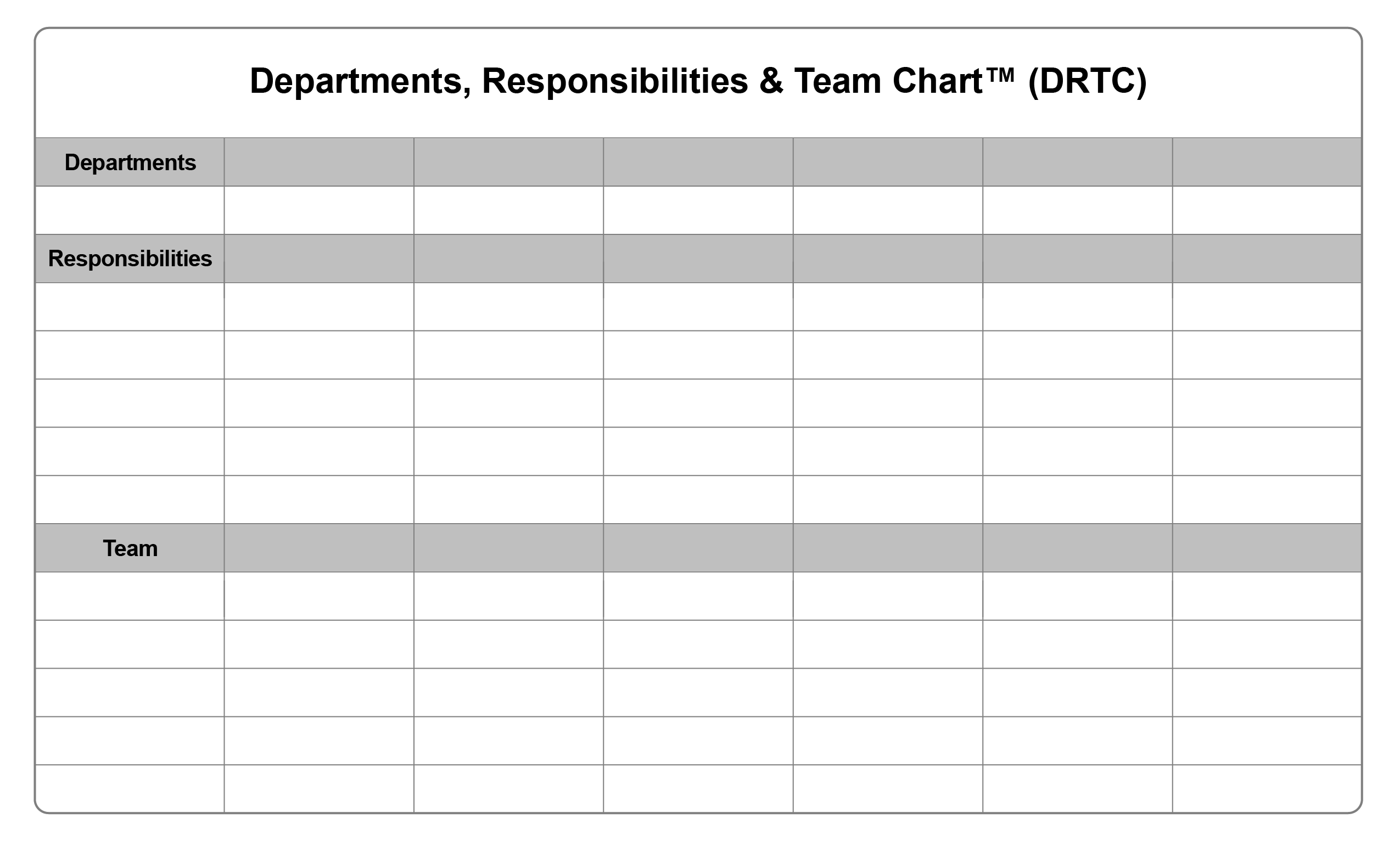
The DRTC sits nicely alongside your CCF. And, as with the previous step, try not to overthink the task or get too bogged down in the details. I know I’ve said it before, but I can’t say it enough: complexity is the enemy of systemisation. You may even hear a little voice in your head trying to convince you that what you’ve created is too simple to work effectively.
Ignore that voice. Stick to the path and you’ll get the results you’re looking for. Head to www.SYSTEMology.com/resources and download the Departments, Responsibilities & Team Chart (DRTC) template.
Step #1: Identify key departments.
We begin by dividing your business into departments and listing them along the top of the worksheet. Think about how your business might be described based on the different functions that make it work.
For example:
-
Marketing – covers all the systems related to how new leads and prospects are generated for the business. This is how you gain the attention of your target audience.
-
Sales – covers all the systems related to how prospects are then converted into clients.
-
Operations – covers everything to do with how your product is created and delivered for your client.
-
Finance – covers all aspects of money moving in and out of the business.
-
Human resources (HR) – covers everything to do with attracting, hiring, onboarding and managing the team.
-
Management – covers the systems for strategic direction, goal setting and the leadership team.
Don’t get hung up on details such as whether some departments should be listed individually or combined. For example, maybe you’d like to put ‘sales and marketing’ together or maybe you would like to create an additional department for ‘administration’ or ‘stock ordering’. It really doesn’t matter, since we’re not setting anything in stone.
Similarly, with your naming, go with what makes sense to your business. Some people call their operations ‘client fulfilment’ while others call it ‘delivery’. Go with your gut instinct and, once you have a list, write them out in a row at the top of the worksheet. If you’re not sure, just use those I’ve listed.
Cross-check your CCF to make sure all the steps you identified there have a department that they would clearly fit under.
Below is a typical set of departments.

Step #2: Assign the responsibilities of each department.
At this step we’re pretty much just breaking down every stage of the CCF and assigning it to a department. There’s no rocket science here.
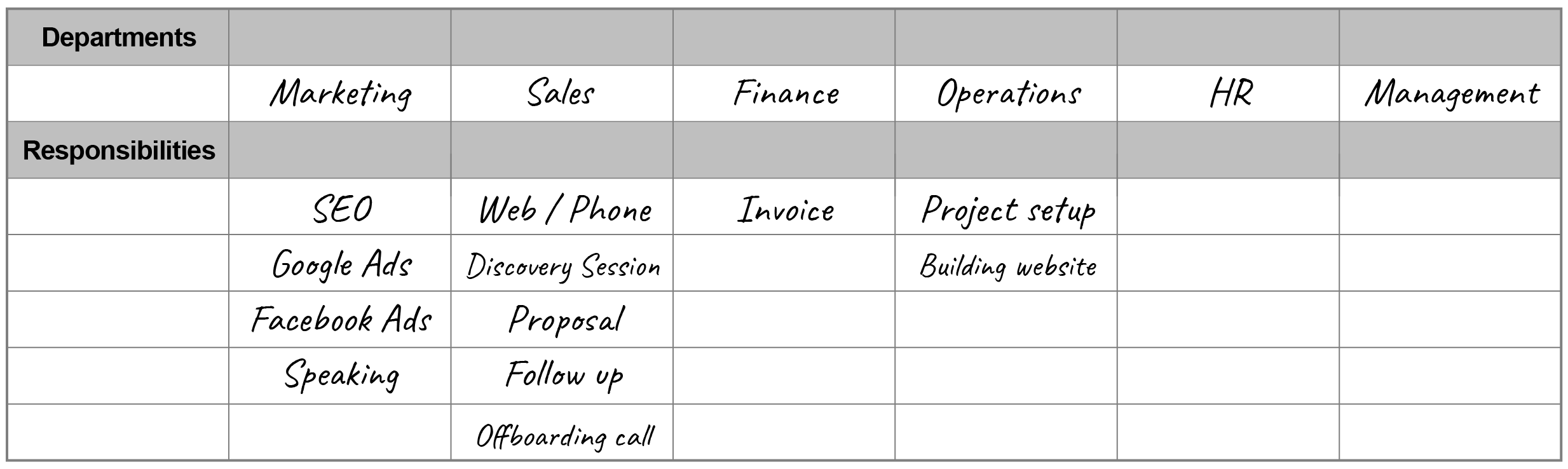
Again, adhere closely to your CCF and list those steps in the relevant columns. For example, on your CCF, you may have identified a few methods to capture your audience’s attention (SEO, Google Ads, Facebook Ads, speaking) – list all of those under the marketing column.
Here’s an example from my digital agency.
Step #3: Assign department heads.
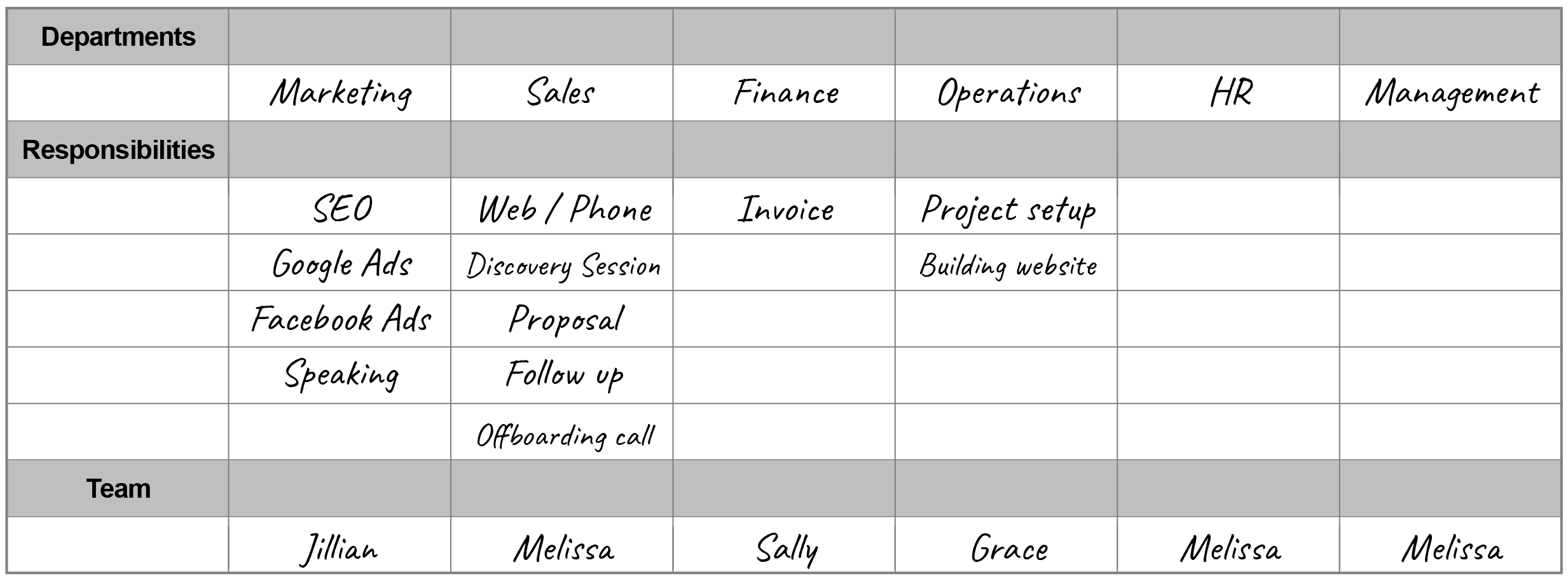
At this step, we’re looking for people within your team to take ownership of each department. As we said earlier, this isn’t an organisation chart and its primary purpose is to help with the systemisation of your business. That said, if you already have an organisation chart, great! Just use your previously assigned department heads. If you don’t have one, that’s fine too. A department head is simply the person who will take ultimate responsibility when decisions around that department need to be made. List the name in the row marked ‘team’. It’s perfectly fine if some people are the heads of more than one department. For very small businesses, this is a given.
That said, if you find the business owner’s name is listed at the top of most or all of the departments, this could mean one of two things: either you’re desperately in need of SYSTEMology, or you’re not quite ready to systemise.
For SYSTEMology to have a marked impact on your business, you need to have at least a few team members or contractors with whom you work on a regular basis. This ensures this whole process doesn’t fall on the shoulders of the business owner and you will get some leverage from the systems you create.
If you’re still a one-man band, it’s best to focus on perfecting your messaging, getting clients and building a reputation for delivering great results for your clients. This will allow you to build a small team before you build your systems. SYSTEMology will replicate what’s already working but you must get some traction first.
Now, if you already have a team and you still find the business owner at the head of almost all of the departments, that’s okay too. We’ll work on this. For now, just be aware that the goal we’re working towards is removing them from those key positions. As before, capture things as they are, not how you’d like them to be.
Step #4: Identify additional knowledgeable workers.
Next up, for each department brainstorm any other, what we’ll call, ‘knowledgeable workers’. Clearly, your department heads are knowledgeable, but chances are they’re also busy … so it’s good to know who else holds the knowledge within your organisation.
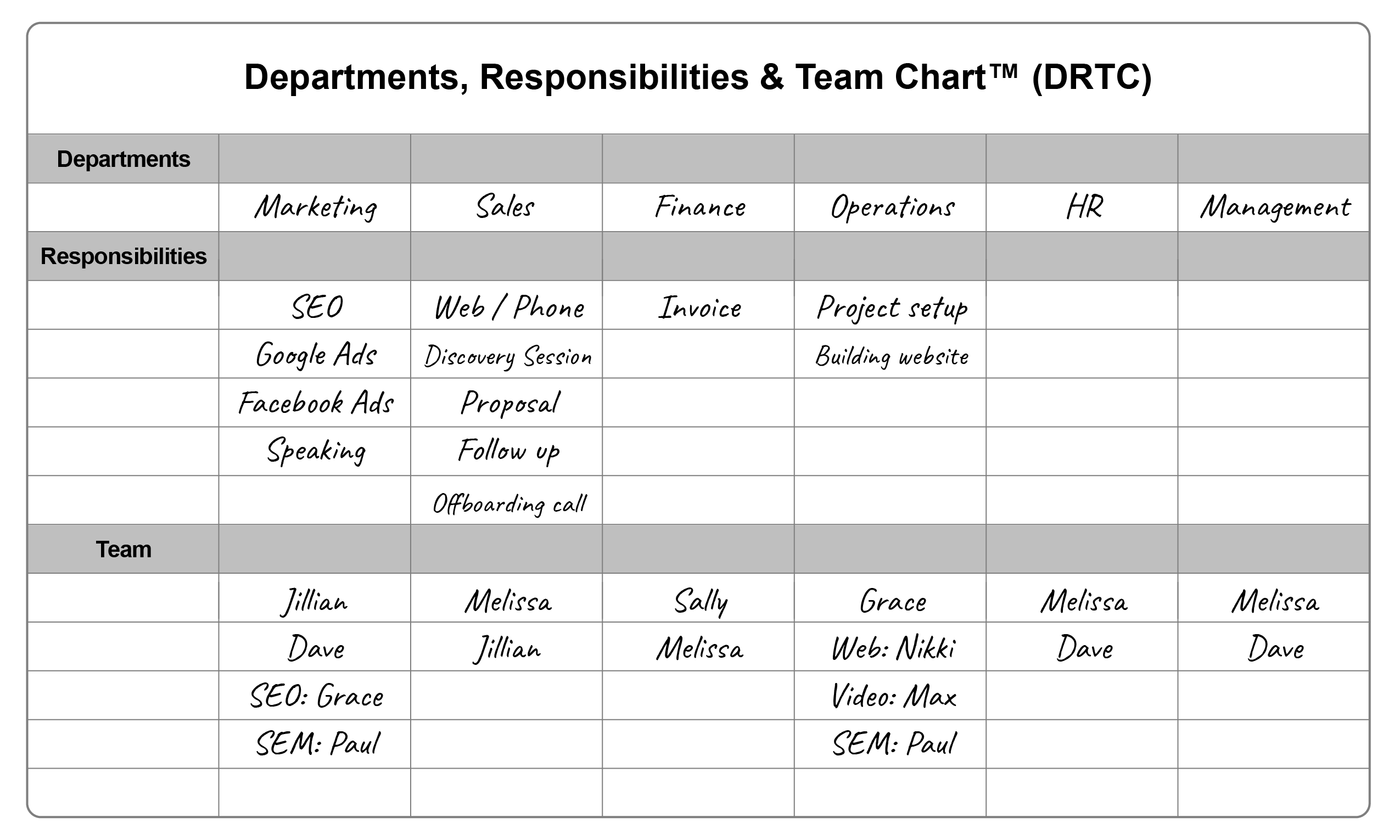
For example, under your marketing department you might have identified one of the critical responsibilities as handling incoming enquiries. If you have an admin person who answers the phone and directs your inbound email enquiries to the relevant person, they would be identified as a knowledgeable worker and should be listed accordingly. Note: You don’t need to list every team member; just those with critical knowledge or expertise that is directly involved in the systems you identified in your CCF.
Once you’ve finished this task, you’ll have a list of team members who are going to be vital when it comes to extracting and developing your systems. Who knows, some of these team members could also be candidates for eventually leading a department.
Continuing our example, here’s how it’s all coming together.
Step #5: Assign critical systems to knowledgeable workers.
Great, you’re almost there! You now know where most of the critical knowledge is stored inside your business. In this step, we’re going to turn this into an action plan, listing the key systems and the individuals that are best placed to help develop those systems.
This step is best explained by looking at the worksheet. Let me share my pre-populated example.
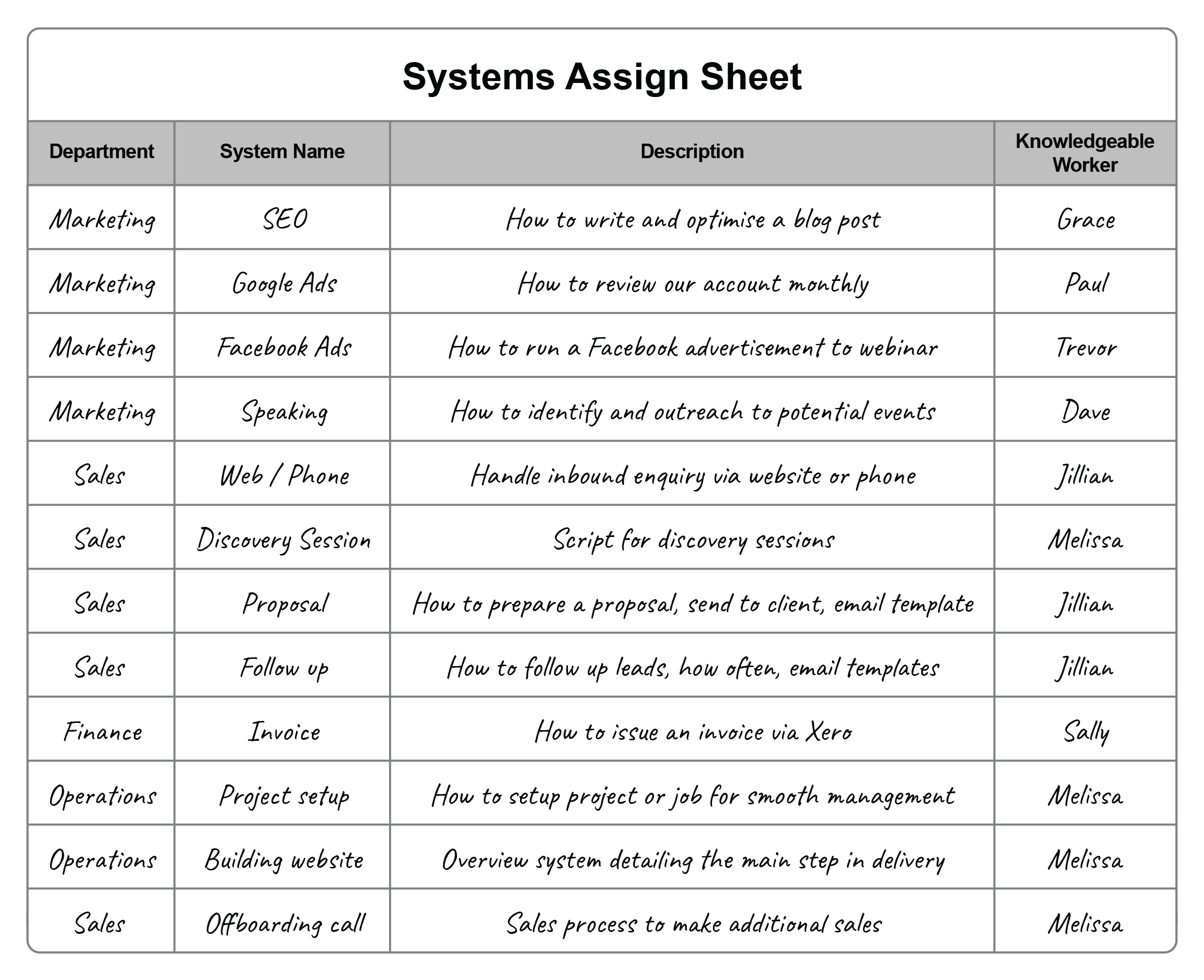
Transfer all of the key data you’ve already populated into part two of the worksheet. Copy across the departments, system titles and a sentence or two that gives some detail about what you imagine the system will cover.
Avoid the temptation to write loads of details here (this comes later). You’re just looking for a brief description (not more than a few sentences) of what the system is intended to achieve.
This might be one of the hardest parts of this step because deciding what is and isn’t critical can be difficult. If, for instance, one of your key tasks for getting attention is looking after your social media accounts, there might be a dozen different jobs connected to this and all may seem essential.
It will be tempting to throw your hands up and just list them all, but this won’t help your cause. It’s possible that, eventually, you will systemise all aspects of this task, but right now you’ve got to decide what is the 20 per cent that makes all the difference.
Remember, not systemising a job doesn’t mean it’s suddenly going to stop happening. All those social media tasks will keep being completed, just as they are now. This process simply identifies one or two critical systems that are central to those particular responsibilities.
For instance, continuing with the social media example, perhaps identifying, creating and scheduling regular posts to keep your pages active is at the core and will make a perfect system to capture.
Just keep the 80/20 rule top of mind and we’ll work on those systems first.
Note: In cases where you’re working with a specialist or consultant outside of your business, and they manage that particular task (such as SEO or SEM or bookkeeping), you can work with them to create an overview system that outlines what’s being done. Or perhaps they might even have some suggestions for you on what you can do to make their job easier and improve their results.
The final step in this whole process is assigning the knowledgeable worker to each of these systems. This may be the department head or another team member. It very much depends on who has the key skills required to complete that task to a great standard.
This is ultimately the person we’ll extract the process from, so ask yourself who does this task and does it to a great standard? In situations where more than one person can do the task, like a sales role, look towards the team member who delivers above average results for that task.
Suggestion: Where possible, avoid adding the business owner’s name. Yes, I know business owners can do everything and they can typically do it better than anyone else (or so they believe), but let’s take them out of the picture. There will be times this is unavoidable, but do your best. We can always loop them back in further down the line.
Model the best
Part of the genius of this process is that we’re going to model your new systems on the best practices of your top performers. This process is then shared with all team members – in so doing, you’ll dramatically improve performance across the board.
Perhaps some of the biggest and quickest gains to be made within any business come from uncovering who in the team does a particular task and gets above average results. Then it’s simply a matter of extracting what they’re doing and teaching others to do the same. This then becomes the new standard and sets the expectation for how best to complete this task.
I’ve seen this work countless times to great effect, particularly in sales systems. Oftentimes, your top performers are top performers for a reason. They’re presenting all the key information and answering objections in a certain way. They’re following up and giving prospects everything they need to make a buying decision. They have a system, whether they recognise it or not.
Now imagine how powerful it will be to capture this method and train all the rest of your team to reach this new level. It’s easier than you think, and the breakthrough you have been looking for may be right under your nose.
Limit your scope to sharpen your focus
If it feels like I’m trying to constrict your early efforts, then I’ve succeeded. What I want is for you to have a clear action plan that is limited in scope and, therefore, will allow you to focus and actually start getting things done. Planning is good, but too much preparation will prevent you from ever acting – you’ll be too bogged down in the details and the overwhelm will soon follow.
The systems you’ve identified are central to how the business makes money, and while you may not have realised it … we’ve totally annihilated the myth we started with at the beginning of this chapter.
The myth that the business owner will need to be the one who creates all the systems.
The truth is, usually the knowledge already exists in the heads of your team members … we just need a way to extract it.
I know that some people will read this and still won’t be able to see this process working without themselves at every level. But sooner or later you will let go. You will trust your team, you will let them step up and you’ll be one step closer to the freedom you’ve been searching for.
Let SYSTEMology guide you through.