Begin here
Introduction
Listen to this chapter — 28 min, narrated by David Jenyns
Imagine for a moment that the number one thought leader in your industry (the Oprah, if you will) calls you out of the blue and asks you to join them, right away, on a dream project for three months. Could you do it? Could your business survive without you for that long? Could you risk downing tools and jumping on board the opportunity of a lifetime?
And could you have taken it on like an apprenticeship, with no pay? A little over three years ago, I had an experience so strange that I knew it HAD to be real. The kind of scenario where I knew that not even the oddest, late night cheese-and-pickle sandwich-inspired fever dream could conjure up what was currently happening.
It was 7 am and I was looking at an email I’d received from someone called Luz Delia Gerber. I didn’t recognise the full name, but I was familiar with a certain Michael E Gerber, author of the E-Myth series of books, the original of which is generally said to be one of the best-selling business books of all time.
I figured it was just a coincidence. I’d never met Michael E Gerber, and I had no relationship with anyone who knew him. But I had to know …
All the email said was, “Call me,” so that’s what I did. It was an American phone number and I knew it was afternoon on the west coast, so it didn’t matter that it was still early morning in Melbourne, Australia.
As it happens, the Gerbers like to record their calls, so I have the transcript of the conversation. What follows isn’t paraphrased or edited.
It’s verbatim.
David: “Good morning. This is David Jenyns, just calling from Australia. I’m actually after Luz – I think it is.”
Luz Delia: “Oh my God, is this the real David?”
David: “This is the real David. How are you?”
Luz Delia: “Oh, I am fine. I did want to cry just because … You have no idea what you picking up the phone and calling me is doing to life – yours and mine.”
David: “Okay, that’s a good thing. Yes. I know your message came through late last night. I don’t know if you know but I’m based in Australia. So that’s why um, yeah.”
Luz Delia: “Yeah. Okay, that’s it. I just finished watching your videos.”
Dave: “Fantastic!”
Luz Delia: “I just watched one and was just now looking for it because I wanted to send it to my husband because I’ve been on a journey this morning. I mean, I’ll tell you how I met you and how I found you and but it’s all spiritual. It’s all part of the journey I’m on. Anyway, I just knew that I had to talk to you. I just had to have a conversation with you. Well, and then I dared to say ‘call me now.’ “I’ll go to wherever you are. Come here. I need you, I have to talk to you. I just have to get over the shock.”
David: “What a great way to start my day.” Luz Delia: “Do you know Michael E. Gerber? Do you know the name?
Do you know his work?”
If you’re getting the sense that I was a little stunned by all of this, you’re reading it correctly. It was surreal. And not just because Luz Delia was talking as if I was the universe’s gift to her.
I was – and still am – a huge fan of Michael E. Gerber and his work. If you’ve read any of his books, particularly in the E-Myth series, you’ll probably know why. If you’ve yet to have the privilege, I urge you to do so (after you’ve finished this book, of course).
Gerber is a legend. You know the popular business adage, “Don’t work IN your business. Work ON your business”? He came up with that. He’s inspired millions of business owners around the world.
And now I was speaking to his wife, and she was talking to me as if I was the answer to some cosmic prayer.
Luz Delia and I had a very long conversation, but the bottom line was that Gerber, at the age of eighty, was getting ready to launch book number twenty-nine, and the final work in the E-Myth series. For the first time, he wanted to self-publish (the previous books were published by HarperCollins), and he wanted someone to show him how to do it.
Having followed the successful launch of my previous book, Authority Content, Luz Delia had decided that I was the person to head up the project.
There was just one snag … It was going to take sixty-plus hours of work per week, for a period of about twelve weeks. For three months I was going to have to eat, sleep and breathe The E-Myth. Which meant that all my own personal projects and business responsibilities would have to be put on hold. Oh, and did I mention I volunteered to do the job unpaid?
What would you have done if you’d been in my shoes?
If Gerber had approached me two years before he did, I would have had to decline the opportunity. Two years ago, there wasn’t a chance that I could just walk away from my business for that long. I was too enmeshed in the day-to-day operations. Without me, there was no business, and I’d have been risking not just my livelihood, but that of all my employees.
Ironically, for all my appreciation of Gerber’s work, I was doing exactly what he advised against. Working IN my business, rather than ON my business.
Fortunately, it wasn’t two years ago. This opportunity came along after I’d discovered and developed SYSTEMology, and I knew for a fact that without me around …
My business was going to be just fine. SYSTEMology was handling my business with such efficiency, I knew that I could leave it for three months and it would barely notice my absence. If anything, it would run smoother without me looking over everyone’s shoulders.
I worked on Gerber’s project for three months. I wrote thousands of emails, made hundreds of phone calls and lined up more interviews than you can poke a stick at. It was hard work, but it was simultaneously one of the easiest projects I’ve ever been involved in simply because I had only to mention Gerber’s name and people would fall over themselves in their eagerness to be involved.
The short version of the story was that Gerber’s twenty-ninth book became his first to be ranked as an Amazon Best Seller within twentyfour hours of its launch. To celebrate, Michael invited me and a few friends who had helped out with the launch to attend one of his last events, called the Dreaming Room, in Carlsbad, California. I was then invited to stay on to facilitate a mastermind group dedicated to the future legacy of Michael’s work.
To top it all off, the Gerbers asked me if I’d consider running their business!
I wasn’t expecting that! I literally hadn’t had any connection to the Gerbers four months earlier, and here I was now being offered the company. I declined – with some difficulty – not because it wasn’t a great offer but because I am on my own path now. That, and there’s no chance my wife would move to America, away from her family.
Looking back now, this experience was nothing short of magical. And while there are probably a hundred lessons I could share with you, I wanted to draw your attention to one in particular.
Serendipity happens in business all the time. When Luz Delia contacted me, she did so because of the work I’d done in my previous business (my digital agency, which you’ll learn more about later). She had no idea that I was also working on SYSTEMology and how it would align so perfectly with the Gerber legacy.
The fact is, business and life are non-linear – that is, things don’t always happen in a logical order or a straight line. There is a level of randomness that can not be easily explained.
Oh, we act as if it’s a linear thing. We read books about success and seek to learn the secrets of how to be the greatest at this or the master of that. But knowledge only gets you so far. Success stories, for the most part, are just that: stories – narratives that people construct to try to explain why things turned out the way they did, by stripping out all the things that didn’t work. The implication is that if someone follows the same journey, minus the dead ends, missteps and failures, rapid success is all but guaranteed. In reality, everyone’s journey to success, no matter how much they might try to follow someone else’s model, is unique, convoluted and, to a certain extent, random.
Anything but linear. Sometimes you’ll get up one morning and you’ll have an email from a personal hero inviting you to come and work with them because you did X, Y and Z and their wife just happened to spot something you put out into the world.
Opportunities rarely come at the end of a steady upwards curve. Success is lumpy and opportunity knocks when you’re least expecting it. Sure, you can lay the foundations, work hard and prepare yourself. But your most significant opportunities won’t be willed into existence by simple visualisation or by following a special formula. They’re going to happen when they’re going to happen and the only thing – the ONLY thing – over which you have any control is whether you’re ready and available to seize them.
What opportunities have you missed?
Think about this for a minute.
Not too hard because it might depress you, but think about it. How many opportunities have already passed you by because you were too swamped with the heaving mass of work that your business throws at you every day?
I’m not just talking about having to turn down opportunities because you’re too busy. I’m talking about opportunities that you didn’t even notice because you barely have time to scoff down a lunchtime sandwich, let alone rise above the noise, study the big picture and spot the big breaks that are in your periphery.
That’s where I was a few years ago, and if I hadn’t found the motivation to change my chaotic existence, I would have had to tell Luz Delia and Michael E Gerber that I simply wasn’t available. Just the thought of that makes me feel sad. Now, I’m not sure where your headspace is at this moment. Maybe you’re early in your career and you’re looking to ramp things up – to make your business more efficient and build it for scale. Maybe you’re getting older and want to reduce your working hours to improve your health. Or perhaps you just want to spend more time with your friends and family.
Or maybe you’re wanting to open up a world of new, exciting opportunities?
Whatever your reasons for picking up this book, understand that the primary purpose of SYSTEMology is to create space for the business owner – to systemise the business to the point where you can step away from the day-to-day operations and know with confidence that your business will continue to perform to your standards.
You might have no desire to reduce your hundred-hour work week. And you don’t have to. But the reality is that most business owners have crazy, working-their-fingers-to-the-bone schedules, not because they WANT to but because they HAVE to. They have no other option other than letting the business fall apart.
SYSTEMology gives you the freedom to choose. You should be able to have a choice in how you run your business. In it. Out of it. Ten hours a week. A hundred hours a week. Instead of the business forcing you to conform to its will, you should be able to shape your business to conform to your will.
It will take time and effort and challenge many of your strongest beliefs about business, but trust me, it will be worth it.
All your hard work, persistence, talent and creativity will pay off eventually. It’s just impossible to predict when those magical moments are going to strike. The fact is, all the best ideas, the biggest breakthroughs and the most tremendous opportunities come when the business owner creates space.
But you must learn to engineer this space. Systems hold the key.
Is this the right book for you?
This book isn’t about getting the right mindset.
It will not help you create your company purpose, vision or mission. It won’t help you define your values, set your goals or create a business plan. It won’t help you identify your target audience, their problems or how to get that product/market fit.
If you haven’t yet addressed these foundations of business, it’s best you do that BEFORE you continue reading this book. The good news is, there are already plenty of great books that address these topics.
This book aims to solve a different problem. One that presents itself a little further down the line when building your business.
This problem arises AFTER the business owner lays a good foundation and has achieved some level of traction. They have built a reputation for delivering great products and services and this earns them repeat and referral business. The business has good cash flow, and from the outside looking in they look like a huge success. But the hidden reality is that they work extremely long hours to keep their business functioning.
The problem is, most small business owners can’t afford to step away from their business for more than a day or two. They’ve built a machine that depends upon them and now they’re stuck. Worse still, this is the inverse to what they were looking to achieve when they started in business – and it’s a serious problem.
Unfortunately, what makes this such a hard problem to solve is that the solution lives in their blind spot. Typically, business owners are big-picture people – they’re quick-thinking problem-solvers who focus on solving the most urgent problems. And while these skills are great when the business is in start-up mode, the strengthening of these abilities often becomes the primary reason for not making it to the next level of business growth.
If this sounds like you, you’ve reached the bridge that all business owners must cross but the majority don’t.
You must learn to clone yourself and your best team members so that the business can grow without single-person dependency. You must evolve from being an employee of a business you own to a TRUE business owner – the owner of a profitable enterprise that works without you.
The solution to the problem lives in the development of your business systems. That is, the non-urgent but extremely important, detail-oriented task of documenting, organising and optimising how your business functions.
Rarely do business owners get excited by the idea of documenting their systems … but having a business that works without your constant oversight? That’s a different story.
Perhaps you’ve read books like The E-Myth, Traction, Scaling Up and Built to Sell, and you’re already sold on the idea of creating systems. But like most busy business owners, you’ve either never really gotten around to it or you’ve tried to systemise your business in the past and failed.
So, where is the solution for you and your small business?
You m i ght have read about Six Sigma and tried to apply it to your business but found there was too much bureaucracy and rigidity in the methodology. Maybe you have realised the Lean methodology was developed for mass production facilities and doesn’t suit your small business. Maybe you looked into ISO accreditation and realised it’s more about ticking boxes to say you have systems within your business than having your team actually use them. You’re not alone – to date, much of the work developed around the topic of business systems has been geared towards larger businesses.
This sets small businesses up to fail right from the start because the methodologies simply weren’t designed for their size. They’re complicated, costly, time-consuming, and the team doesn’t follow them anyway. Small business is a different beast. There’s little margin for error and no room for doing activities that don’t dramatically impact the bottom line.
The good news is, this book contains the solution. It’s a revolutionary new approach to business systemisation. It is, quite literally, the system for systemising your business.
Of course, if you’re not the business owner, that’s perfectly fine too. There’s a good chance you work with one and someone you know has passed this book along to you. If so, I’m excited for you too since, although you may not realise it just yet, you’re going to play a very important role in transforming the business you work in.
At what stage is your business in terms of systemisation?
To start, it’s important to know where you are and where you’re going. It sounds obvious, but with a clear understanding you’re much more likely to reach the destination.
Is your business’s intellectual property (IP) trapped in the brains of your best team members? Are you super dependent on these few key team members? Are the rest of your team making things up as they go? Do you have any documented systems? And if you do, does your team follow your systems or do you find yourself constantly reminding your team to follow them?
Having worked with hundreds of companies over the years, I have found companies typically find themselves in one of four stages: #1 Survival; #2 Stationary; #3 Scalable; #4 Saleable.
The four stages of business systemisation.
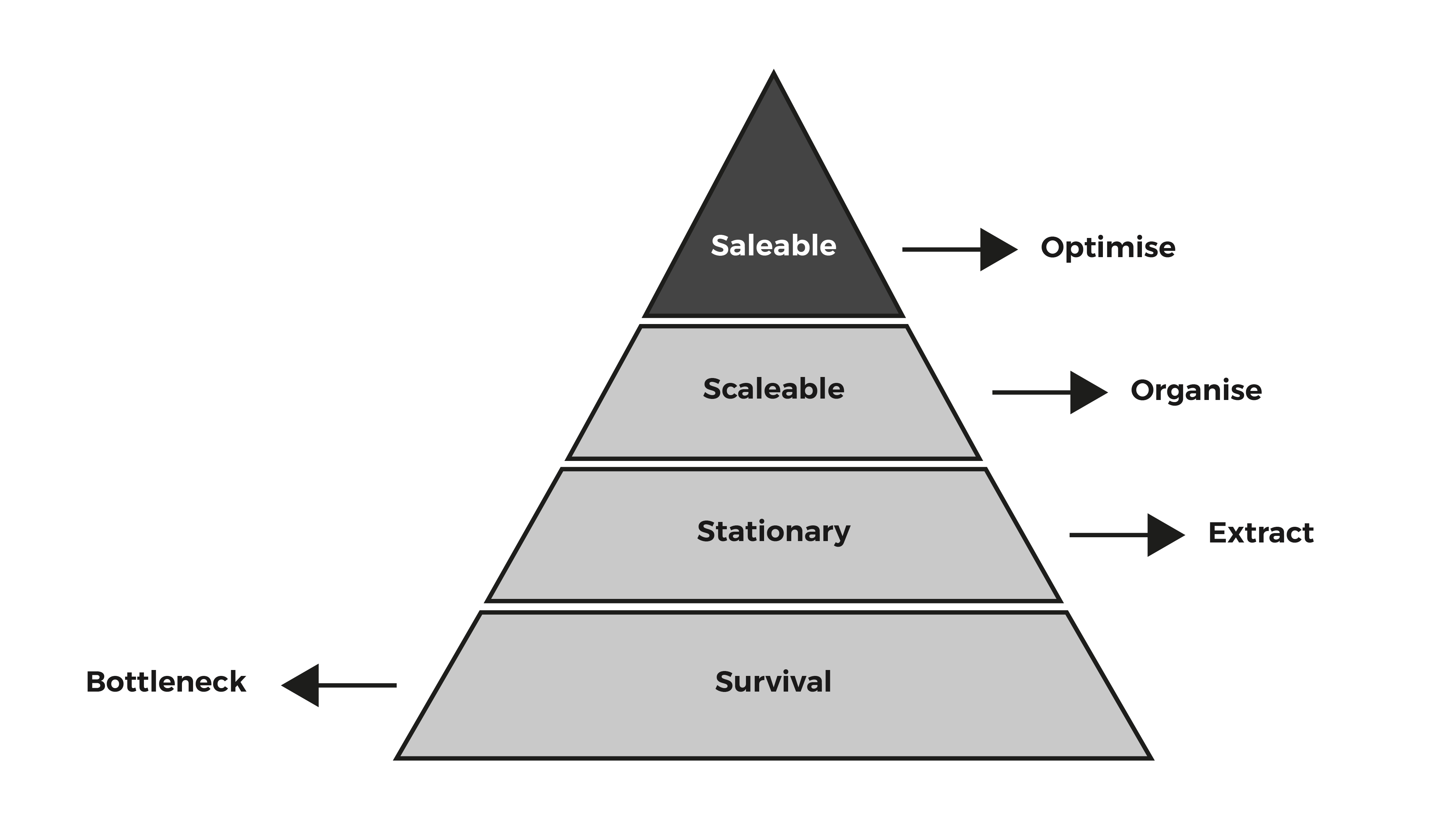
Stage #1: Survival At the base of the pyramid, survival mode is where most business owners start. The business owner is in an endless loop of chasing the work, getting the work and doing the work. This creates up and down performance with lumpy results.
You’re still figuring out product/market fit, you spend 80 per cent of your time in problem-solving mode and you’re hustling your way through. You’ve got one million ideas but the ability to execute on only a handful of things at any one time. This means you’re trying lots of new things but you never really take anything to completion.
Your team (if you have one) makes things up as they go. It’s not clear who is doing what and when tasks are due. There are no systems or processes, and no one really likes them anyway. In short, this isn’t a great state to remain in. The business owner is quite often the bottleneck in this stage, and there’s no real insight that systems are the ‘way’ and that they (the business owner) are not the best person to develop them – more on this later.
Stage #2: Stationary In the stationary stage, the ups and downs have been smoothed out and you’re starting to see a little more consistency in the business. You have a loose way of doing things, but this is still typically trapped in the heads of your best team members.
You may have a few documented systems but they’re more like unorganised notes scattered all over the place. This lack of system certainty makes your business team-member dependent. You don’t have the right tools or software, so the performance of the small number of systems you do have is average at best. This lack of clarity results in a lack of team ‘buy-in’.
It often feels like the business owner is simply spinning plates. They create a to-do list for one team member and move onto the next. One after the other, the business owner lists out what needs to be done. Once they’re all the way through the team, they have to circle back around to the first team member because it’s time to assign out new tasks. This cycle never ends, and the business owner often feels like they run an adult daycare centre. Not to mention, the business owner rarely finds the time to do their own work!
Obviously, this still isn’t a great place to be since your business often feels stationary. You’ve reached capacity and you can’t seem to break through to that next level of business. To move beyond this stage, the secret is to extract and document your core systems.
Stage #3: Scalable Once you’ve got a good amount of your core business systems documented, this is where things start to get interesting. You have now proven your core business model works. You still need to extract and organise systems from all business departments, but you’re well on your way.
System performance has improved dramatically, and you’re shifting the culture within your business. Your tools are clunky, and you still have to constantly remind your team to follow your process, but you’ve overcome any initial resistance.
Now is the time to focus on increasing your business capacity by installing human resources systems, finance systems and management systems. You also need to develop the ability to solve business problems well before they develop into more serious problems.
A funny thing happens at this stage. People often reach this point and think things are ‘good enough’. They buy into the thought that We’re doing okay, we have most of our systems documented, we’re a systemised business. The truth is, ‘good enough’ traps you. You don’t want to stop here! The biggest wins and opportunities present themselves when you move to the final stage. You want to move your team’s thinking from We have to follow process to This is how we do things here. Achieve this and the magic happens.
Stage #4: Saleable The ultimate goal within business is to have a saleable asset – to have a business someone else would want to buy.
Don’t get me wrong, whether you sell or not is your choice, but when your business is saleable you operate at a different level. You recognise your business as a collection of interdependent systems that can be engineered to deliver extraordinary outcomes. In this stage, you will have a clear ‘way’ of doing business, your operations run with the precision of a Swiss watch and your team upholds your systems-centred company culture.
No longer are you dependent on specific team members for things to work. The systems work and the people work the system. This is a different level of business, where you’re able to rise above the noise and be deliberate and strategic in the work you do. You can begin to optimise your performance.
Once you reach this stage, systems become your competitive advantage and you’ll look for constant and never-ending improvement. At this level you achieve what we call ‘complete business reliability’.
Which stage are you in?
There is no ‘right’ or ‘wrong’ here, it just is what it is. Typically, most people who pick up this book are in the stationary stage with one foot in the survival stage, but let’s think about you and where you are. Does one of the stages jump out at you, and what does it feel like to be in that stage? Think about where you are and where you’d like to get to. It should be everyone’s goal to move their business into the saleable stage – I mean, who wouldn’t want complete business reliability? Just imagine what that will feel like when you reach that goal. What would it mean to you – to your business, to your family and your life?
This book provides a proven step-by-step blueprint for moving from Survival to Saleable.
“Yeah, but my business is different…”
A quick heads-up, though: no matter how effective SYSTEMology becomes, no matter how many businesses we revolutionise, or how many raving fans we create, it’s natural to wonder Will this work for me? Maybe you’re thinking about it right now. This is normal.
There’s an old and rather depressing anecdote about a fully grown elephant held in place by a tiny stake in the ground. The elephant, if she chooses to, can escape with minimal effort; the only reason she doesn’t is because that same slender stake was used to hold her in place when she was just a calf. She tugged and tugged on it when she was young and just a few feet high, but experience taught her to give up.
The elephant doesn’t remain in captivity because it’s incapable. It remains in captivity because previous attempts discouraged it. It has learned helplessness.
The truth is, this happens to all of us.
So, what are the ‘stakes’ that hold you back in business?
- Have you tried to systemise in the past but failed?
- Are you worried systems and processes will remove the creativity within your business?
- Do you think you need to be the one to create systems in your business?
- Do you believe systemisation is too time-consuming?
- Do you suspect that, even if you put systems in place, your team won’t follow them?
- Do you believe you need to systemise with the efficiency of McDonald’s?
These are all reasonable concerns, but don’t let previous failed attempts fool you into thinking systemisation won’t work for you. I believed many of these myths too, and it wasn’t until I challenged my thinking that I discovered these ideas often stemmed from outdated information – methods designed for large corporate businesses or ideas shared by ‘gurus’ who don’t practice what they preach.
Trust me, as you go through the SYSTEMology process, you’ll begin to test these assumptions, bust the myths, and reach your own conclusions.
One final word before we begin. And that word is… PATIENCE!
What makes systemisation and installing a culture of systems-thinking in your business especially challenging is that the beneficial effects aren’t always felt instantly. And when the impact is finally felt, the results are so far-reaching that it can be hard to quantify the positive results in one or two key metrics. The impact is felt across the entire company.
Other focus areas of business may provide rapid and obvious measurable benefits. For example, when you create a new ad campaign, you know very quickly whether you’re generating leads or burning cash. If it’s the former, you know you’re doing something right and you double down. If it’s the latter, you tweak things and try again. It’s a simple equation, the feedback is swift and the results can be easily translated into an appropriate action.
What’s challenging is that installing systems doesn’t always provide that kind of instant feedback. There’s often a noticeable lag to the results, and it may take weeks or even months before you can see their effects.
That’s not to mention that the real magic occurs even further down the line when you layer the positive effects of multiple systems, with each system saving you a little time here and a little extra efficiency there. Changing your company culture takes time, but when you add up all the wins, the breakthroughs are unparalleled. Your team and clients are happier, efficiency skyrockets and, most importantly, you win back hours, days, weeks and months of your most valuable asset … time.
As cliché as it is, I’m sure we’d all agree that time is your most valuable asset. Everyone has limited supply and once it’s gone, it’s gone.
So beware of chasing the bright, shiny objects – while the appeal of the quick win is strong, it’s rarely where you will see the biggest returns. You need to slow down in order to speed up. It’s this lag time that causes most people to lose their way and why SYSTEMology requires counterintuitive thinking. It’s going to require a lot of patience and the discipline to stay the course, but you will be well rewarded for your efforts.
In time, everything will come together. Certain elements of your job will either take a fraction of the time they used to take to complete, or you will delegate your responsibilities entirely. Before you know it, your business will consistently deliver its core products and services, to a very high standard, without your involvement. You will have created a scalable and saleable asset.
The secret is to remove the biggest bottleneck within your business … YOU – the business owner!
How SYSTEMology works
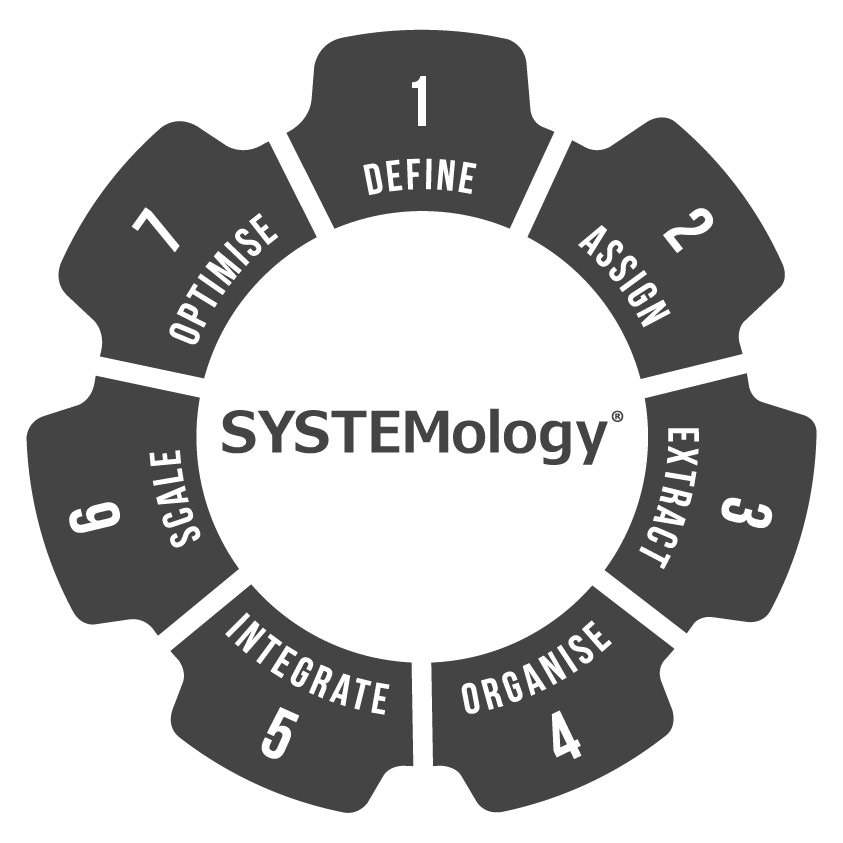
SYSTEMology is a seven-stage process that is designed to identify and create the critical systems within your business. You’ll learn to organise them, get your team following them and continue to optimise them. Here are the seven stages we’ll work through: