
Implementation
Your Action Plan
Listen to this chapter · 28 min, narrated by David Jenyns
Did you ever watch The Matrix?1 It’s one of my favourite movies! There’s a moment in it when the main character, Neo, experiences an awakening. For the first time, he sees the world as it truly is. Not the everyday reality he knew, but as streams of digital code. Everything that once appeared as a chaotic blur suddenly reveals its underlying patterns and structure.
You might not realise it just yet but you’re going to go through a very similar transformation. At first, your business might feel like a constant whirlwind of tasks, emails and decisions. You’re always playing catch-up, scrambling to put out fires. Then something shifts. You start to see the “code”, the systems that underpin everything in your business. The invisible infrastructure that, when properly built, can transform chaos into harmony.
But it’s not going to be easy. In The Matrix, Morpheus warns Neo, “You have to understand, most of these people are not ready to be unplugged. And many of them are so hopelessly dependent on the system, that they will fight to protect it.”
You’ll find that some team members have become so accustomed to “the way things have always been done”, even if that way is inefficient or chaotic, that they’ll resist any attempt to change the status quo. You’ll see this show up in their excuses: “I don’t know how,” “I didn’t know it was my job,” “I don’t want to.” But you know how to combat these. You know how to remove these excuses before they even become excuses.
You’ve learned about the three key pillars you must strengthen on the path toward systemisation bliss: Documentation, Tools and Culture. Underneath each, I’ve given you a range of tactics: from using the Minimum Viable Systems (MVS) to identify the key processes, to the System for Creating Systems 2.0 to make documentation easier; from systems management and project management software, to running workshops and training; through to rebuilding your recruitment and onboarding processes and developing a system for how to handle when systems are not followed.
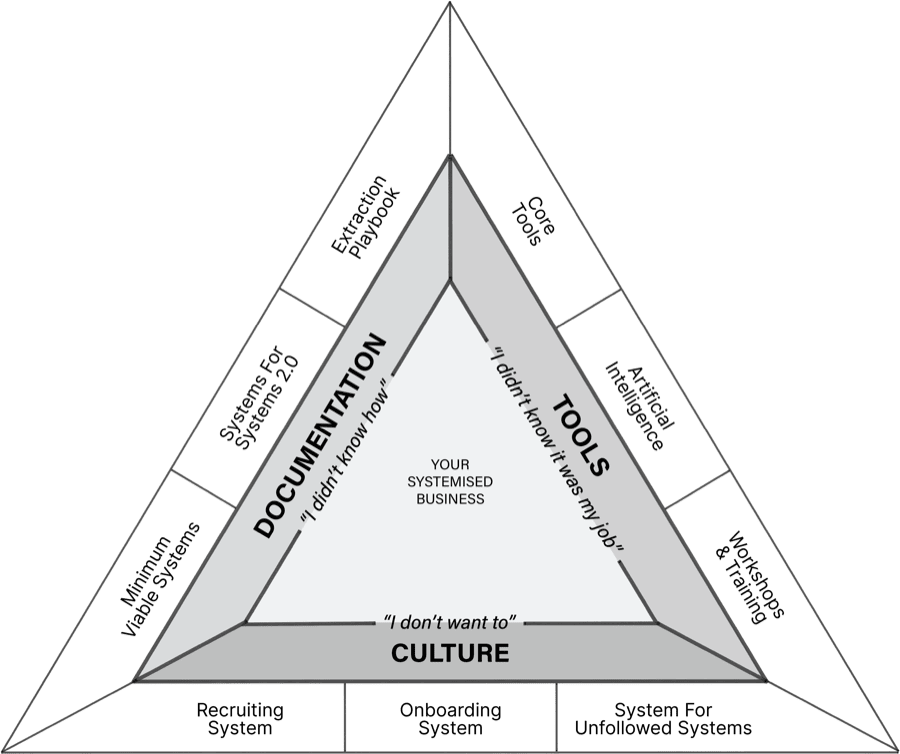
Like Neo in The Matrix, once you see it, you can’t unsee it. Your business is a collection of systems. Every success becomes a process waiting to be documented. Every challenge becomes a system waiting to be created or refined. Now it’s time to pull it all together into a cohesive action plan.
The implementation plan I’m about to share combines what you’ve already learned in this book and the core stages in the SYSTEMology methodology (Define, Assign, Extract, Organise, Integrate, Scale, Optimise). Use this to create your own customised roadmap that’s both structured and flexible.
The SYSTEMology Implementation Plan
Step 1: Clarify your goal and pain points
Revisit your notes from Chapter 5 where you described what the core systems goal meant to you. Now make it specific: identify 1–3 concrete pain points your systems work will solve. These might be bottlenecks in your delivery process, errors in client communications or inconsistencies in quality. Current pain points often provide the quickest wins and build momentum.
Step 2: Do a systems audit
Get chatting with your team. (Don’t call it an “audit” — people associate that with tax investigations. Call it “taking a systems inventory”.) The goal is to discover what’s already working, what needs attention and where the opportunities lie across three key areas:
- Documentation: Most businesses have more systems than they realise. Look for formal procedure manuals, informal checklists, email templates people reuse, training materials and even sticky-note reminders.
- Tools and technology: Create a master list of all the digital tools your team uses — communication tools, CRM, accounting, industry-specific software, and more.
- Culture: Identify who naturally gravitates toward systems (your natural allies), who holds key knowledge, and who might be attached to “the way we’ve always done things”.
Start by having the business owner announce the project in an all-hands meeting, then schedule casual, curious conversations with team members. Helpful questions: “Can you walk me through a typical day in your role?”, “What are the most important tasks you’re responsible for?”, “Do you have any checklists, templates or documentation you use?”, “What recurring challenges or bottlenecks do you encounter?” Record these (with permission) so they can be transcribed into a searchable database later.
Step 3: Start with communication and quick wins
Begin running systems workshops immediately, even if they’re simple (Chapter 16). Get your team talking about systems and the potential of AI. This early engagement sets the tone for everything that follows.
Step 4: Customise your System for Creating Systems 2.0
How will you capture processes? What screen recording software will you use? How will you use AI? What tools will house your documentation? Make these decisions early — they’ll form the foundation of your systems journey (Chapter 11).
Step 5: Focus on your Minimum Viable Systems (MVS)
Start documenting the core systems that directly impact your ability to attract, serve and retain clients. This gives you a clear starting point and delivers immediate value (Chapter 10).
Step 6: Spot any AI quick wins
Look for opportunities where AI can immediately reduce workload or improve efficiency — creating marketing content, drafting customer service emails, helping with data entry. Early wins build momentum (Chapter 15).
Step 7: Time your tools rollout
Introduce your systems management software, and carefully consider when to introduce project management software. Sometimes it’s needed immediately; other times it’s better to wait until you have core systems documented. Let your audit findings guide this (Chapter 13).
Step 8: Create your System for Unfollowed Systems
Put together your fair, clear process for handling non-compliance, including briefing your leadership team to help with enforcement should the time come (Chapter 20).
Step 9: Adjust your people processes
Depending on your needs, prioritise rebuilding your recruitment and onboarding processes. Getting the right people and setting them up for success is crucial for long-term systems success (Chapter 18 & Chapter 19).
Step 10: Focus on repeatability
Once you’ve documented your MVS, establish a sustainable rhythm for ongoing systemisation. We do “continual systemisation sprints” — continuously planning and prioritising your next batch of systems. This prevents overwhelm while maintaining momentum. Just ensure the systems you create add value: perfect processes aren’t helpful if no one uses them.
Pulling it together
Set up your systemisation project like you would any other — in your project management software, or something as simple as a spreadsheet. The key is making it visible. Create a simple scoreboard to track your target systems, their current status and target completion dates.
Footnotes
-
I am so sorry for this! I know I promised no more pop culture references but it’s really hard for me. I’ve refrained for the last eight chapters so I’m hoping you can let this one slide. This is my last opportunity before we finish. ↩