Here’s a pattern that plays out in thousands of businesses every year. The owner reads a book about systems. Gets fired up. Blocks out Tuesday mornings to start documenting processes. Three weeks later, the documents are half-finished, the Tuesday sessions have been swallowed by client work, and the whole initiative quietly dies.
If that sounds familiar, you’re not failing at systemisation. You’re just the wrong person for the job. According to SYSTEMology founder David Jenyns, business owners are often the worst people to build their own systems. Not because they lack intelligence or drive. Because their natural wiring works against them. Owners are quick-start, high-intensity thinkers. They move fast, skip steps without realising it, and lose interest once the novelty fades. Systemisation needs the opposite: steady, consistent, detail-oriented effort over months.
Michael E. Gerber put it simply in The E-Myth: work ON your business, not IN it. But most owners hear that and think, “I should build the systems myself.” The real move is to delegate business systems to someone whose strengths match what the work actually requires. Value Builder System research confirms the stakes: in a study of over 52,000 businesses, companies that could operate without the owner received offers 71% higher than average when it came time to sell.
This article shows you why delegation works, who to delegate to, and what it looks like in three real businesses that made the shift.
Why Business Owners Fail at Building Their Own Systems
Intensity without consistency. Owners get excited, go hard for a few weeks, then burn out. David Jenyns describes this as the intensity curve: high peaks followed by long valleys. Systems work doesn’t reward bursts of energy. It rewards the same small effort repeated every week for months. That’s not how most founders operate.
Too close to the work. When you’ve done a task a thousand times, critical details become invisible. You skip steps without realising it. You write procedures that make perfect sense to you but confuse anyone seeing the process for the first time. The person documenting a system should be learning it, not performing it on autopilot.
It never feels urgent. Sales calls, client delivery, hiring emergencies will always scream louder than documentation. Systems are important but never urgent, so they stay on the to-do list permanently. This is the E-Myth trap in action: the owner who tries to do everything ends up doing nothing well.
None of this means you’re lazy or incompetent. It means the task doesn’t match your strengths. The faster you accept that, the faster your business gets the systems it needs.
“Business owners are often the worst people to create their own systems. Not because they lack ability. Because their wiring works against them.”
— David Jenyns

What Happens When You Delegate Business Systems
The difference between trying to build systems yourself and handing the work to someone dedicated is not incremental. It’s transformational. Here are three businesses that made the shift.
Luke Davies, Davies Construction: Signing Contracts from a Beach
Luke Davies started his building company at 24. He was a brilliant carpenter, but the business side nearly destroyed him. “We got into cash flow problems and ended up having to sell my house to sort of get out of trouble,” he recalls. Technical skills didn’t translate to business management.
After scraping together his last savings for a business coach, Luke discovered SYSTEMology. He listened to the book, then listened again, then passed it around to the entire team. But the key decision was delegation. Instead of documenting everything himself, Luke worked with his knowledgeable team members to extract their processes. He focused on the Critical Client Flow first and kept documentation simple: who does what, by when.
The results were dramatic. During a month-long overseas holiday, a multi-million dollar building contract came through. “I got a link through on my phone to sign a building contract,” Luke shares. “I hadn’t had anything to do with the sales process or designing or prepping. I just opened it up, reviewed it, and clicked ‘sign.'” Davies Construction now runs six companies using the same transferable systems.

Luke was selling his house to keep the business alive before he delegated his systems. What’s your version of that costing you?
Invisible bottlenecks, repeated mistakes, and wasted hours compound quietly. The free Cost of Chaos Calculator puts a dollar figure on it.
Kane at PorterVac: The Apprentice Nobody Expected
Dave Porter runs PorterVac, a gutter cleaning company. When he decided to systemise, he didn’t hire an operations consultant or a process specialist. He looked at his existing team and found Kane, an apprentice working in the office who didn’t want to get out on the tools.
Kane went through the SYSTEMology training, identified the Critical Client Flow, and built the systems assignment sheet. Then he grabbed a GoPro and followed the lead technicians into the field. He filmed an entire day: greeting clients, setting up equipment, safety checks, packing down. He used Loom for screen recordings of office processes and Zoom for job dispatch walkthroughs.
Kane watched the recordings back, pulled out the key steps, and documented everything. The systems assignment sheet expanded beyond the Critical Client Flow into every department. Dave’s takeaway: “I don’t have to be the guy who is driving this.” The person who builds your systems doesn’t need to be the most experienced person on yo
“I don’t have to be the guy who is driving this.”
— Dave Porter, PorterVac
Natalie Joseph, Mirror Group: From Analyst to Systems Leader
When Natalie Joseph started as a research analyst at Mirror Group LLC, she wasn’t hired to build systems. But she naturally spotted process gaps and started suggesting improvements. The company recognised the instinct and made her their Process Champion.
Over four months, Natalie’s team broke all systems into manageable chunks, tackling two to three processes per week. Each followed the same cycle: knowledgeable workers recorded video explanations, the operations team transcribed them, and Natalie coordinated reviews and revisions. They used Asana for project coordination with automatic reminders and dependencies.
The surprise for Natalie was the scope of the role. “I thought I was going to be support, but I had to lead these people to the end,” she reflects. That’s the reality of delegation: the person you hand it to will grow into it. The team built a habit of checking documentation before asking questions. “We got into the habit of: if you have a question, did you check the SOP?” That’s culture change, driven by someone who wasn’t even in a management role.
Tip: You don’t need to hire externally. Look at your current team for someone who naturally organises things, asks “why do we do it this way?”, and gets frustrated by inconsistency. That instinct matters more than experience.
Each of these businesses found a different path. Luke delegated to his existing team. Dave found an unexpected champion in an apprentice. Mirror Group promoted from within. The right starting point depends on your situation.
Ready to delegate but not sure which path fits your business?
Whether you need a book, a training program, or done-for-you support, the free Product Finder Quiz matches you to the right starting point based on your team size, budget, and goals.
Who Should You Delegate Business Systems To?
In the SYSTEMology methodology, the person who owns systemisation is called a Systems Champion. Think of them as the department head of a “systems” department, the same way your sales manager owns sales. They’re not a COO or operations manager. They report to leadership and have authority within their domain.
What makes someone right for this role? David Jenyns uses the Kolbe assessment to illustrate the mismatch.
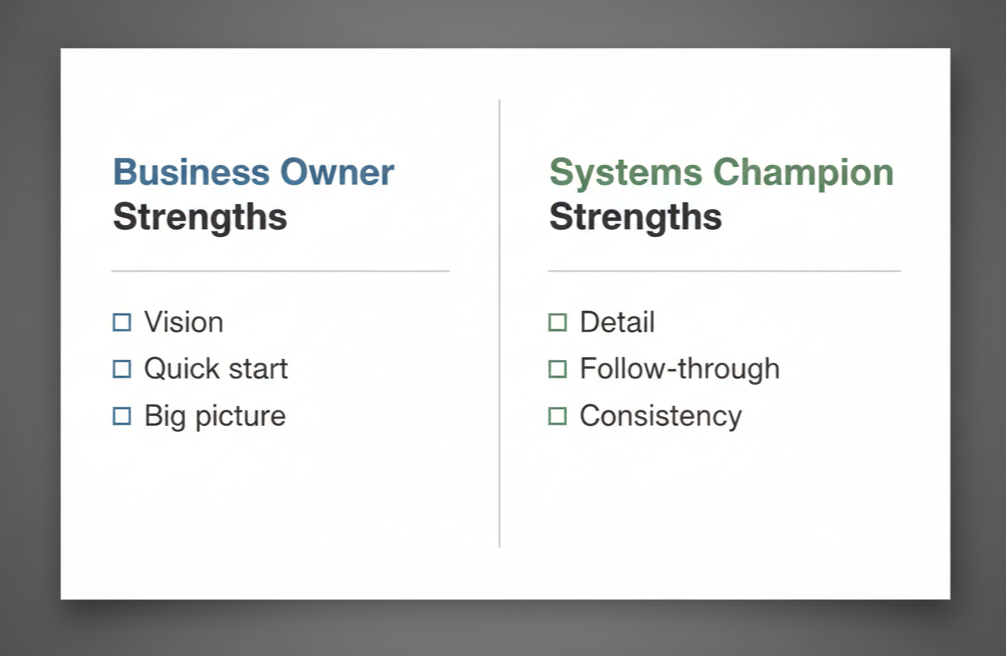
Owners typically score high on Quick Start (action, risk-taking) and low on Follow Through (detail, completion). The ideal Systems Champion scores the opposite. They complete each other. The owner provides direction. The champion provides execution.
The five qualities to look for: organisational skills and attention to detail, strong communication across all levels of the team, curiosity about how things work, creative problem-solving when roadblocks appear, and a proactive drive that doesn’t wait for instructions. Prior documentation experience is not required. Kane at PorterVac was an apprentice. Eryn at Stannard Family Homes started in interior design at 17. Natalie at Mirror Group was a research analyst. What they all shared was the right temperament.
“You don’t need someone with documentation experience. You need someone who’s open-minded, a good listener, and a go-getter.”
— David Jenyns
Part-time or full-time? In smaller businesses, the role can start at half a day per week with dedicated, protected time. That time must be genuinely protected. If it gets swallowed by other responsibilities, the initiative will stall. The scope of investment directly impacts how quickly results show up.
Convinced you need to hand this off? Here’s the playbook you give to the person who takes it on.
The Systems Champion book covers the full role: responsibilities, the extraction process, how to build a systems culture from the inside, and how to use AI to speed up documentation. Hand it to your champion and let them run.
How to Start Delegating This Week
Identify your candidate. Look internally first. Who already organises things without being asked? Who gets frustrated when processes are inconsistent? That instinct is your signal. If nobody comes to mind, hire someone junior with the right traits. Systems thinking can be taught. The temperament can’t.
Give them protected time. Even half a day per week. Block it in the calendar. Treat it like a client meeting that can’t be moved. Systems work that gets squeezed between other responsibilities doesn’t get done.
Start with the Critical Client Flow. Map the 10 to 15 systems that make up your core product or service delivery. This gives your new champion a clear starting point and produces immediate, visible wins. The SYSTEMology process page walks through this in detail.
Get out of the way. Your job is to support, not control. Provide resources and authority. Answer questions when asked. But resist the urge to take the documentation back. The fastest way to kill a delegation initiative is to reclaim the work when it’s not perfect. Your first systems won’t be flawless. That’s fine. Consistency beats perfection every time.
Tip: When your champion finishes their first documented system, have a new team member try to follow it without help. Where they get stuck is the revision list. This simple test validates the system and gives your champion their first quick win.
Delegating business systems isn’t losing control. It’s gaining it. When processes live in documented systems instead of the owner’s head, the business becomes more valuable, more resilient, and more capable of running without constant supervision. That’s the shift that creates real freedom.

Want to fast-track your systems development?
Systemise your business in 90 days or less even if you don’t like documenting and your team’s resistant to change.
Delegate Business Systems FAQ
Why shouldn’t the business owner build the systems themselves?
Owners tend to work in high-intensity bursts and then move on. Systems work requires steady, consistent effort over months. Owners are also too close to the work; they skip steps without realising it, creating documentation that only makes sense to them.
What is a Systems Champion?
The dedicated person who manages and drives systemisation forward. Think of them as the department head of your “systems” department. They document processes, organise them, and make sure the team actually follows them. They’re not a COO or operations manager. They report to leadership. Full details are in the Systems Champion book.
Do I need to hire someone new for this role?
Not necessarily. Many businesses find their Systems Champion already on the team. Kane at PorterVac was an apprentice. Natalie at Mirror Group was a research analyst. Look for someone who’s naturally organised, detail-oriented, and curious about how things work.
How much time should a Systems Champion spend on systems work?
Start with at least half a day per week of dedicated, protected time. The more time invested, the faster results show up. In larger businesses, this becomes a full-time role. The key is that the time is protected from other responsibilities.
What should the Systems Champion work on first?
Start with the Critical Client Flow: the 10 to 15 systems that make up your core product or service delivery. These are the processes that directly affect revenue and client experience. The SYSTEMology process page walks through this step by step.
How long until I see results from delegating systems?
Most businesses see initial improvements within 30 to 60 days. Significant cultural and operational transformation typically takes 6 to 12 months. The compounding effect becomes dramatic after 12 to 18 months as systems start interacting and reinforcing each other.
What if I’m worried about losing control by delegating?
Start small. Give your champion one process to document. Review it together. Once you see the quality of their work, trust builds naturally. The case studies in this article show that owners who let go gain more control, not less, because the business runs on documented systems instead of tribal knowledge. More stories are on the SYSTEMology client stories page.