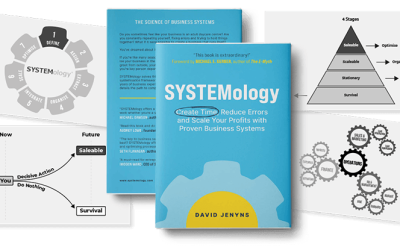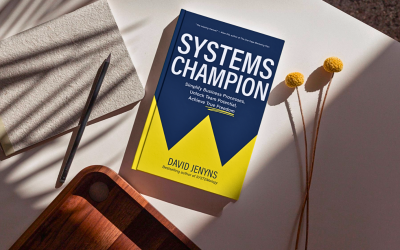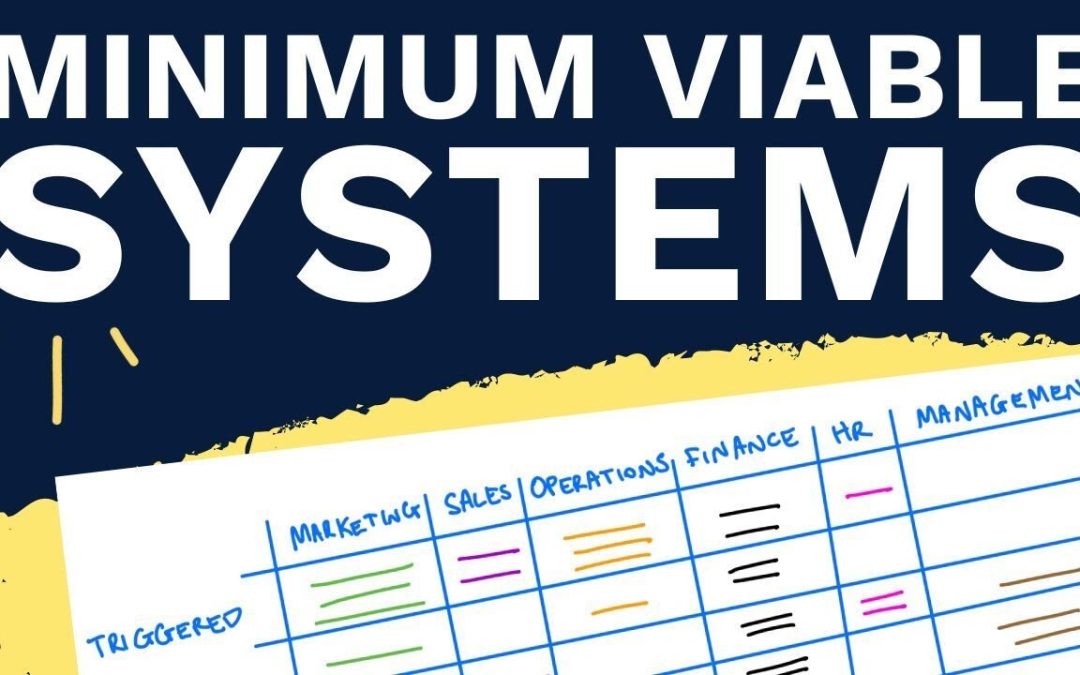
David Jenyns explains Minimum Viable Systems and how to turn systemisation into a game.
In one line: A Minimum Viable System (MVS) is the smallest set of documented systems your business needs to run without you. The SYSTEMology rule of thumb: seven systems per department, forty-two systems total.
Most business owners think systemising the business means documenting everything. That is why most business owners never finish. The task is so vast they quit before the payoff arrives.
Minimum Viable Systems flips the problem. Instead of chasing every task, you identify the critical few that keep each department healthy and document only those. Finish that set and your business can operate, train, and scale without you holding it together.
What is a Minimum Viable System (MVS)?
A Minimum Viable System is the minimum number of documented systems required to run your business reliably. Borrowing the Pareto principle, it is the 20 per cent of systems that deliver 80 per cent of your operational results. Identify those, document those, and the rest can stay undocumented for now without hurting the business.
The concept was codified in Systems Champion by David Jenyns. It is the answer to the most common systemisation question business owners ask: “Where do I start, and when am I done?”
An MVS tells you both. Start with the critical systems in each department. You are done when every department has its core set in place.
The 80/20 Applied to Business Systems
Vilfredo Pareto noticed in 1897 that 20 per cent of Italy’s population owned 80 per cent of the land. A century later, business thinkers noticed the same pattern shows up in nearly every process. Twenty per cent of your customers generate 80 per cent of your revenue. Twenty per cent of your product lines drive 80 per cent of profit. Twenty per cent of the tasks in your business produce 80 per cent of the outcomes.
MVS extends that logic to documentation. Rather than asking “which tasks do we do?” (which produces an overwhelming list), ask “which tasks must not fail or the department collapses?” (which produces a short list). That short list is your MVS.
The point is not that the other systems do not exist. They do, and your team will keep running them. The point is that you do not need to document them yet. Get the critical few right and you buy yourself the time, confidence, and momentum to document more later.
MVS vs MVP vs CCF: What is the Difference?
These three acronyms get confused often, especially by founders who have read both lean startup books and SYSTEMology.
| Term | Full name | What it is | Use it for |
|---|---|---|---|
| MVP | Minimum Viable Product | The smallest version of a product you can ship to learn from real users | Validating a product idea in market |
| CCF | Critical Client Flow | The 10 to 15 systems that attract, convert, and deliver your primary offer | Getting your first systems map in one page |
| MVS | Minimum Viable System | The 7-per-department set of systems that keep every function healthy (~42 total) | Scaling beyond the founder and covering the whole business |
Think of it as a ladder. MVP gets a product into the world. CCF gets your revenue-generating path documented. MVS gets the entire organisation documented to a practical minimum. Each is a bigger container than the one before.
The 7-Per-Department Rule
The MVS rule of thumb is deliberately tight: no more than seven systems per department. Six or seven departments in a typical small-to-mid business means around forty-two systems total.
Why seven? Two reasons.
First, it is small enough to actually finish. Most businesses abandon their systemisation push because the list grows faster than the team can document. A hard cap forces prioritisation.
Second, seven systems per department covers the genuine 20 per cent. Push past seven and you start documenting nice-to-haves. Stop short of seven and you leave genuine risk on the table.
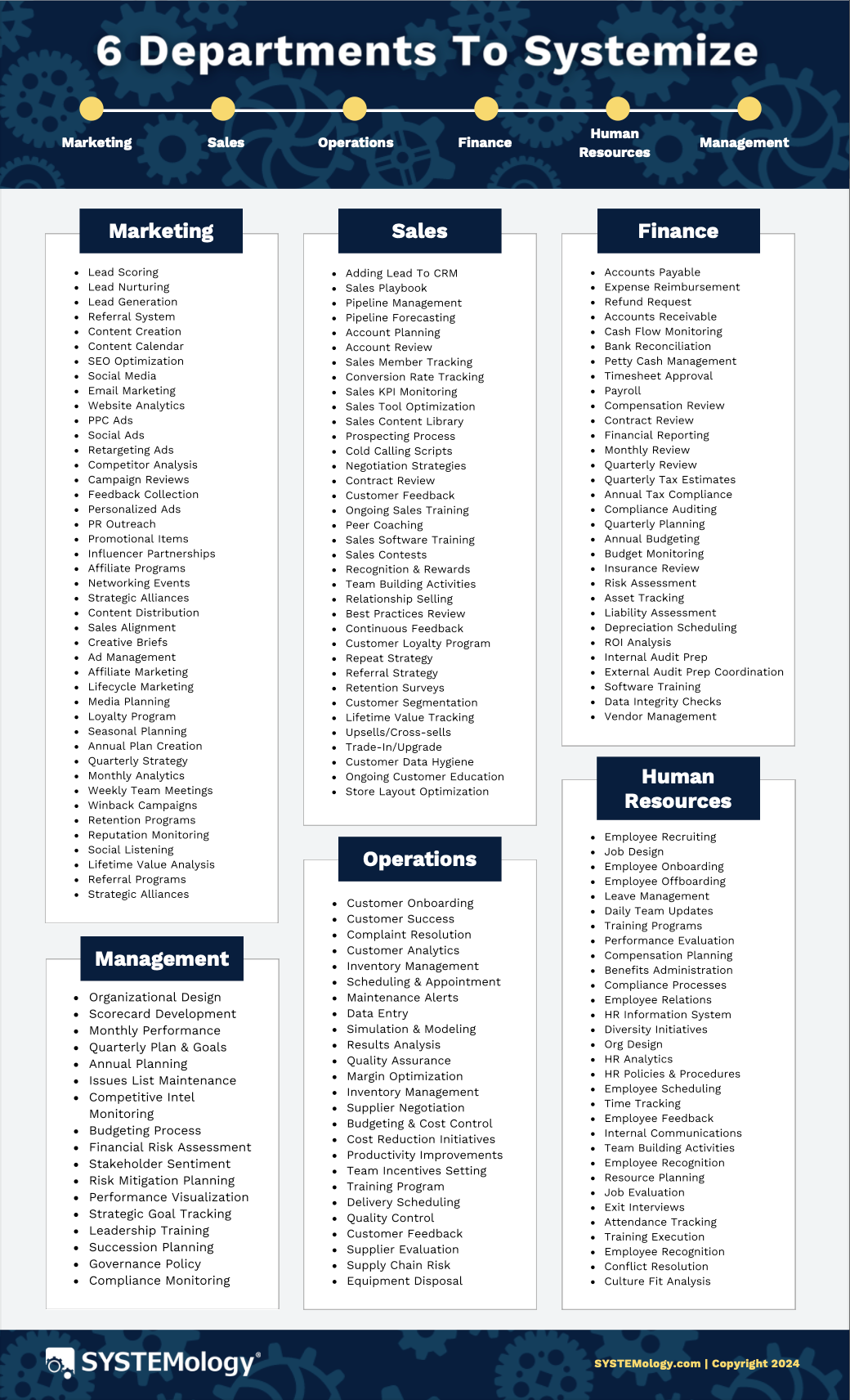
A typical MVS in a service business looks like:
- Marketing: content calendar, lead magnet fulfilment, social posting, email broadcasts, website updates, SEO review, metrics review
- Sales: lead qualification, discovery call, proposal generation, follow-up sequence, close and handoff, pipeline review, objection responses
- Operations / Delivery: client onboarding, project kickoff, weekly delivery cycle, QA review, client reporting, project completion, offboarding
- Finance: invoicing, accounts payable, payroll, month-end close, cashflow forecast, management reporting, tax compliance
- Human Resources: recruitment, onboarding, performance review, training, offboarding, leave management, grievance handling
- Technology / Admin: password management, software provisioning, backup check, security review, vendor management, access requests, general troubleshooting
Your specific list will differ. The structure will not.
How to Build Your MVS: A 4-Step Process
Map your departments
Start with the functional areas your business runs on, not the job titles. Even if one person wears three hats, the functions still exist. Most businesses land on 5 to 7 departments: marketing, sales, operations, finance, HR, and technology/admin. In a growing team, some of these may overlap. That is fine. You are mapping functions, not org-chart boxes.
List the critical 7 systems in each department
For each department, ask: “What are the seven tasks that must not fail or this function falls over?” Be ruthless. If a task happens once a year, it probably is not MVS. If it happens weekly and drives output, it probably is. Write each system with a clear action-oriented name (“Process customer refund”, “Publish weekly blog post”) not a category name (“Marketing admin”). You should end with a tight list of 30 to 42 systems.
Share the completed MVS with the team
Put the list somewhere everyone can see. A shared document, a whiteboard, a systemHUB dashboard. Make it visible. When the team can see the MVS, three things happen: people own specific systems, gaps become visible, and the list stops being “one day we will write these” and becomes “this is what we are writing now.”
Create your MVS scoreboard
Turn the MVS into a game. A simple scoreboard shows each department, each system, and the status: not started, draft, reviewed, published. Update it weekly. Celebrate when systems go green. A little friendly competition between departments moves this along fast. Gamification is not a cute add-on, it is why MVS projects actually finish.
Why the Scoreboard Works
The MVS scoreboard solves the hardest part of business systemisation: keeping people motivated long enough to finish.
Most systemisation projects die in month two. The initial energy fades, the documentation piles up, the feedback loop feels distant. A visible scoreboard creates a short feedback loop. Each published system is a visible win. Each stalled system has an obvious owner. Nothing hides.
Businesses that run MVS with a scoreboard hit their forty-two systems in 90 to 120 days. Businesses that run MVS without a scoreboard still talk about “getting around to it” two years later. The scoreboard is the difference.
MVS and the Critical Client Flow: How They Fit Together
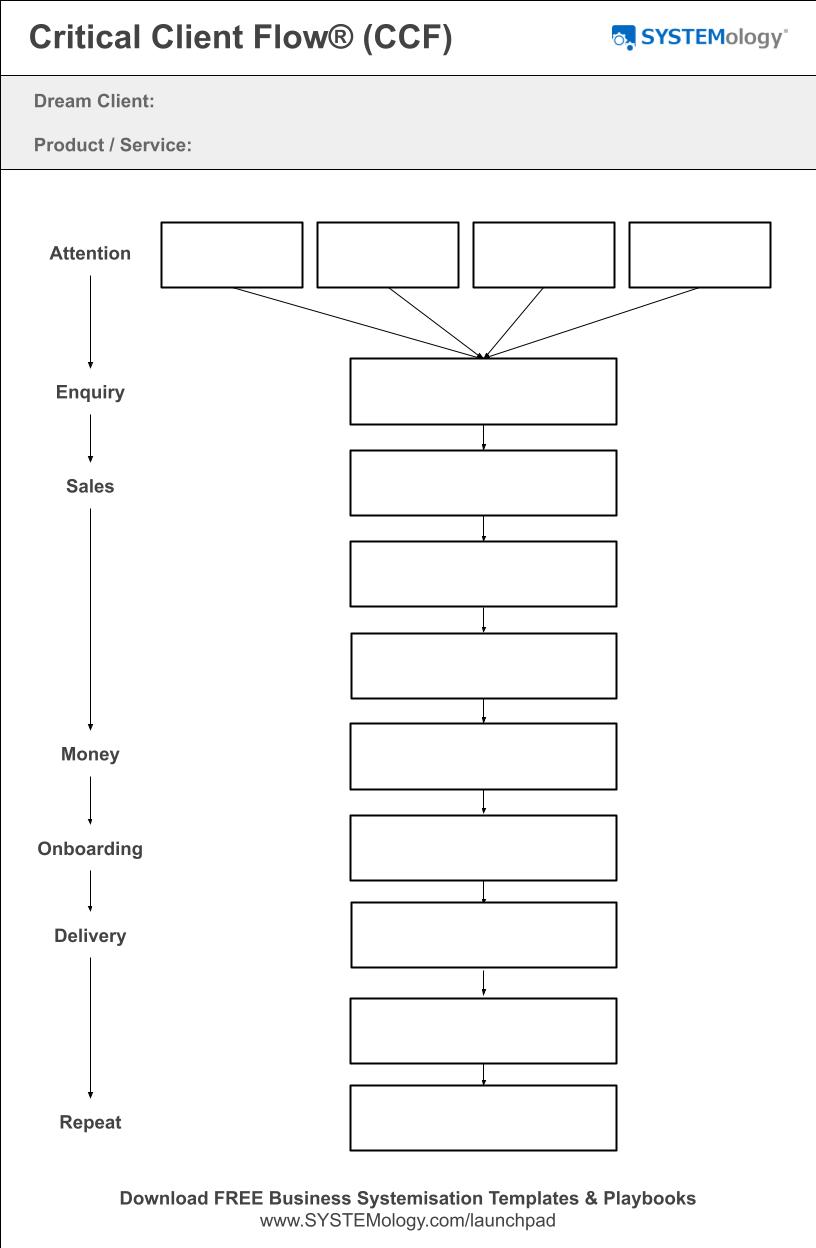
If you have read SYSTEMology, you already know the Critical Client Flow (CCF). You may be wondering how it relates to MVS.
The CCF is the 10 to 15 systems that attract, convert, and deliver your primary product or service. It is the most critical 20 per cent of your MVS. Start with CCF because it maps to revenue most directly. Then zoom out to MVS to cover the rest of the business: finance, HR, technology, internal operations.
Put another way: CCF gets your revenue engine documented. MVS gets your whole business documented. Neither replaces the other. CCF is the first stop on the way to MVS.
Build Your MVS in the Free MVS Builder
Our free online MVS Builder walks you through every department and suggests the seven systems most businesses need. Ten minutes in, you have a working draft you can hand to your team.
Minimum Viable Systems FAQ
What does MVS stand for in business?
MVS stands for Minimum Viable System. In the SYSTEMology framework, it refers to the minimum set of documented systems (typically 42, structured as 7 per department) required to run a business reliably without relying on the founder for every decision.
What is the difference between MVS and MVP?
MVP (Minimum Viable Product) is the smallest version of a product you can ship to real users to learn from them. MVS (Minimum Viable System) is the smallest set of documented operational systems required to run the business behind the product. One is market-facing, the other is internal.
What does MVS mean in the SYSTEMology framework?
In SYSTEMology, MVS is the target state for systemisation. Every department of the business has its critical seven systems documented, team members follow them, and the business can continue to operate consistently even when the owner steps away.
Why seven systems per department?
Seven is small enough to finish and large enough to cover the real 20 per cent. Setting a tight cap forces prioritisation and prevents the systemisation project from sprawling. It also matches how human memory handles a dashboard: seven items per group is scannable, twenty is not.
How long does it take to build an MVS?
Mapping the list: a single 2-hour workshop per department. Documenting each system: 30 to 60 minutes with AI assistance, longer without. Most businesses hit a complete MVS inside 90 to 120 days when a scoreboard keeps the project visible.
What if my business does not have seven obvious systems in a department?
Then you have fewer. The rule is “no more than seven”, not “exactly seven”. Some departments land at four or five. What matters is that each department has its critical systems captured, not that every department matches.
Does MVS replace the Critical Client Flow (CCF)?
No. CCF is the revenue-focused subset of MVS. CCF covers the 10 to 15 systems that attract, convert, and deliver the primary offer. MVS adds finance, HR, technology, and internal operations on top. Use CCF as your starting point, then extend to MVS.
What tools do I need to build my MVS?
A place to list the 42 systems (a spreadsheet, a Notion board, or the Systems Champion MVS template), a place to document each system (systemHUB, Notion, Google Docs), and a visible scoreboard tracking progress. Most businesses already have all three.
What is an MVS scoreboard?
A visible dashboard showing each department, each of its MVS systems, and the current status of each (not started, draft, reviewed, published). Updated weekly, the scoreboard turns documentation into a game and is the single biggest reason MVS projects finish on schedule.
Key Takeaways
- MVS = the minimum set of systems needed to run your business. Seven per department, around 42 total.
- It is 80/20 applied to systems. Document the 20 per cent that deliver 80 per cent of outcomes. The rest can wait.
- CCF is the revenue-facing subset of MVS. Start with CCF, extend to MVS.
- A visible scoreboard is the unlock. It is why MVS projects finish in 90 days instead of stalling for two years.
- Finished beats perfect. A documented “good enough” system beats an undocumented one every time.