

Why SYSTEMology?
Most owners try DIY tools, expensive consultants, or popular frameworks. They still end up stuck. Here’s what makes SYSTEMology different.
Trusted by 100,000+ businesses worldwide
The test
How long could it run without you?
Drag it. This is the only diagnostic that matters, and most owners already know their answer before they touch the slider.
One day
The phone starts inside a few hours. That isn’t a business — it’s a very demanding job that happens to have your name on it.
The trap
Why the obvious fixes don’t hold
Almost every owner tries at least one of these first. They come apart in five fairly predictable ways.
DIY tools
Notion, Drive, Scribe. You buy the software, capture a few processes, build a folder structure, then stop. What’s left is a graveyard of half-written docs nobody opens.
Tools without a method
Big consultancies
Six figures, a beautiful slide deck, and team adoption of roughly zero. They leave and the systems leave with them, because the knowledge never actually moved into your people.
Expensive theory
EOS / Traction
A genuinely good strategic operating system — vision, scorecards, rocks. It assumes the operations underneath are already documented, and in most businesses they simply are not.
Strategy without systems
Buying AI
The newest version of the oldest mistake. Point a model at an undocumented process and it will confidently automate the wrong thing, faster. AI turns a recorded interview into a usable draft beautifully — it just cannot tell you which process mattered.
Process first. Then AI.
Doing it yourself
Documenting after hours, on weekends, between meetings. Now you are the bottleneck and the librarian. This is the one that feels like progress and usually ends up worse than where you started.
Worse than standing still
The other side
What changes when it’s fixed
Not theory. This is what owners describe six to twelve months in.
- You take a holiday and the phone stays quiet.
- New staff are useful in days, not months.
- The same job gets done the same way, whoever does it.
- You stop being the answer to every question.
- The business is worth more, because it isn’t you.
- You get to do the work you actually liked in the first place.
Want the mechanics rather than the case for it? See how the 7-stage method works →
What you’re actually after
Most owners want one of six things
Same method underneath. Pick the one that sounds like your reason and see how it plays out.
Holiday
Take a Real Holiday
Build a business that doesn’t follow you on holiday, because the work no longer lives in your head.
Explore the Holiday story →Scale
Scale Without Burnout
Grow the business without growing your hours. Gary McMahon grew 338% and used the free time to get his pilot’s licence.
Explore the Scale story →Exit
Build to Sell
Make the business actually sellable. Renee Kelly sold Lime Therapy because she could prove it ran without her.
Explore the Exit story →Replace yourself
Stop Being the Operator
Stay the owner. Step out of running it. The Systems Champion model is what makes the handover stick.
Explore the Replace-Yourself story →Succession
Family Business Succession
Pass it to the next generation without passing on the chaos. What sits in your head has to become theirs first.
Explore the Succession story →Key person risk
Lose the Person, Keep the Knowledge
Someone resigns and years of “how we actually do it” walks out with them. Capture it while things are calm, not during a notice period.
Explore Key Person Risk →Risk
Insure What You Run On
You pay for cover on the van and the premises. The way the work gets done isn’t on any policy you own.
Explore Systems Insurance →Ownership
Own What Makes It Work
You don’t own your staff, your AI or your software. What’s left is how you do what you do, and only once it’s written down.
Explore the Ownership story →Payday
Your Biggest Payday
The wage pays you like an employee. The profit pays you like an investor. Neither pays you for carrying the risk. That arrives once, at exit.
Read the Exit Argument →more likely to scale, with documented processesComprose / Whale
higher growth where operational excellence is deliberateHarvard Business Review
faster onboarding of new staff with documented SOPsSCORE
valuation discount on owner-dependent businesses at saleBennett Financials
Franchises with documented systems succeed between 75 and 95 per cent of the time. Independent businesses land around 20 per cent. The gap isn’t talent, capital or luck — it’s that somebody wrote it down.
How we work together
How would you like to work together?
Two paths to building business systems that run without you. Pick the one that fits where you’re at.
Path 1
I’ll drive it.
Accelerator. You bring the Champion, we bring the platform. 100+ done-for-you templates, 12+ AI assistants built around the framework, training tracks, and weekly office hours. From $195/mo. Best for owners with a Champion ready to go who want to build at their own pace.
Start your $1 trial →Path 2 · Most popular
Let us drive it.
Systems Champion Academy. Hand us the keys. Our team works alongside you for 90 days — 42 critical systems documented, your Champion trained, $50K+ in AI savings identified. Best for owners who want it done fast and want a partner in the trenches with them.
Book a strategy call →Who this is built for
Ten years in, successfully trapped
Not startups and not enterprises. The owner who built something that works, and discovered that the thing it works on is them.
annual revenue
people on the team
years old, 10+ years in
hours a week, interrupted
Trades and construction, professional services, allied health, manufacturing. Service businesses, mostly. Some documented process, inconsistently followed. Growth capped by the number of hours one person has.
The line: if the business can’t run without you for three months, you don’t own a business. You own a job.
Proof
Three owners who actually did it
Different industries, same move: the work came out of their heads and into the business.

Renee built a clinic that could be sold. Genshare bought it.
“It’s calm. And I’m not a calm person. But I needed calm for my team. Systems gave me that.”
Renee Kelly · Lime Therapy
Read the story →
Gary learned to fly. His business grew 338% while he did.
“Turnover increased 338%. Net profit up 180%. And that doesn’t include my salary.”
Gary McMahon · Ecosystem Solutions
Read the story →
Shannon’s team got more than 1,000 hours a year back.
“Someone using AI will replace someone who isn’t. We’re using it to free our team for higher-value work.”
Shannon Smit · SMART Business Solutions
Read the story →The consensus
The idea was never new. The method is.
People have been saying this for decades. What was missing was a repeatable way to actually do it.
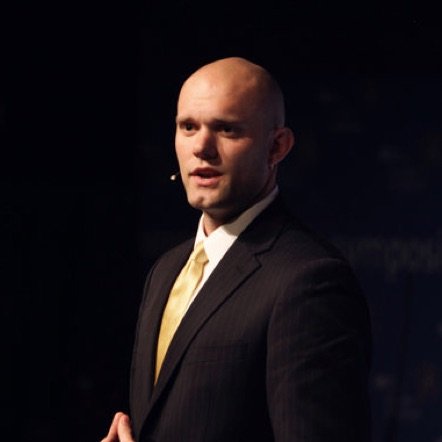
“You do not rise to the level of your goals. You fall to the level of your systems.”
James Clear
Author, Atomic Habits

“I try to buy stock in businesses so wonderful that an idiot can run them. Because sooner or later, one will.”
Warren Buffett
Berkshire Hathaway

“Systems run the business. People run the systems.”
Michael Gerber
Author, The E-Myth
The founder
Built by someone who tried everything else first
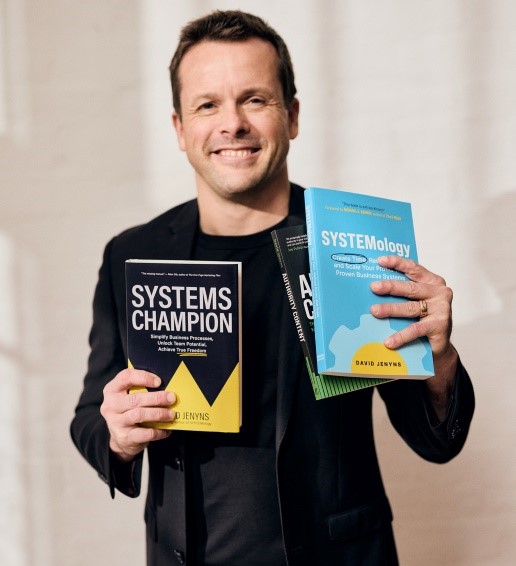
David Jenyns built and exited three businesses. Melbourne SEO Services was the first. He got stuck running it. He hired consultants, tried popular frameworks, used every tool on the market. Nothing worked for a business that size.
So he built the methodology that did. The business sold a few years later. The same approach has now been tested across hundreds of small businesses worldwide — from rural Australian therapy clinics to Western Australian bushland consultancies.
“What Michael Gerber started, David Jenyns completed.”
— Jack Daly, author of Hyper Sales Growth
Before you decide
What owners ask before they start
How is SYSTEMology different from EOS?
EOS is a strategic operating system: vision, traction, scorecards, rocks. SYSTEMology is a methodology for documenting how the work actually gets done. They complement each other. Many of our clients run EOS at the leadership level and SYSTEMology at the operations level.
Will it work for my industry?
SYSTEMology is industry-agnostic. We’ve seen it work across trades, healthcare, agencies, accounting, e-commerce, manufacturing, consulting, and more. Every business has a Critical Client Flow. Finding it is what matters.
How long until I see real results?
Your first documented system inside two weeks. A mapped Critical Client Flow within a month. Real operational impact within three months. A business that can run without you for a week within 6–12 months, depending on starting state and how much you invest in the work.
What if my team won’t follow the systems?
The Three Pillars (Documentation, Tools, Culture) explicitly address resistance. We also have a System for Not Following Systems (S4NFS) for handling persistent non-compliance. In practice, most resistance evaporates once the documentation is genuinely usable and the Systems Champion is properly empowered.
Do I need to buy systemHUB to use SYSTEMology?
No. SYSTEMology is the method. You can implement it with any systems management software. We built systemHUB because we wanted a tool designed specifically for the method, but it’s not required.
Start here
Three ways to begin
No pitch. Pick whichever matches how far you want to move today.
Free · no email needed
Read the book
The whole method in book form. Download the PDF and judge it for yourself before talking to anyone.
Get the book →Most popular · free call
Systems Strategy Session
Find where the business is most exposed right now, and which single system is worth fixing first.
Book a session →Fit conversation
Just talk to us
A short conversation to work out whether this is the right move for where the business sits today.
Start a conversation →