Two businesses. Same industry. Same profit. One sells at the top of the market. The other sits on the shelf for eighteen months and gets pulled from market.
The difference? One owner took a holiday. The other couldn’t.
Short answer: You tell owners their business needs to be transferable. SYSTEMology is what actually makes it transferable. You bring the strategy. We do the operational work. Your client sells for a higher multiple. You look like a hero. You collect a bigger fee.
Why now: The Exit Planning Institute projects more than 100,000 US businesses will transact in the next 5-7 years as baby boomers exit. Roughly three in four of those owners want a third-party sale — not a handover to family. Every one of them will be priced on transferability. Pick your side of that line.
On this page
- The transferability gap
- Why advisors need an operational partner
- What buyers actually pay for
- The Ted vs James story
- How much is transferability worth?
- Kerry Boulton’s EXIT framework
- Four real exits, four lessons
- Introducing it without spooking the team
- Two paths for CEPAs
- Tools for your CEPA toolkit
- FAQ for advisors
Business Systems Summit panel — Kerry Boulton (The Exit Strategy Group), Sandra Allars (Taking Care Mobile Massage) and David Jenyns on what makes a business actually sellable.
The transferability gap
Every Certified Exit Planning Advisor knows the conversation. The owner walks in, proud of the business. You run the numbers. You tell them, gently, that the multiple they want is out of reach because the business is still running on the owner. They nod. They agree. They go back to the business. Eighteen months later the conversation repeats.
The diagnosis isn’t the problem. The implementation is. Ian Jones runs businesssales.com.au and has seen more Australian businesses come to market than almost anyone. He describes the outcome bluntly:
“One of them relies absolutely solely on the business owner. The other one, the guy can take holidays. It’s not necessarily that they’re going to make a higher multiple, but that one will sell and the other one might sit on the shelf for a while.”
— Ian Jones, businesssales.com.au
Same industry. Same profit. Same multiple on paper. One transacts; one doesn’t. Owner-dependency is the difference. Every buyer — trade, corporate, private equity, strategic — models the same risk, and they all price it the same way: heavy discount, long earn-out, or walk away.
That’s the gap SYSTEMology closes. Not the diagnosis. Not the valuation. The implementation.
Why advisors need an operational partner
Mike Taylor is a Pinnacle Guide, a Certified Value Builder, and a certified SYSTEMologist. He’s also honest about the shape of his own industry:
“We tell you what you need to do. But you’re kinda on your own.”
— Mike Taylor, Pinnacle Guide & Certified Value Builder
That’s the CEPA experience in one sentence. You can score the Value Builder assessment, run the EXIT framework, map the gaps. But the 10-20 documented processes a business needs to become owner-independent? That’s 3-9 months of operational work most advisors aren’t scoped, staffed or paid to deliver.
Joanna Oakey, M&A lawyer at Aspect Legal and host of The Deal Room podcast, puts the stakes bluntly:
“These decisions that you make along the way deplete your exit value. Most people building a business have absolutely no idea which small different decisions they could be making that will make the difference between a business that’s saleable and a business that’s not.”
— Joanna Oakey, Aspect Legal, author of Buy Grow Exit
SYSTEMology is the implementation layer. The owner does the work inside your exit engagement. The team gets documented and trained. The business becomes transferable. You stay in the advisory seat where you belong. When the deal closes, both sides look good.
What buyers actually pay for
Ian Jones again, on what buyers bring to the table when they walk in the door:
“What they want is comfort and confidence that when they take the business on, it’ll continue to run well. So whatever making your business transferable looks like for your business is something that everybody should give consideration to.”
— Ian Jones, businesssales.com.au
Comfort and confidence aren’t soft language. They’re priced. Every due-diligence question ladders back to a single concern: if the founder walks out tomorrow, does this cashflow survive? If the answer is yes, buyers pay the market multiple — sometimes a premium. If the answer is no, they price the risk: 30% discount, 3-year earn-out, hold-backs, personal guarantees, or they pass.
Kerry Boulton, founder of The Exit Strategy Group and one of Australia’s leading exit specialists, quotes Warren Buffett when she frames this for owners:
“Warren Buffett says, ‘I only ever buy businesses that have a big wide moat around them.’ Well, what better way to build that moat than with documented systems?”
— Kerry Boulton, The Exit Strategy Group, author of Million Dollar Payday
The moat is transferability. The moat is documented processes that any trained operator can follow. The moat is a team that doesn’t collapse if the founder takes three months off. That’s what a premium buyer pays for — and it’s what a timid buyer quietly discounts.
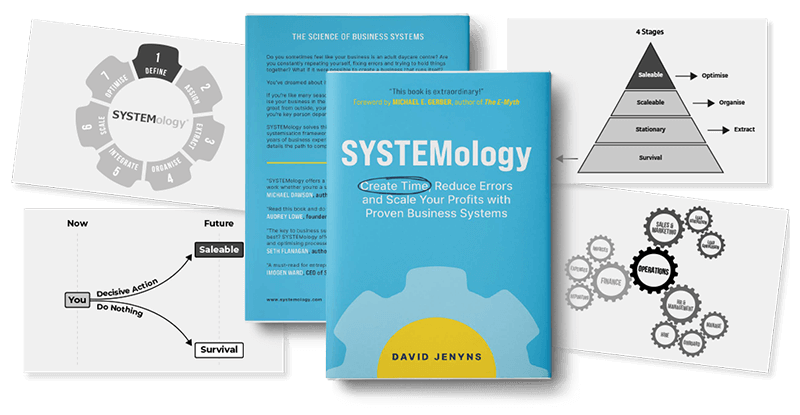
Got a client 1-3 years out from exit? Put the SYSTEMology book in their hand today. It frames the method, gives them the language, and makes your next exit-prep conversation land.
The Ted vs James story
Joanna Oakey on Buy Grow Exit — the full Ted vs James story.
Joanna Oakey has handled hundreds of transactions. Two Italian immigrants, both built companies over decades, both wanted to step back. Ted systemised and ended up with five buyers at the table. James delegated without documenting, hit a key-customer default, and lost the business, his marriage, and his net worth.
“We as advisers are the ones who sit in the role of being able to help provide insight as to how they can be Ted, not James.”
— Joanna Oakey, Aspect Legal
That’s the advisor’s job description. Diagnosis, insight, planning. SYSTEMology is what Ted did between Joanna’s advice and the sale. Watch the full story in the video above.
How much is transferability worth?
Numbers the exit community can quote to their clients.
Kerry Boulton, on the multiple lift from systemising:
“There is absolutely no doubt it’ll increase the value of the business. Definitely 30 or 40 percent — without a doubt. That’s about risk.”
— Kerry Boulton, The Exit Strategy Group
Mike Taylor, citing John Warrillow’s Value Builder data:
“Businesses with a Value Builder score of 80 or above sell for seventy-one percent higher multiple.”
— Mike Taylor, Pinnacle Guide & Certified Value Builder
Mike again, on how Value Builder operationalises the transferability test:
“Hub and spoke is: how your business would perform if you were unexpectedly unable to work for a period of three months. If the owner got sick, got ill, would that business still be able to perform?”
— Mike Taylor, Pinnacle Guide
Three-month absence test. That’s a systems test in disguise. Businesses that pass the test sell. Businesses that fail it don’t — or they sell at discount with a long earn-out attached to the founder staying around, which is not really an exit.
Kerry’s view on the single most leveraged system to document first:
“If you’ve got a really well-systemised marketing system that just keeps pouring leads in, that could quadruple the value of a business.”
— Kerry Boulton, The Exit Strategy Group
Not an efficiency gain. A value-driver multiplier, measured in exit proceeds.
The advisor math — what this means in your pocket
Your average client: $2M EBITDA, sells at 3× = $6M transaction.
Your success fee at 2% = $120,000.
Same client with documented, owner-independent systems: sells at 4× = $8M transaction.
Your success fee at 2% = $160,000.
You earn $40,000 more per deal for making one introduction.
Close 10 exits a year? That’s $400,000 of additional income for a referral partnership that requires zero delivery work from you. Your time stays on strategy. Our team does the systemisation sprint.
Kerry Boulton’s EXIT framework — and where systems plug in
Kerry’s four-stage exit process is a useful map for CEPAs who want to understand exactly where a SYSTEMology engagement delivers value. Her acronym is EXIT: Evaluate, Explore, Innovate, Transition.
| Stage | Advisor’s role | Where SYSTEMology fits |
|---|---|---|
| Evaluate | Owner goals, timeline, retirement-funding gap, current valuation baseline | Benchmark with Owner Dependency Score + Systems Strength Test for discovery |
| Explore | Exit options (trade sale, MBO, ESOP, family succession, full divest) | Scope the operational readiness required for the chosen path |
| Innovate | Close value-driver gaps before going to market | Deliver the 90-day Critical Client Flow sprint + ongoing systemisation |
| Transition | Structure the deal, due diligence, handover, earn-out | Due-diligence-ready data room, documented team, minimal founder handover |
Innovate is where the real work happens. It’s also where most exit engagements stall because neither the advisor nor the owner has a way to execute it. That’s the SYSTEMology window — typically 12-24 months of operational work sitting inside the advisor’s 3-5 year exit runway.
Kerry also makes a point that applies to every business, sellable or not — the five Ds:
“You don’t want to be at the effect of what we call the five Ds — death, divorce, disability, disease, disagreement. You need the business transferable whether you’re selling or not.”
— Kerry Boulton, The Exit Strategy Group
Built-to-sell is the same thing as built-to-survive-the-unexpected. Every business needs to be exit-ready. The ones that aren’t run on a founder who’s also gambling the family’s wealth on never getting sick.
Four real exits, four lessons
DiggiddyDoggyDaycare — Jeanette Farren to PETstock
Jeanette Farren and her sister Nicole built DiggiddyDoggyDaycare in South Melbourne from a backyard experiment into a high-throughput pet care operation — 80 dogs a day, over 2,000 active customers. Kerry Boulton was her exit planner. Systemising was the first recommendation. Twelve months of focused work through the SYSTEMology framework took the business from founder-dependent to franchise-ready. When PETstock came to the table, due diligence moved fast — Jeanette estimated she was “probably about seventy-five percent information ready” on day one of DD. The sale closed at a high multiple of profit earnings. PETstock lifted the entire systemHUB library into their own platform as part of the handover. Jeanette and her husband now travel Australia in a caravan.
Lime Therapy — Renee Kelly to GenShare
Lime Therapy is a 40-person allied health practice in regional Australia. When Renee Kelly decided to sell, Caleb was her Systems Champion and the business had been running on documented processes for years. The acquirer — GenShare — didn’t need Renee tied to the business via a 2-3 year earn-out, because the team could run it without her. Read the full Lime Therapy case study for the long version. Here’s what Renee says systemisation actually bought her at transition:
“Without systemology, I couldn’t give them the confidence that everything was out of my head or out of anyone else of being that knowledgeable person’s head. So you don’t need me standing beside them for the next two, three years to make sure everything’s as I’m saying it is.”
— Renee Kelly, Lime Therapy
The earn-out avoidance is the CEPA-relevant moment. Every advisor has watched an owner sign a deal with 40% of the proceeds tied to an earn-out that then underperforms. Documented systems are how you negotiate the earn-out down — or out.
School Stream — Melissa Bridson’s 13-year SaaS exit
Melissa Bridson built School Stream, a parent-school communications SaaS, over 13 years. Acquirers first circled in 2015. She chose not to sell. In 2019 she started working with systemHUB, turning every operational process into documented, searchable, trainable content. When she finally went to market 13 years to the day after starting, here’s how the handover ran:
“It was all in systemHUB. It was almost like handing a franchise over. Like, here you go, here’s all our systems. Literally, that handover was completed in record time. And the buyer was definitely an influencer in the transaction.”
— Melissa Bridson, founder, School Stream
Buyer feedback to Melissa post-close: “We’ve never seen a business in as organised and good shape as yours.” That sentence is what CEPAs should want written on every exit engagement they run.
Taking Care Mobile Massage — Sandra Allars (in progress)
Sandra Allars built Taking Care Mobile Massage over 21 years from a solo remedial therapist into a 60-therapist operation serving aged-care facilities across three Australian states. Her exit plan is in motion — Kerry Boulton is the advisor. Sandra’s Systems Champion is her daughter Abby. The business ran through a 3-week Turkey holiday with Sandra barely checking email. Target acquirer profile: a national aged-care provider. The exit is planned over 12-18 months, stepping through board role first.
Sandra’s own framing for the order of operations:
“We did the book (SYSTEMology), then we did the Value Builder, then we did EOS.”
— Sandra Allars, Taking Care Mobile Massage
Four businesses. Four industries — pet care, allied health, EdTech SaaS, aged-care services. Four different buyer profiles. One common thread: systemisation made the business transferable, and transferability is what actually transacted.
Introducing it without spooking the team
A common CEPA concern: the owner doesn’t want the team to know they’re planning to sell. Systemisation can look, to a nervous team, like the business is being fattened for market.
Renee Kelly hit exactly this problem. Her language shift, after reading Systems Champion, was to stop talking about “built to sell” and start talking about being buyable:
“I now talk in terms of being buyable. Every day you don’t have an exit, you’re effectively the buyer of the business. You wanna have the business in a state where you’re like, this is worthy of being owned.”
— Renee Kelly, Lime Therapy
Buyable reframes systemisation as professional pride rather than sale preparation. Every day you own the business, you should want it to be worth owning.
Mike Taylor uses a different lever — the vacation test:
“I set every new client a holiday goal. If they haven’t taken a two-week vacation, it’s gonna be two weeks. What that forces them to do is get systems and processes in place, because the owner’s not gonna leave if they think the office is gonna fall apart.”
— Mike Taylor, Pinnacle Guide
Same result. Different language. The team doesn’t hear “we’re preparing to sell.” They hear “the owner is going on holiday and trusts us to run it.” That’s a culture win, not a sale signal.
Two paths for CEPAs with SYSTEMology
Two ways for an exit planning professional to add SYSTEMology to their practice. Most advisors will use the first. A few will grow into the second.
Path 1 — Refer clients (recommended for most advisors)
Your time is worth more than the delivery work. You stay in the strategic seat, doing what you’re licensed and credentialed for. You refer clients to a certified SYSTEMologist — someone trained to deliver the Critical Client Flow sprint, install a Systems Champion, build the documentation, and hand back to you at Transition.
The simplest way to start the referral is to put a copy of the SYSTEMology book in the client’s hand. It frames the method, gives them the language, and turns the next conversation — the one where you introduce a certified practitioner — into a yes. You keep the client relationship. SYSTEMology delivers. You collect the advisor fee on the exit itself.
Path 2 — Become a certified SYSTEMologist yourself
For advisors who already do hands-on operational work with clients — typically fractional COOs, business coaches, and M&A consultants — the SYSTEMologist Certification teaches the full framework. You deliver the engagement under your own brand, capture the implementation fee yourself, and add a differentiated service to your practice.
Mike Taylor runs both sides — CEPA-adjacent advisor and certified SYSTEMologist. Three of his current clients are in a 3-year exit prep with systemisation as the centrepiece. His stated goal on each: get the full sale proceeds on day one, no earn-out.
Add a Bigger Number to Your Next Exit
Two ways to plug SYSTEMology into your practice today:
1. Gift the book — $25 on Amazon. The fastest way to start the conversation with an owner 1-3 years from exit. If it doesn’t shift how they think about transferability in the next 30 days, we’ll refund you personally.
2. Become a certified SYSTEMologist — deliver the 90-day sprint under your own brand. Mike Taylor (CEPA, Value Builder, Pinnacle Guide) runs both. Most dual-credentialed advisors recover certification cost inside one engagement.
Tools for your CEPA toolkit
Five free SYSTEMology tools CEPAs can send to clients during Evaluate and Explore — built to surface the operational gaps before the exit planning work starts. Use them in discovery, post-Value-Builder score, or alongside the EBITDA quality-of-earnings review.
Advisor-ready diagnostic tools
- Business Valuation Calculator — the dollar impact of systemisation on sale multiple
- Owner Dependency Score — the 4-week holiday test, quantified
- Systems Strength Test — 9-dimension maturity diagnostic
- Owner Time Audit — hours lost to low-value work every week
- Cost of Chaos Calculator — annual dollar cost of under-systemised operations
All free. No email wall. Built for owners to complete in 2-5 minutes each. Use them to give the exit conversation teeth with numbers the owner generated themselves.
What real business owners say about SYSTEMology — the praise reel.
FAQ for advisors
How does SYSTEMology fit into a standard 3-year CEPA exit engagement?
Cleanly. The Critical Client Flow 90-day sprint happens inside the Innovate stage of Kerry Boulton’s EXIT framework — typically in year one of the 3-year runway, so documented systems are live and battle-tested by the time due diligence starts. Ongoing depth documentation fills years two and three. Nothing is retrofitted under the pressure of a DD clock.
Do my clients need to adopt systemHUB software, or can SYSTEMology run on their existing tools?
systemHUB is the default repository because it’s built for the framework, has AI-assisted process creation, and handles role-based access out of the box. Clients already using Notion, Confluence or Trainual can run SYSTEMology on those — with the caveat that the buyer in a transaction usually prefers a platform that can be handed over cleanly. systemHUB handovers happen in record time (see the Melissa Bridson acquisition); Notion handovers require untangling whose workspace owns what.
How do I introduce systemisation to a client who says “we already have SOPs somewhere”?
Use the hub-and-spoke test from Value Builder: if the owner was unavailable for three months, would the business perform at current levels? If the answer is no, the SOPs either don’t exist in reality, aren’t being used, or aren’t owner-independent. Run the Owner Dependency Score with them. The gap between “we have SOPs” and “the team actually runs on them” is usually the entire engagement.
What’s the typical uplift in Value Builder score from a SYSTEMology engagement?
Kerry Boulton estimates a minimum 30–40% multiple uplift from systemising alone, stated conservatively. John Warrillow’s Value Builder data shows businesses at score 80+ sell for 71% higher multiple than the average. The biggest single driver improvements tend to be in Hub and Spoke (direct systems effect), Switzerland Structure (reduced customer concentration risk through documented sales systems) and Valuation Teeter-Totter (working capital efficiency from documented processes).
Can I become a certified SYSTEMologist alongside my CEPA credential?
Yes. Mike Taylor holds both, along with Pinnacle Guide and Certified Value Builder credentials. The SYSTEMologist Certification is designed for advisors who want to deliver the implementation themselves rather than refer out. Most dual-credentialed advisors use CEPA for the advisory engagement and SYSTEMology as the operational delivery inside it.
Key takeaways
- Transferability is the deal variable. Same profit, same industry, same multiple on paper — the systemised business sells; the owner-dependent one sits on the shelf.
- Systemisation lifts the multiple 30–40% minimum (Kerry Boulton), and businesses at Value Builder score 80+ transact at 71% higher multiple (John Warrillow).
- Systems shorten or eliminate earn-outs. When the team can run without the founder, the buyer doesn’t need the founder tied to the business for three years.
- The 3-year CEPA runway is the exact window in which SYSTEMology produces full implementation. Not too short, not too long.
- Two paths forward: put the SYSTEMology book in your client’s hand and refer them to a certified practitioner, or add the SYSTEMologist certification to your own practice.