Short answer: Scaling Up is a business operating system. SYSTEMology is a process operating system. Verne Harnish wrote the Scaling Up playbook in 2002, five years before EOS existed, and it still sets the standard for strategy and cash rigour. SYSTEMology plugs in underneath as the process documentation layer that makes Scaling Up actually execute. Many of our clients run both.
On this page
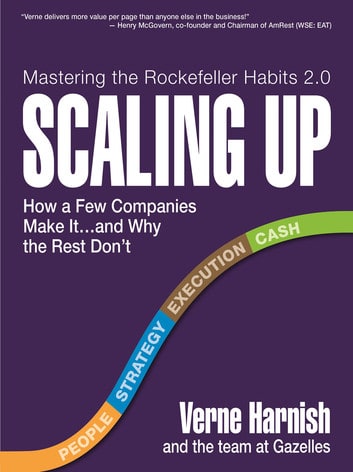
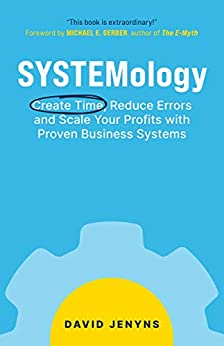
If you have read Verne Harnish, you already know this: Scaling Up is the grandfather of the modern business operating system. Verne published the original playbook in 2002 as Mastering the Rockefeller Habits, expanded it in 2014 as Scaling Up, and along the way built Gazelles, the Scaling Up Coaches network, and Growth Institute. Every serious business operating system since, including EOS, drew from the same well he dug.
That is worth saying up front. SYSTEMology owes a debt to Scaling Up too. The rhythms, the scorecards, the One Page Strategic Plan, the idea that a company has four decisions it must get right (People, Strategy, Execution, Cash) — these ideas shaped how thousands of us think about growing a business.
So this is not a versus article in the usual sense. Scaling Up and SYSTEMology are not fighting for the same spot in your business. They live at different levels of the stack and many of the best operators we know run both. This page is the honest explanation of how they fit together, with a real client example.
What is Scaling Up?
Scaling Up is a complete business operating system built around the 4 Decisions every growing company must get right.
People
Right people in the right seats. Core values alive in daily behaviour. A-players attracted, developed, and kept. Weak performers addressed.
Strategy
A differentiated, profitable, durable position in the market. Core Customer defined. BHAG named. Entire strategy compressed onto one page.
Execution
Priorities, data, and meeting rhythm that turn strategy into progress each quarter. Rocks, scorecards, daily huddles, weekly leadership meetings.
Cash
Enough oxygen to fund the growth. Cash conversion cycle shortened. Cashflow forecast. Profit optimised. The decision most growth frameworks ignore.
The toolset around the 4 Decisions is richer than any other framework in the business OS space:
- One Page Strategic Plan (OPSP) — the entire company’s vision, priorities, and metrics compressed onto one page. The most-copied strategy tool in small business.
- Rockefeller Habits Checklist — the 10 habits that separate world-class execution from average. Still the most useful self-diagnostic in the category.
- Meeting Rhythms — Daily Huddle, Weekly, Monthly, Quarterly, Annual. Each has a specific purpose and length. When followed, communication compounds instead of degrading.
- Cash Conversion Cycle — how long between you spending a dollar and receiving it back with profit. Scaling Up is the only major framework that takes cash seriously at this level.
- Themes and Rocks — the quarterly priority structure that drives focused execution.
Best for: $1M to $500M companies, typically 10 to 1,000+ staff, serious about growth but struggling to keep leadership aligned, cash healthy, and strategy executed consistently.
What is SYSTEMology?
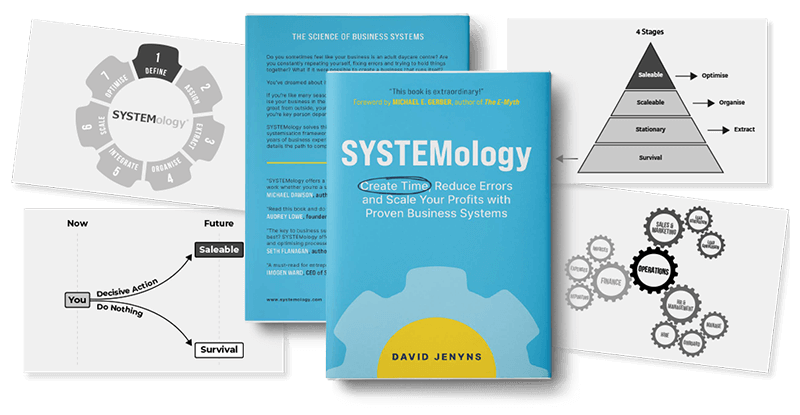
SYSTEMology is the process operating system. Where Scaling Up focuses on the 4 Decisions at the leadership layer, SYSTEMology focuses on the day-to-day work that happens below it — getting the operational knowledge out of people’s heads and into documented systems the team can actually follow.
- Critical Client Flow (CCF) — a one-page map of the 10 to 15 systems that attract, convert, and deliver your primary offer
- Minimum Viable Systems (MVS) — the 7-per-department rule that gets the whole business documented without overwhelming the team
- System for Creating Systems 2.0 — the AI-assisted method for documenting a process in minutes rather than hours
- Systems Champion — the dedicated role that owns the systems function, so the founder and leadership team do not have to
- Scoreboard gamification — the tool that turns systemisation into a game the team can actually finish
Best for: businesses at any stage that need to get the owner out of the daily operational work and make the business runnable without them.
Verne Wrote the Playbook Before EOS Existed
This context matters because most comparison articles skip it.
Verne Harnish published Mastering the Rockefeller Habits in 2002. Gino Wickman published Traction in 2007. The 10 Rockefeller Habits Checklist predates the 6 EOS Components by five years, and many of the EOS ideas have clear parentage in Verne’s earlier work. Quarterly priorities (Rocks in EOS language) are Verne’s 13-week plans. Weekly scorecards, rhythmic meetings, vision on a page — these were Scaling Up before they were EOS.
None of this diminishes EOS. Gino did something Verne did not: he simplified, packaged, and franchised an implementation model that made the ideas accessible to a huge audience. Millions of companies now run EOS because of that work.
But when people ask “is Scaling Up just an older version of EOS?” the honest answer is the other way around. EOS took the best of Scaling Up, added its own simplifications, and built a massive distribution. Scaling Up remains the richer, more demanding framework, especially on strategy and cash.
Scaling Up vs SYSTEMology: Side by Side
| Dimension | Scaling Up | SYSTEMology |
|---|---|---|
| What it is | A business operating system covering strategy, people, execution, and cash | A process operating system for documenting how the work gets done |
| Year introduced | 2002 (Mastering the Rockefeller Habits), 2014 (Scaling Up) | 2020 (SYSTEMology), 2026 (Systems Champion) |
| Framework core | 4 Decisions: People, Strategy, Execution, Cash | 7-stage systemisation framework |
| Primary tools | One Page Strategic Plan, Rockefeller Habits Checklist, Cash Conversion Cycle, Meeting Rhythms, Themes/Rocks | Critical Client Flow, Minimum Viable Systems, System for Creating Systems 2.0, Systems Champion role, Scoreboard |
| Key roles | CEO, Chief of Staff / COO, leadership team, Scaling Up Coach | Systems Champion, knowledgeable workers, department heads |
| Team size sweet spot | 10 to 1,000+ staff, $1M-$500M revenue | Any, especially 5 to 100 staff |
| Strategy depth | Deep (OPSP, 7 Strata of Strategy, Core Customer, BHAG) | Light — not its focus |
| Cash depth | Deep (Cash Conversion Cycle, Power of One, cash acceleration) | None — not its focus |
| Process documentation depth | Light — acknowledged as essential but not prescribed | Deep (the whole framework) |
| Cadence | Daily Huddle, Weekly, Monthly, Quarterly Theme, Annual Planning | Weekly documentation sprints, 90-day MVS sprint |
| Adoption pathway | Scaling Up Coach (certified), Growth Institute training, self-study | Books, systemHUB platform, SYSTEMologist Academy, certified practitioners |
Where the Frameworks Overlap
Both frameworks want the same ultimate outcome: a business that grows without breaking, run by a team that knows what it is doing. Both use scoreboards, rhythms, and accountability structures. Both emphasise that operational excellence requires repeatable process, not heroic effort.
The Rockefeller Habits Checklist includes the habit that every successful company has processes that are “documented, simplified and followed by all.” That is the exact outcome SYSTEMology was built to produce. Verne names the requirement. SYSTEMology provides the implementation path.
Where They Diverge
Scaling Up operates at the leadership and strategic layer. It answers the questions a CEO and leadership team must answer to grow a business: Where are we going? Who is on the bus? How do we make our money? Are we executing the plan?
SYSTEMology operates one layer below. It answers: Now that the leadership team has set direction, how does the actual work get done, consistently, by someone other than the founder? That is a different problem with different tools.
Think of Scaling Up as the architecture of the building — the blueprint, the load-bearing walls, the flow between rooms. SYSTEMology is the plumbing, the wiring, the fittings — the systems that make the building actually function day to day. Both matter. Neither works without the other.
Why Scaling Up Teams Add SYSTEMology
Here is the pattern we see constantly. A company adopts Scaling Up. The leadership team runs weekly meetings, quarterly planning, OPSP reviews. The Rockefeller Habits Checklist gets filled in. Most boxes tick green over time.
One box does not. The process documentation box. Every quarter it gets rolled forward. “We’ll document the core processes next quarter.” Two years later it is still on the list.
That is not a discipline problem. Scaling Up companies have plenty of discipline by definition. It is a method problem. Scaling Up does not prescribe how to capture, document, and deploy processes. It correctly identifies that you must, but it does not give you the playbook for doing it.
SYSTEMology is that playbook. It gives a Scaling Up company the CCF to map their critical processes, the MVS framework to cap documentation work at 42 systems across 6 departments, the System for Creating Systems 2.0 to make the actual documentation take minutes rather than hours, and the Systems Champion role so the leadership team is not the one doing the documentation.
Most importantly, SYSTEMology makes the Scaling Up OPSP real. Execution priorities on the OPSP depend on processes the team can reliably run. If those processes live only in people’s heads, the OPSP cannot be executed as planned.
OPSP vs Critical Client Flow — They Pair Perfectly
Verne’s OPSP and our CCF are both one-page tools, both sit at the centre of their respective frameworks, and both compress a complex business idea into something a leadership team can actually read at a glance.
They answer different questions though.
The OPSP answers: what business are we in, where are we going, and how will we know we are on track? Strategic, external-facing, revenue-oriented.
The CCF answers: what is the one-page flow a client experiences from first awareness to delighted, and what system powers each step? Operational, internal-facing, process-oriented.
Running both gives you the full picture in two pages. Your OPSP tells the leadership team the destination and the markers along the way. Your CCF tells the operations team the work that has to run perfectly for the OPSP to be achievable.
A Real Client Running Both
Absolute Immigration is one of Australia’s largest immigration firms. Jamie Lingham runs it on Scaling Up for the leadership and strategic layer, and on SYSTEMology for the operational documentation layer.
Jamie Lingham on systemising Absolute Immigration. Full case study here.
The short version: Scaling Up gave Jamie the team alignment, quarterly priorities, and strategic clarity to grow the firm. SYSTEMology gave him the process documentation infrastructure to ensure every immigration case, every client interaction, every team handover runs exactly the same way every time. In a highly regulated, stakes-are-high industry, that combination of strategic direction and operational repeatability is the moat.
This pattern is not unusual. Many of our clients come to SYSTEMology specifically because they are already running Scaling Up and their Scaling Up coach told them to. Scaling Up Coaches understand that their framework works better when clients have a credible implementation partner for the process documentation layer. We work well with Gazelles coaches and with the broader Scaling Up community.
How to Run Them Together (The Practical Setup)
If you are a growing company that fits both frameworks, here is the operating model that works.
The person who unlocks this operating model is the Systems Champion — the role David Jenyns defined in Systems Champion (the sequel to SYSTEMology). The Systems Champion reports to your Integrator / Chief of Staff and owns the process documentation function so your leadership team can stay focused on strategy, cash, and people.
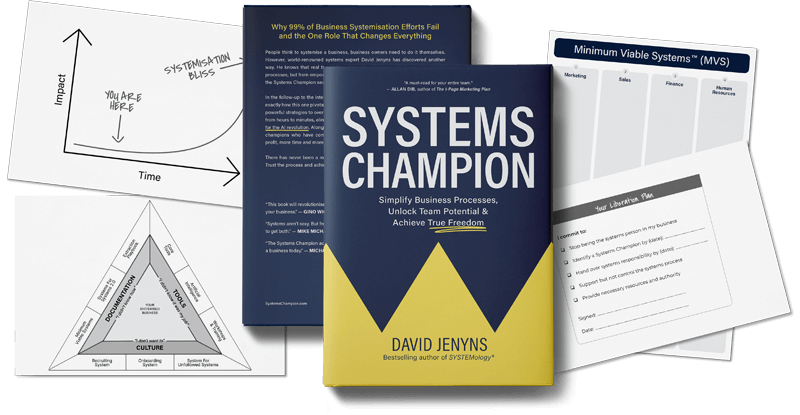
The Systems Champion is not a senior leader. They are not the Integrator, Chief of Staff, or COO. They are the department head of the “systems” function — the same way your sales manager owns sales and your marketing manager owns marketing. Reports to senior leadership, owns authority within a defined scope.
Their day-to-day is four things: identify which systems in the business are critical and missing, extract how the best person doing each task actually does it, document that as a clear system in your operations library, and deploy it so the team adopts the new standard. Week after week. Department by department. Until your Minimum Viable Systems are complete and the business no longer runs on tribal knowledge.
This is the role that makes Scaling Up’s Rockefeller Habits actually finish. Your Integrator runs Scaling Up. Your Systems Champion runs SYSTEMology. They report together to leadership. The Integrator stays focused on strategy, cash, and execution. The Systems Champion keeps the process documentation engine running. Both roles are needed; they do not compete for the same seat.
Full role description, hiring guide, and compensation structure in Systems Champion.
- Scaling Up sits at leadership level. Weekly huddles, quarterly planning, OPSP, Rockefeller Habits Checklist, cash conversion cycle reviews. Typically run by your CEO and leadership team, ideally with a Scaling Up Coach.
- SYSTEMology sits at operational level. CCF, MVS, documented systems, scoreboard, Systems Champion role. Run by your Systems Champion reporting into the leadership team.
- The Chief of Staff / COO role bridges both. In Scaling Up language this is the Integrator-equivalent. They make sure leadership strategy translates into operational reality, and operational feedback feeds into strategic decisions.
- Artifacts pair naturally. Your OPSP defines the strategy. Your CCF defines the revenue-generating operations. Your MVS defines every critical system across every department. Reading all three gives any new leader a complete picture of the company in minutes.
- Rhythms complement, not collide. Scaling Up rhythms are for leadership and strategic execution. SYSTEMology sprints are for process documentation and improvement. Keep them on separate calendars; the Systems Champion reports weekly into one of the Scaling Up rhythms so the leadership team has visibility.
Which Should You Start With?
Start with Scaling Up if:
- You have a functioning leadership team (not just you) and you are struggling with alignment or cash
- Your team is 20+ staff and growing fast
- Your annual strategy is chaotic or driven by the loudest voice in the room
- Your business has revenue growth but no cash control
- You want a complete framework for the strategic and leadership layer of the business
Start with SYSTEMology if:
- You are still the bottleneck — the business cannot run a week without you
- You have tried to document processes before and the project stalled
- You are under 30 people and still founder-heavy
- Your leadership team is mostly just you
- Scaling Up feels too strategic for where you are today; you need to first make the day-to-day work reliable
Run both if:
- You are already running Scaling Up and the Process component of the Rockefeller Habits Checklist keeps rolling over unfinished
- You are past 30 people and need both strategic cadence and operational documentation
- Your Scaling Up coach has asked you “who owns documented processes?” and you do not have an answer
Not sure where you are stuck? Take 2 minutes with one of these free tools.
- Owner Dependency Score — the “4-week holiday test”, quantified
- Systems Strength Test — 9-dimension diagnostic of your systemisation maturity
- Owner Time Audit — how many hours you are losing to low-value work
- Cost of Chaos Calculator — annual dollar cost of operating without systems
- Business Valuation Calculator — what systemisation is worth in sale multiple
What Real Business Owners Say About SYSTEMology
This reel collects short clips from business owners, authors, and thought leaders who have run the SYSTEMology framework inside their own businesses. Watch a few and you will hear the same pattern repeatedly: the owner finally stopped being the bottleneck, the team finally gained real ownership, and the business finally started running without them.
Systemise Your Business In Weeks, Not Years.
Whether you run Scaling Up, are about to start, or have no strategic framework at all, SYSTEMology plugs straight into your operations layer. systemHUB is where your documented systems live and run. Free trial, no credit card.
Scaling Up vs SYSTEMology FAQ
Do I have to pick between Scaling Up and SYSTEMology?
No. Scaling Up is a business operating system focused on strategy, people, execution, and cash. SYSTEMology is a process operating system focused on documenting the daily work. They solve different problems and the best operators run both.
Is Scaling Up the same as EOS?
No, and Verne Harnish’s work actually pre-dates EOS by five years. Verne published Mastering the Rockefeller Habits in 2002; Gino Wickman published Traction in 2007. Many EOS ideas have clear origins in Verne’s earlier work. Scaling Up remains the more demanding, richer framework, especially on strategy and cash.
Can a small business use both Scaling Up and SYSTEMology?
Under 20 people, Scaling Up is typically overkill. Start with SYSTEMology to get the business off your plate operationally. Add Scaling Up once you have a leadership team and you are struggling with strategic alignment or cash.
Does Scaling Up cover process documentation?
The Rockefeller Habits Checklist explicitly includes the requirement that core processes are documented, simplified, and followed by all. It names the requirement. It does not prescribe how to do it. SYSTEMology is the implementation method that makes that habit real.
Which book should I read first, Scaling Up or SYSTEMology?
Read SYSTEMology first if you are a founder still in the daily work. Read Scaling Up first if you already have a leadership team and your strategic alignment or cash health is the bigger problem.
Can SYSTEMology work without Scaling Up?
Yes. Most SYSTEMology clients are not running Scaling Up. SYSTEMology is a complete framework for operational documentation on its own.
Can Scaling Up work without SYSTEMology?
Yes, but process documentation tends to be the Rockefeller Habits box that never gets ticked. That is why so many Scaling Up companies eventually add SYSTEMology.
Do Scaling Up Coaches recommend SYSTEMology?
Many do. We work with Gazelles and Scaling Up Coaches regularly. Coaches appreciate having a credible implementation partner for the process documentation layer so they can stay focused on strategy, cash, and leadership.
What is the One Page Strategic Plan (OPSP)?
The OPSP is Scaling Up’s flagship tool — a single-page compression of a company’s core values, purpose, BHAG, three-to-five year targets, one-year plan, quarterly priorities, and key performance indicators. It is the most-copied strategy tool in small business for good reason.
Key Takeaways
- Scaling Up is the OG business operating system. Verne wrote it in 2002, before EOS existed, and it still sets the bar on strategy and cash.
- SYSTEMology is the process layer. It plugs in below Scaling Up without competing with it.
- Rockefeller Habit #10 is the Scaling Up box SYSTEMology finishes. Documented processes followed by all — named by Verne, implemented by SYSTEMology.
- Run both if you are past 30 people. Scaling Up for the leadership and strategic layer; SYSTEMology for the operational documentation layer.
- OPSP + CCF = two pages that describe your whole business. Strategy on one, operations on the other.