What if you could explain your entire business on one page?
That is exactly what a Critical Client Flow allows you to do. It is a simple, one-page map of the 7 to 12 essential steps your business uses to attract, convert, and serve clients. And it takes just twenty minutes to create.
But most business owners never get this clarity. They know they need systems. Every business book, podcast, and consultant says the same thing. Document your processes. Build your operations manual.
So they sit down to start. And within minutes, they are staring at a blank page, completely overwhelmed. Where do you even begin when your business has dozens of moving parts?
Here is the problem. Most business owners who attempt to systemize make the same critical mistake. They try to document everything at once.
What if you could explain your entire business on one page?
David Jenyns, founder of SYSTEMology, once shared office space with a digital marketing agency owner who tried this approach. The owner documented every aspect of his operations and created hundreds of systems. He even built an index and stuck it to his office wall so everyone could see the master list.
It bombed.
The wall of systems was too overwhelming. Employees could not make sense of it. And because digital marketing is evolving constantly, keeping everything current was impossible.
This experience taught a valuable lesson. You do not need hundreds of systems to build a systemized business. You need to focus on the critical few.
What’s in this article:
What Is a Critical Client Flow (CCF)?
The 80/20 Principle Behind the CCF
How to Create Your Critical Client Flow: 3 Steps
Critical Client Flow Example: Clothing Store
Common Mistakes When Creating Your CCF
What Happens After You Complete Your CCF
Real Results: Case Studies from Business Owners
Frequently Asked Questions
Start Your Critical Client Flow Today
What Is a Critical Client Flow (CCF)?
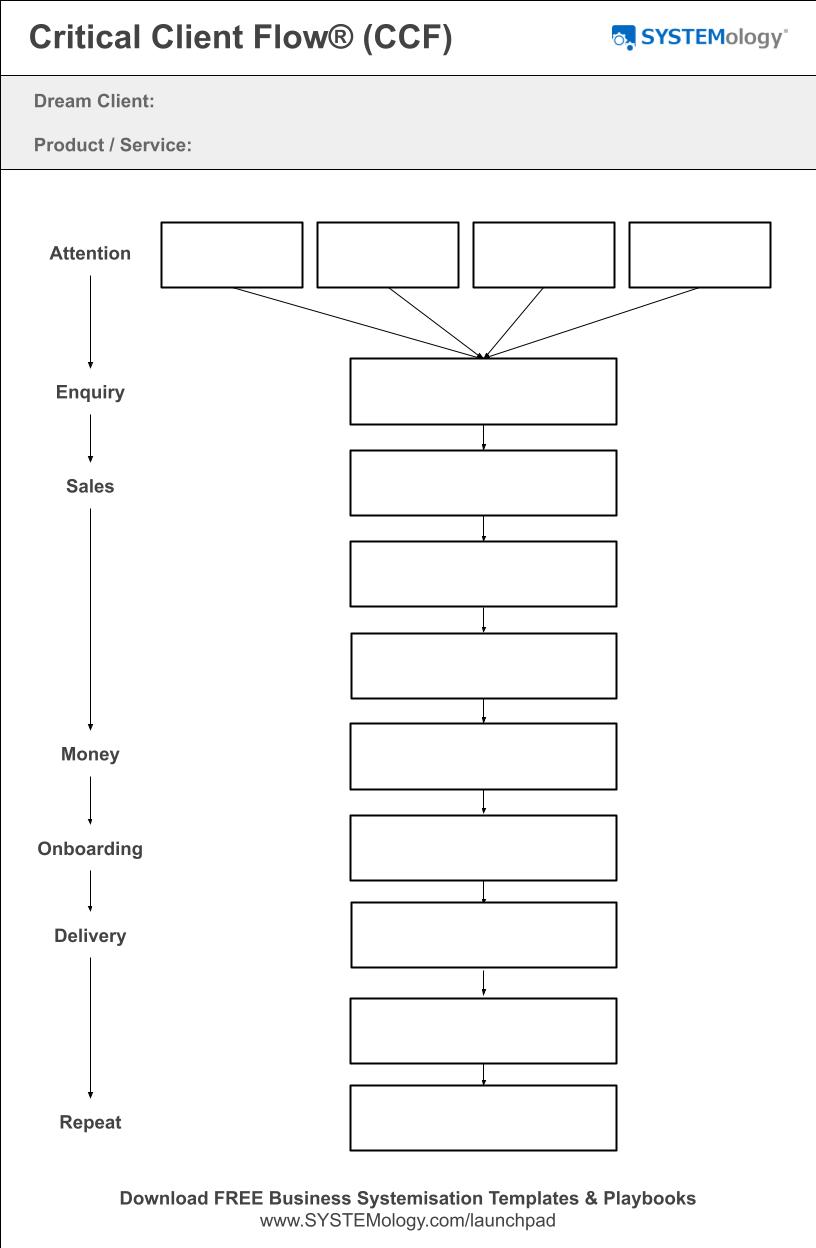
A Critical Client Flow is a one-page visual map that captures how your business delivers its core product or service. It identifies the 7 to 12 essential steps your clients and business go through, from first contact to completed delivery.
The CCF is the first tool in the SYSTEMology methodology. It takes about twenty minutes to complete and identifies the systems that matter most.
Think of it this way. Could you explain how the core of your business works on the back of a napkin? If not, the CCF will help you get there.
One important distinction: the CCF is not a detailed process map. It captures both the client experience and the internal business requirements at the highest possible level. You are not creating detailed documentation here. That comes later.
The 80/20 Principle Behind the CCF
Italian economist Vilfredo Pareto discovered that roughly 80% of effects come from 20% of causes. This principle appears everywhere in business. 80% of your leads often come from 20% of your advertising. 80% of complaints come from 20% of clients.
Just 20% of the systems you create will account for 80% of your efficiency wins.
Business systems are no exception. Just 20% of the systems you create will account for 80% of your efficiency wins.
The CCF helps you identify that critical 20%. Instead of documenting hundreds of processes and getting nowhere, you focus on the 7 to 12 systems that directly impact how you attract, convert, and serve clients.
How to Create Your Critical Client Flow: 3 Steps
Ready to create your own CCF? Visit our SYSTEMology resources and download the free template. Then follow these three steps.
Step 1: Identify ONE Target Client and ONE Primary Product
Before mapping your flow, narrow your focus. Pick just one target client and one product or service.
Begging by considering your dream clients. The ones you enjoy working with most. The ones who pay your advertised prices and happily refer others. Then pick the product that would be the best starting point for that client.
For example:
- A bookkeeper might choose farmers as their target client and an initial financial audit as their primary service
- A digital agency might select franchisors as its target and build websites as its primary service
- A physiotherapy clinic might pick office workers with back pain and an initial assessment as their primary service
This focus is not permanent. You can create additional CCFs later. But starting with one ensures you complete the exercise.
Step 2: Define Your Critical Client Flow
Now, map the key stages your client goes through when working with your business. The CCF follows a linear progression:
Attention: How do people learn about your business? Referrals? Speaking engagements? Advertising?
Enquiry: When someone is ready to enquire, how do they do it? Phone? Website form? Email?
Sales: What steps convert an enquiry into a paying client?
Onboarding: How do you get new clients started? What information do you collect? What expectations do you set?
Delivery: How do you actually deliver your product or service? Keep this simple on your CCF, even if the reality is complex.
Repeat or Referral: How do you encourage clients to come back or refer others?

Three rules as you complete this step:
- Do not overthink it
- Use only two or three words per step
- Only include activities you are currently doing
Capture what you actually do today, not what you wish you were doing. Any gaps will become immediately apparent.
Your completed CCF should have between 7 and 12 steps. If you have more, combine steps handled by the same person.
Step 3: Share and Test Your Completed CCF
Here is the validation test. Show your completed CCF to someone outside your business. Preferably someone who is familiar with your work but is not directly involved in daily operations.
If they can understand your CCF without you having to explain it in detail, you have succeeded.
If they can understand your CCF without you having to explain it in detail, you have succeeded. If they find it confusing or too complex, simplify it further.
The goal is to explain in simple terms how your business works linearly, from start to finish. Remember: one client, one product, one journey.
Download the free CCF template
Map your entire business on one page in about 20 minutes. The template walks you through every step.
Critical Client Flow Example: Rock Music Clothing Store
Let us walk through a real example.
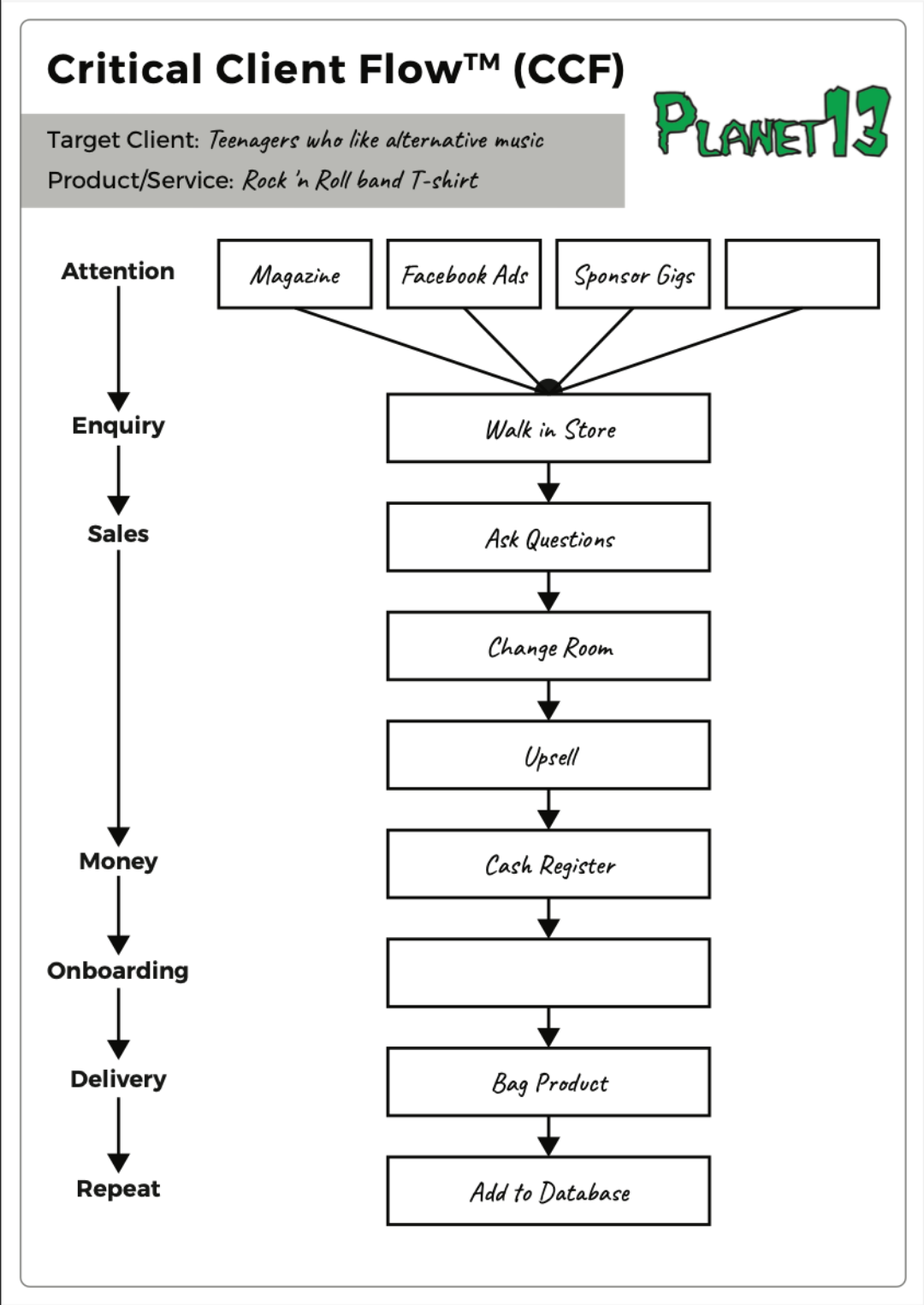
David Jenyns was a joint owner of Planet 13, a rock ‘n’ roll music-inspired clothing store that was one of his first business ventures. Here is what that CCF might look like:
Target Client: Teenagers who like alternative rock music
Primary Product: Heavy metal and rock n’ roll band T-shirts
The Flow:
- Attention: Mall foot traffic, local gig flyers, word of mouth
- Enquiry: Customer walks into the store or asks about a band
- Browse: Customer looks through shirt racks and displays
- Sale: Customer selects items and pays at the register
- Bag and Receipt: Items bagged, receipt provided
Follow-up: Flyer in bag for upcoming sales or new stock arrivals
Notice how simple each step is. Just a few words. This CCF may not have an in-depth sales system, invoicing system, or even a complex delivery system. But there is still a flow that can be documented.
Also, notice that retail businesses might combine some steps. There is no separate “onboarding” stage for walk-in customers, so it gets folded into the sale and delivery.
Common Mistakes When Creating Your CCF
Through working with hundreds of business owners, certain CCF mistakes appear repeatedly.
Going into too much detail. The CCF boxes are intentionally small. If you cannot fit your description in a few words, you are going too deep.
Documenting what you wish you were doing. Capture your current reality. If you have gaps, let them show. That information guides where to focus.
Creating more than 12 steps. If your CCF has too many boxes, combine steps. If the same person handles multiple steps, they can often be grouped.
Trying to cover every product and client type. One client, one product, one journey. You can create additional CCFs later.
Making it too complex for others to understand. If an outsider cannot follow your CCF at a glance, simplify it.
What Happens After You Complete Your CCF
The CCF is the first step of a larger methodology. Once completed, it becomes the foundation for everything that follows.
Next, you will create a Departments, Responsibilities, and Team Chart (DRTC) to identify who is responsible for each step. Then you begin extracting that knowledge and documenting systems, starting with the most critical ones from your CCF.
The CCF is the first step of a larger methodology.
Your CCF also becomes a tool for onboarding new team members and tracking performance metrics at each stage.
The exciting thing is this: once you systemize your Critical Client Flow, you are well on your way to delivering your product without key person dependency.
Ready to document the systems your CCF reveals?
systemHUB is purpose-built for exactly this — with 100+ SOP templates and a simple way to capture, store, and share every process in your business.
Real Results: Case Studies from Business Owners
Jeanette Farren, diggiddydoggydaycare
Jeanette Farren ran her award-winning doggy daycare for thirteen years. When she decided to sell the business, she knew documentation would be critical.
“The first areas corporate buyers look at when valuing a business are its accounts and systems,” Jeanette explains.
She started by documenting her Critical Client Flow. The result? She went from working full-time hours in the business to stepping out and working on the business. Her systems made the company attractive to buyers.

Alison Rogers, Vocal Manoeuvres Academy
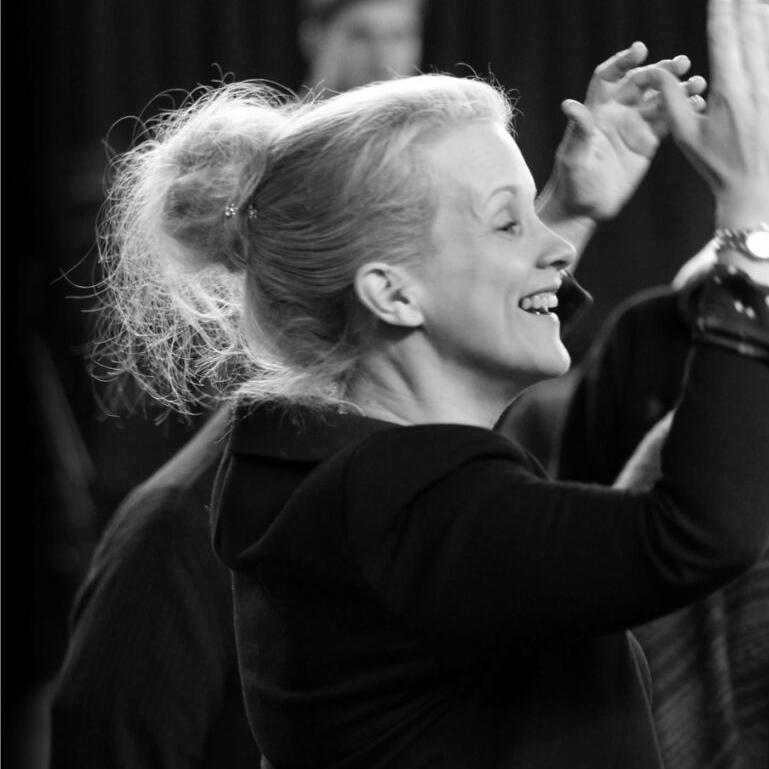
Alison Rogers had been teaching singing since she was fifteen. But success brought a cost.
“I had this constant state of heightened anxiety,” Alison recalls. “Always on tools, always working.”
When she discovered SYSTEMology, she initially resisted the idea. Eventually, she trusted the process.
The transformation was remarkable. Her team now speaks in terms of systems. When someone encounters a question, their instinctive response is “Is it in the system?”
Ryan Stannard, Stannard Family Homes
Ryan Stannard runs a custom home-building company in Adelaide and loves water skiing with his family. Before systemizing, he was stuck in the business answering questions all day.
He committed to documenting his processes, starting with the CCF. Now he can step away for weeks at a time. Over Christmas, he left the office on December 18th, and the business continued to run smoothly.
“Once you document something, you actually find the flaws in it,” Ryan explains.

How dependent is your business on you?
Take the free Owner Dependency Score — a 2-minute quiz that shows exactly how much your business relies on you to function.
Frequently Asked Questions
Start Your Critical Client Flow Today
The SYSTEMology Critical Client Flow gives you something most business owners lack: clarity. In just twenty minutes, you can see your entire business on one page and identify the systems that matter most.
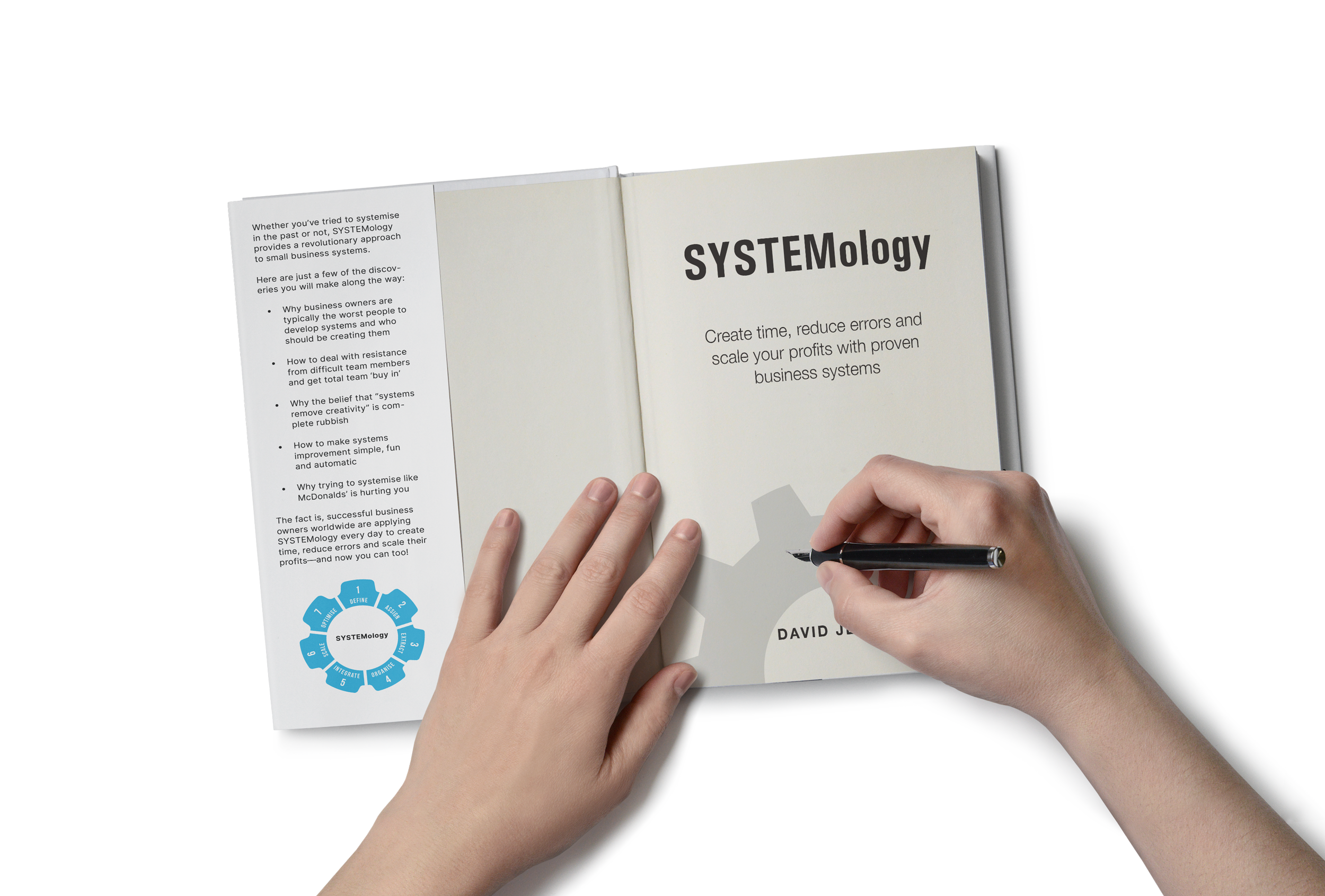
Take the guesswork out of what to systemize first. Download the free CCF template and start mapping your flow. For a deeper dive into the full approach, the SYSTEMology book adds plenty of clarity.
One client. One product. One journey. Document that, and you have a CCF.