There are hundreds of AI tools for small businesses. New ones launch every week. And if you are like most business owners, you have no idea which ones actually matter for your operation.
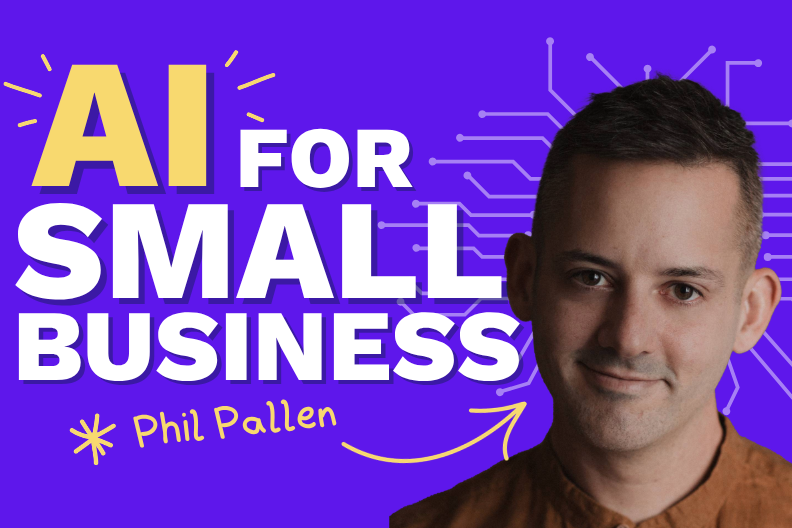
That is the problem Phil Pallen set out to solve. Phil is a brand strategist who has spent three years testing AI tools across every department of business. He wrote the book on it: AI for Small Business (Simon & Schuster). His approach is refreshingly simple. Do not start with the tools. Start with where your time is going.
“AI is an incredible way to automate before we jump to delegation,” Phil says. “It’s not going to replace the human part of the work. But it can free your best people to focus on what they love doing and where they make the highest impact.”
Key Takeaways
- Track your time before you pick a tool. Highlight what takes too long each week.
- AI handles admin tasks so your team can focus on high-impact work.
- ChatGPT is good for editing; specialist tools like Anyword or VOC AI solve specific problems faster.
- Check the tools you already pay for that are rolling out AI features.
- One AI save builds confidence and momentum for the next.
Track Your Time Before You Pick a Tool
Phil tracks every working minute using a time-tracking tool called Aberhour, which syncs with project management platforms like Asana and Monday. At the end of each week, he reviews where the hours went.
His recommendation for any business owner: grab a highlighter and mark the tasks that took up more time than they should. Those are your automation targets.
“That’s often marketing tasks,” Phil says. Social media, email replies, content creation. The stuff that gets tacked onto an already full schedule. Starting there means you are solving a real problem, not chasing a shiny tool.
How much is it costing you NOT to systemise?
Use our free Cost of Chaos Calculator to put a dollar figure on the time, mistakes, and missed growth your business loses every year without documented systems.
Match the Tool to the Task, Not the Hype
Phil splits AI tools into two categories: generalist tools like ChatGPT that do a lot of things reasonably well, and specialist tools built for one job.
For marketing, ChatGPT is better at editing copy than writing it from scratch. You need to feed it examples of your tone and details about your audience first. For ad copy specifically, Phil recommends Anyword, which scores your copy’s predicted performance based on millions of samples and identifies the target demographic automatically.
For sales, the numbers get specific. Phil’s client Ashley, a business coach, was spending roughly 400 hours a year on manual sales work: researching leads, crafting outreach emails, tracking everything in a notebook. After implementing tools like HubSpot for lead management and an email plugin called Ellie that drafts replies in a single click, her lead time dropped from two hours per prospect to about 35 minutes. She now manages around 700 qualified leads annually.
For customer service, Phil points to VOC AI, a chatbot platform where you paste a single product URL and it crawls your entire website. It banks your FAQs, reviews, and product information, then uses that to respond to customers. No custom GPT build required.

Start With the Tools You Already Pay For
Before adding new subscriptions, look at what you already use. Platforms like Xero, QuickBooks, and Gusto are all rolling out AI features. Phil attended the Xero Conference in Nashville and saw integrations that go beyond bolting on a ChatGPT API. The AI lets you have a conversation with your financial data instead of digging through expense reports manually. This is the same principle behind re-engineering existing systems with AI: start with what you already have, then layer intelligence on top.
Even simple tools count. MileIQ lets you swipe right for a business expense and left for personal. Phil’s point: the sustainable AI solutions are the ones that are actually fun to use.
Need one place for all your business systems?
systemHUB is purpose-built to store, organise, and share your SOPs, policies, and training materials with your whole team.
Small Wins That Build Real Momentum
Phil’s friend Mike Russell runs a voiceover company. Before a conference, Mike used ChatGPT’s API to scrape the conference website and cross-reference it with his LinkedIn connections. He wrote custom outreach messages for every relevant attendee and finished his entire conference prep in a single day. That process used to take weeks.
For Phil, the moment AI clicked was a client’s brand photo shoot. She loved the photos but hated the red brick in the background. The day Adobe launched generative fill in Photoshop, Phil selected the background and changed the brick to white with a text prompt. That image is now on her homepage. It saved a reshoot and kept the project on schedule.
These are not hypothetical wins. They are small, specific moments that build confidence. And they compound once your team starts looking for the next one. That mindset of continuously improving your systems is where AI goes from a distraction to an advantage.
AI tools for small business are not about replacing your team. They are about giving your best people the space to do what humans do best: communicate, tell stories, and build relationships. Start by tracking your time. Pick one task that takes too long. Find a tool that handles it. Then move to the next one. The businesses that win with AI are not the ones with the most subscriptions. They are the ones that match the right tool to the right problem.

Ready to systemise your business yourself?
The Business Systems Accelerator gives you systemHUB, step-by-step training, and 90+ templates in one DIY package. Built for teams of 3–40.