Disclosure: SYSTEMology is one of the frameworks compared on this page, and we publish it. I’ve tried to be straight about where EOS, Scaling Up and the others fit better.
Short answer: the best business operating systems — EOS, Scaling Up, Pinnacle, Metronomics, and ActionCOACH’s ABoS — all do the same core job: set the vision and direction, run the meeting rhythm, and keep targets honest. Choosing between them is largely a matter of preference, so grab the books, find the one that resonates, and stick with it. Whichever you run, the layer underneath is the same: documented systems and processes. That’s where SYSTEMology fits.
On this page
What is a business operating system?
A business operating system is a complete, opinionated way to run a company. Strip away the branding and each one gives you the same four things:
- Vision and direction — a documented long-term picture of where the business is going, broken down into annual and quarterly targets.
- A meeting cadence — the daily, weekly, and quarterly rhythm where those targets get set, reviewed, and kept honest.
- Accountability — clear seats, clear owners, and a scoreboard everyone can see.
- A common language — shared tools and terms so the leadership team solves problems the same way.
In short: it’s the way you run the business. Just like the operating system on your phone, your company has one whether you chose it or not — and in a founder-dependent business, the default operating system is the owner’s brain. Every decision, every priority, every fix routes through one person.
The thinking behind the whole category traces back to Michael Gerber’s The E-Myth Revisited, the book that convinced a generation of owners to work on the business rather than in it (Michael later wrote the foreword to SYSTEMology — the full story is in SYSTEMology vs The E-Myth). Today the best-known operating systems built on that idea are EOS, Scaling Up, Pinnacle, Metronomics, and ActionCOACH’s ABoS. Here’s an honest look at each, and then where SYSTEMology fits underneath them.
The best business operating systems, compared
Here are the five, in the order you’re most likely to meet them. Each profile links to a deeper comparison where one exists.
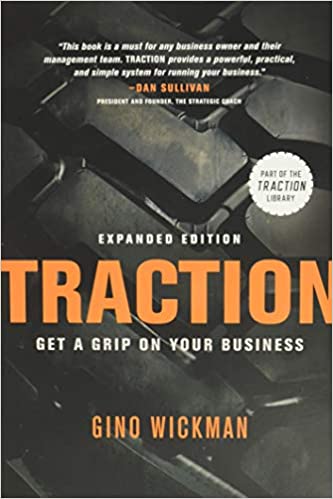
EOS / Traction — Gino Wickman
The Entrepreneurial Operating System is the most widely adopted business operating system in the small business world, built around Gino Wickman’s book Traction. It organises a company into Six Key Components (Vision, People, Data, Issues, Process, Traction) and gives the leadership team a strict rhythm: 90-day Rocks, a weekly Level 10 Meeting, a Scorecard, and an Accountability Chart that splits the Visionary from the Integrator.
EOS is at its best when a leadership team of roughly 10 to 250 staff is drowning in firefighting and needs discipline. It’s simple, prescriptive, and supported by a large network of implementers, which is why it’s so often the first operating system a company installs. Its Process Component deliberately stays high level: document the 20 percent of core processes and get them “followed by all.” Who actually writes them, to what depth, and how they stay current is largely left to you.
Deep dive: SYSTEMology vs EOS: how they compare and why they work together.
Scaling Up / Rockefeller Habits — Verne Harnish
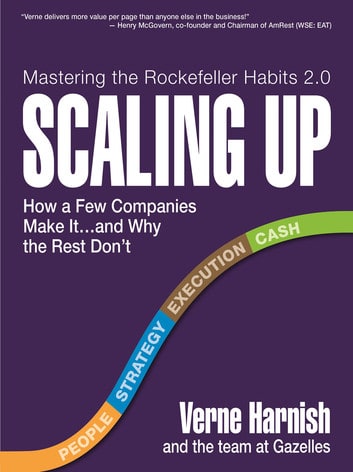
Verne Harnish wrote Mastering the Rockefeller Habits in 2002, five years before EOS existed, and expanded it into Scaling Up in 2014. It’s the original modern business operating system, organised around Four Decisions: People, Strategy, Execution, and Cash. Its signature tools are the One-Page Strategic Plan, daily huddles, quarterly themes, and the cash-flow rigour that has become its trademark.
Scaling Up suits companies from around 30 up to a few hundred staff, especially ones with genuine growth ambitions and the management depth to run a heavier toolkit. It’s more demanding than EOS and goes deeper on strategy and finance.
Deep dive: SYSTEMology vs Scaling Up: the business OS and the process OS.
Pinnacle — Steve Preda & Gregory Cleary
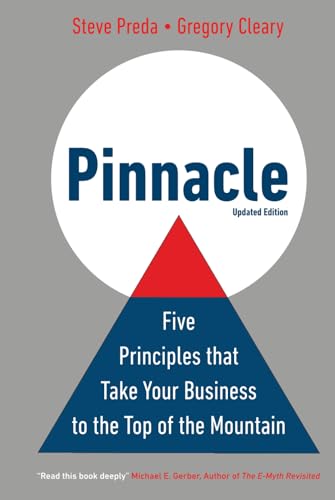
Pinnacle, from the book by Steve Preda and Gregory Cleary, is the flexible one. Where EOS gives every company the same toolbox, Pinnacle is built on five principles — People + Purpose + Playbooks + Performance = Profits — and lets you customise the tools underneath each principle to fit your business. It’s delivered by Certified Pinnacle Business Guides, typically experienced entrepreneurs rather than career consultants.
Its natural home is companies that started on EOS, got real value from the discipline, and then wanted more room to tailor. Worth noting for readers of this site: one of Pinnacle’s five principles is literally Playbooks — documented processes are baked into the model as a requirement.
Metronomics — Shannon Byrne Susko
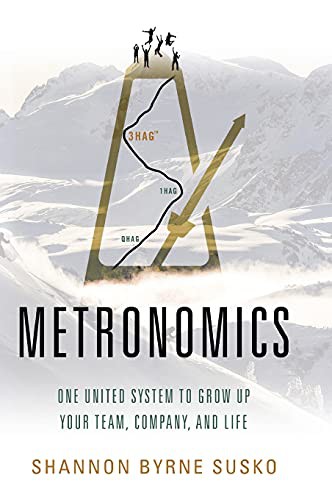
Metronomics is Shannon Byrne Susko’s system, and its distinguishing idea is integration: rather than picking one guru, it deliberately weaves thinking from Verne Harnish, Jim Collins, and Patrick Lencioni into one united system covering strategy, execution, cash, culture, and team — anchored by her 3HAG (3-Year Highly Achievable Goal). Susko built and exited two companies with it before writing the Metronomics book, and it’s coach-led by design, with software to run the rhythm day to day.
It resonates most with growth-stage companies (their client base runs from a few million to hundreds of millions in revenue) whose CEOs want one integrated system rather than a collection of frameworks bolted together.
ABoS — ActionCOACH’s business operating system (Brad Sugars)
ActionCOACH is the world’s largest business coaching franchise, and ABoS (the ActionCOACH Business Operating System) is Brad Sugars’ entry in this category: three decades of coaching IP formalised into a six-step operating system — Mastery, Marketing, Systemisation, Team, Scale, and ultimately Freedom, a business that works without you.
The structural difference is delivery. You don’t self-implement ABoS from a book; it comes with a coach attached, through ActionCOACH’s network of over 1,000 coaches in 80-plus countries. If you’re the kind of owner who knows what to do but doesn’t do it without accountability, that’s a feature, not a bug. And notice step three: Systemisation is baked into the model — which is exactly where we plug in when working alongside ActionCOACH firms.
Deep dive: SYSTEMology and ActionCOACH: coaching plus the process layer.
Where’s SYSTEMology in this lineup? Deliberately absent. SYSTEMology isn’t a business operating system — it’s the systems and process layer that every framework above depends on. EOS calls it the Process Component, Pinnacle calls it Playbooks, ABoS calls it Systemisation. Whichever operating system you run, the glue underneath is the same, and that’s where SYSTEMology fits.
How to choose between them
Honestly? It’s largely a matter of preference. Each of these systems has its own flavour, and when you look closely they share far more than they differ on: a documented vision, a quarterly target cycle, a weekly meeting, a scoreboard, clear accountability. Most of them will have pieces you love and pieces you’ll quietly leave out, and in practice every company ends up tailoring whichever one it adopts.
So my advice is simple. Grab a couple of the books above and read them. Find the one whose language and tools resonate with you and your leadership team, because the system you’ll actually run beats the theoretically perfect one every time. Then commit to it. Sticking with one system for a few years beats hopping between them chasing the perfect fit.
The real key sits underneath the choice: whichever methodology you go with, identify the rhythms and processes it asks of your business and systemise them — documented, delegated, and stored somewhere your team actually uses. That’s the part none of the frameworks does for you, and it’s the part SYSTEMology was built to handle.
Not sure where you’re stuck? Take 2 minutes with one of these free tools.
- Owner Dependency Score — the “4-week holiday test”, quantified
- Systems Strength Test — 9-dimension systems maturity diagnostic
- Owner Time Audit — hours lost to low-value work each week
- Cost of Chaos Calculator — the annual dollar cost of running without systems
- Business Valuation Calculator — what systemisation does to your sale multiple
Systems underpin all of them: where SYSTEMology fits
Look back at the five systems above and you’ll notice something: every single one has a box for documented processes. EOS wants core processes “followed by all.” Pinnacle makes Playbooks one of its five principles. ABoS puts Systemisation at step three. Scaling Up and Metronomics assume process discipline underneath their execution rhythms. The creators all agree: without documented systems, an operating system is a meeting cadence sitting on top of chaos.
Here’s the pattern I’ve watched for two decades. An owner installs one of these frameworks, and for a quarter or two things genuinely improve. Then they hit the process box. The task lands on the owner’s plate or gets assigned to whoever looks least busy, and six months later there’s a folder of half-finished documents nobody reads — while the business still can’t run without its founder.
That’s not a flaw in the frameworks. Documenting how work gets done is a different discipline with different rules. It needs knowledge extracted from the people who already do the work (not written by the owner), a system for keeping documents current, a home your team actually uses, and one person — a Systems Champion — who owns the effort so it survives busy seasons.
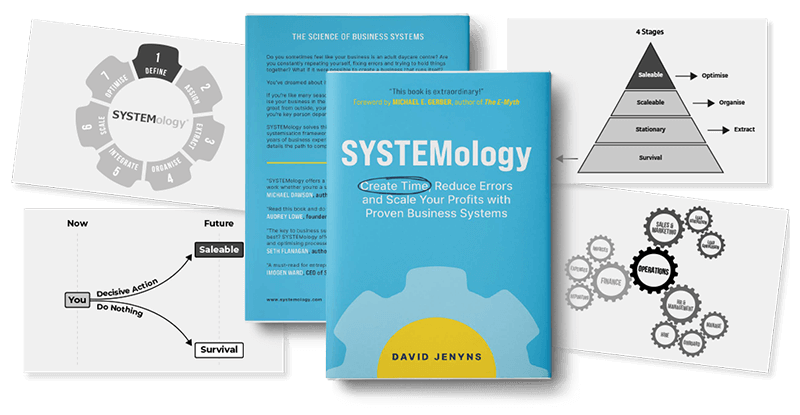
That’s the job SYSTEMology does. It’s a seven-stage method: map your Critical Client Flow (the single path from lead to cash), build a Minimum Viable Systems register of the processes that matter most, extract and document them from your team, and store them in systemHUB where they actually get used. It’s not a business operating system, and it doesn’t want to be. It’s the glue that makes whichever one you choose stick — and it’s why the creators of these frameworks have been generous about it rather than territorial:

“Systems Champion delivers exactly what every business owner needs. David Jenyns has created a practical framework that removes the owner from systems creation process and puts that responsibility where it belongs, with the team.”
— Gino Wickman, author of Traction & Shine, creator of EOS®

“What Michael started with The E-Myth decades ago, David continues today. SYSTEMology is the modern recipe for building their business playbook.”
— Michael E. Gerber, author of The E-Myth Revisited (from his foreword and introduction to SYSTEMology)

“Systems Champion breaks the biggest myth in business — that systemising is the leader’s job alone. David Jenyns shows that true leadership lies in empowering others to build systems that drive the business forward, without constant owner involvement.”
— Brad Sugars, founder of ActionCOACH
When the creator of EOS, the author of The E-Myth, and the founder of ActionCOACH all endorse the process layer, that’s not a coincidence. It’s an acknowledgment that their frameworks work better when the documentation problem is solved underneath them.
Here’s what business owners say once that layer is in place:
What real business owners say about SYSTEMology.
Systemise Your Business In Weeks, Not Years.
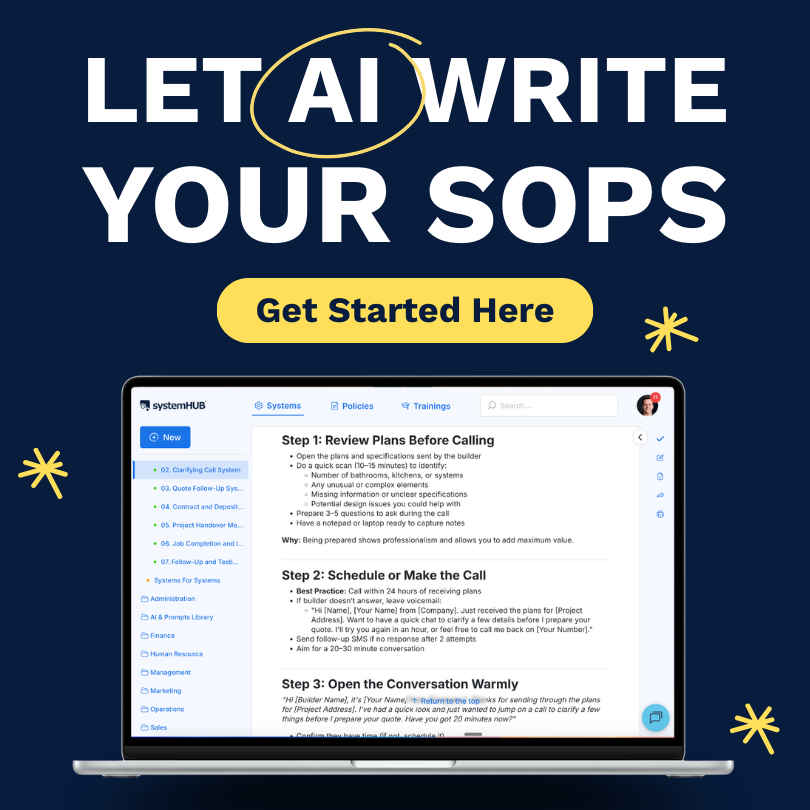
Whichever operating system you run at the top, systemHUB is where your documented processes live underneath it. Free trial, no credit card.
Frequently asked questions
What is the best business operating system for a small business?
For most small businesses under about 10 staff, the honest answer is: none of them yet. Start by documenting your core processes with SYSTEMology so the business can run without you, then add a leadership framework when you have a genuine leadership team to run it. From roughly 10 to 250 staff, EOS is the most proven choice; past 30 staff with aggressive growth plans, look hard at Scaling Up or Metronomics.
EOS vs Scaling Up: which is better?
Neither is better; they’re weighted differently. EOS is simpler, more prescriptive, and easier to self-implement, which makes it the safer choice for most companies of 10 to 250 staff. Scaling Up is heavier and goes deeper on strategy and cash-flow discipline, which suits larger firms with the management depth to run it. Both leave process documentation largely up to you.
Is SYSTEMology a business operating system?
No, and that’s deliberate. A business operating system sets vision, meeting cadences, and targets for the leadership team. SYSTEMology is a process operating system: it governs how the work itself gets documented, delegated, and done. It runs underneath EOS, Scaling Up, Pinnacle, Metronomics, or ABoS — it’s the glue that makes them stick, not a competitor to them.
What’s the difference between EOS and SYSTEMology?
EOS runs your leadership team: vision, accountability, meetings, and metrics. SYSTEMology runs your process layer: extracting and documenting how things get done so the business isn’t dependent on any one person. They solve different problems and run well together — many EOS companies use SYSTEMology to complete the Process Component. Full breakdown in SYSTEMology vs EOS.
Do I need a business operating system?
If your business can’t run for four weeks without you, something has to replace you as the operating system. Whether that’s a full leadership framework or simply documented processes depends on your size — under about 10 staff, documented processes come first. Take the Owner Dependency Score for a quick read on how exposed you are.
What are the best business operating system books?
The top five: Traction by Gino Wickman (EOS), Scaling Up by Verne Harnish, Pinnacle by Steve Preda and Gregory Cleary, Metronomics by Shannon Byrne Susko, and The E-Myth Revisited by Michael E. Gerber — the book that started the whole category. Then read SYSTEMology for the process layer every one of them depends on. For the wider reading list, see our 12 must-read books for small business owners.
How do you install an operating system in a founder-dependent business?
Start with the dependence, not the framework. First, map your Critical Client Flow — the single path from lead to cash. Second, build a Minimum Viable Systems register and document those processes by extracting knowledge from the people who do the work. Third, appoint a Systems Champion so documentation continues without the founder driving it. Once the business runs on documented systems rather than the founder’s memory, installing EOS or Scaling Up on top is straightforward.
Can I run SYSTEMology alongside EOS or Scaling Up?
Yes, and that’s the most common configuration we see. The operating system runs the quarterly and weekly rhythm at the top; SYSTEMology runs the process documentation layer underneath. Nothing conflicts, because they operate at different altitudes of the business.
How much does a business operating system cost to implement?
Self-implementing EOS or Scaling Up from the books costs almost nothing but takes discipline. A professional EOS Implementer typically runs into five figures per year; Scaling Up, Pinnacle, Metronomics, and ActionCOACH coaching are similar, since all are coach- or guide-delivered. SYSTEMology can be self-implemented from the book, with systemHUB plans from $95/month if you want the software, templates, and support to move faster.