Key Takeaways
- The Critical Client Flow maps your entire client journey on one page and reveals where your business is breaking down.
- You don’t need a hundred systems. You need about ten of the right ones. The CCF shows you which ones matter most.
- Only capture what you’re actually doing, not what you’d like to be doing. The gaps will show you where to focus.
- Fix one bottleneck first. Everything else gets easier after that.
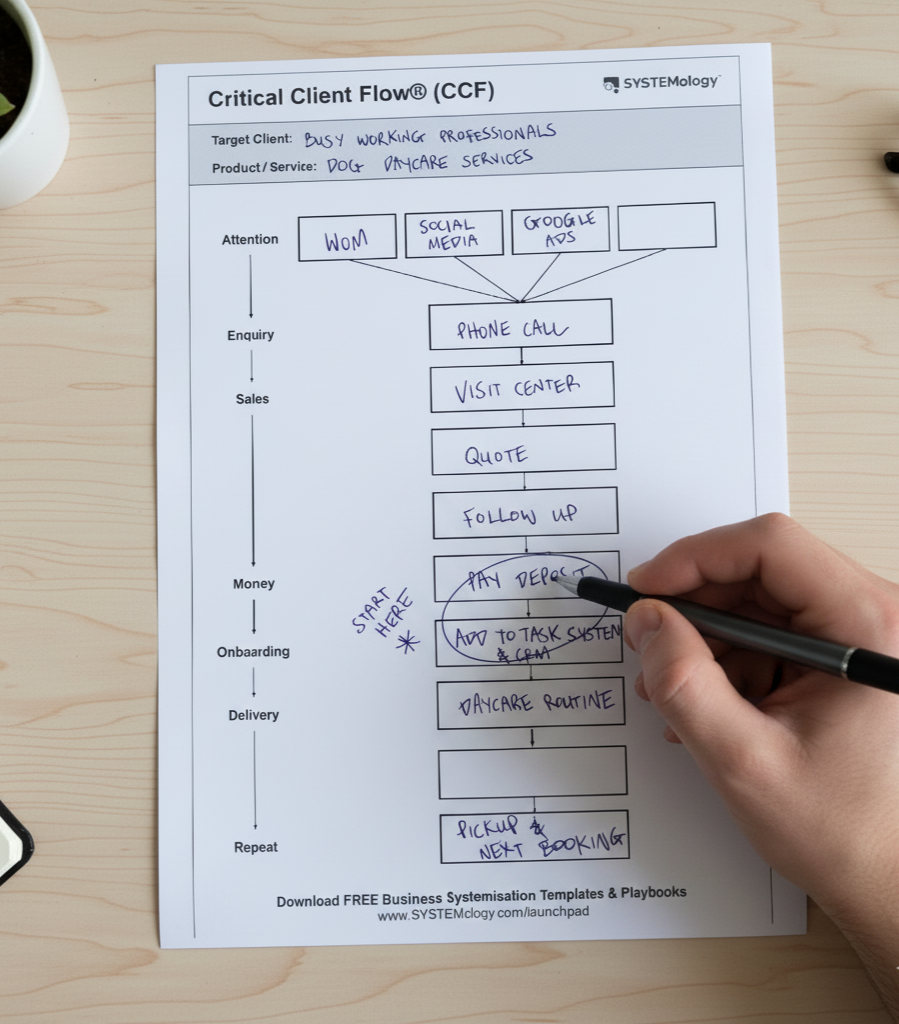
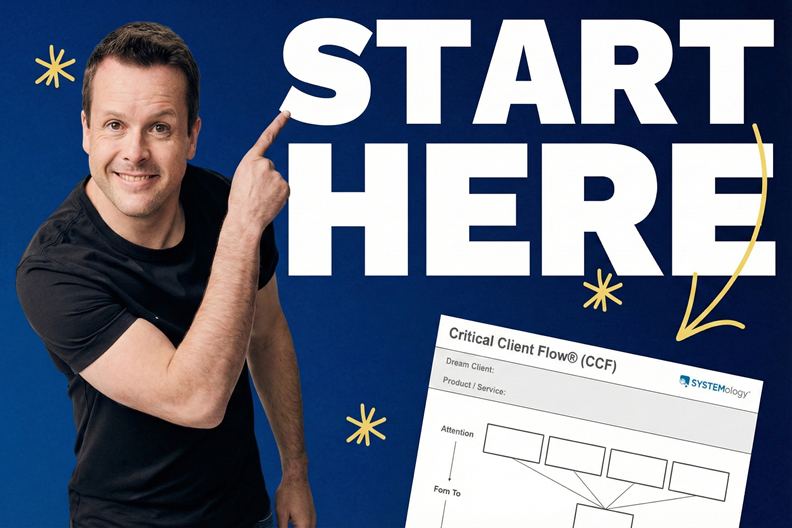
The Critical Client Flow (CCF) is a simple diagnostic tool that shows you where your business is breaking down. It maps how you attract, convert, and deliver your core service on a single page. But the real power comes after you complete it: you can see exactly where the bottleneck is hiding.
Most business owners know something’s off. The phone rings too much. The same questions come up again and again. Clients slip through the cracks. Quality depends on who’s working that day. But figuring out the root cause of all that feels impossible when you’re neck-deep in daily operations.
The CCF changes that.
In about 30 minutes, you map out your entire client journey. Then you look at it and ask one question: Where’s the pain?
The answer tells you exactly what to fix first.
Why Most Systemization Efforts Fail
Business owners who try to systemize often start by listing every process they can think of. Marketing workflows. HR policies. Client onboarding. Accounting procedures. Team communication protocols.
The list grows. Fifty items. Seventy. A hundred.
Then paralysis sets in, because where do you even start with a list that long?
Most people pick something at random or choose whatever feels easiest. They spend hours documenting a process that has minimal impact on daily operations. A few weeks later, the whole effort stalls.
The problem isn’t a lack of discipline. It’s focus.
You don’t need a hundred systems. You need about ten of the right systems. The CCF shows you which ten matter most.
What Makes the CCF Different
Here’s what separates the CCF from every other business planning tool: it’s not about what you should be doing. It’s about identifying what you’re actually doing right now.
Think of it like holding a mirror up to your business. It shows you what’s working and what’s not. Any gaps become obvious. And those gaps tell you exactly where to focus.
One rule when you create yours: only capture what you’re currently doing, not what you’d like to be doing. The details and improvements come later. First, you need to see reality clearly.
How to Find Your Bottleneck
Once your CCF is complete, finding your bottleneck is straightforward.
Look at your map and ask: Where are things breaking down? Where do clients get stuck? Where do you personally get pulled in to solve problems? Where does quality depend on who’s handling the work?
Those answers usually cluster around one or two stages. That clustering points to your bottleneck.

For most business owners, the answer jumps out almost immediately. They look at the map and say, “This is where things start falling apart.”
That’s your starting point. Not the 57 other things you could be documenting.
A Real Example: Where the Phone Kept Ringing
Jeanette Farren ran DiggiddyDoggyDaycare, and every morning the phone rang with clients asking the same questions: “How does drop-off work? What do I need to bring? What time do you close?”
She knew something was broken, but couldn’t isolate the problem. Staffing issue? Communication problem? Training gap?
She mapped her CCF.
Dream client: busy professionals without kids who treat their dogs like family.
Primary service: daily doggy daycare.
The map took less than 30 minutes.

When she looked at the finished CCF, the bottleneck was obvious. The pain was in onboarding. New clients were showing up with their dogs and had no idea what to expect. No welcome packet. No orientation process. No clear instructions before their first visit.
So every new client asked the same questions. And the team answered them repeatedly, day after day.
The fix: a welcome email with FAQs, a short orientation video, and a checklist for first-time visitors.
Within six weeks, those repetitive questions dropped to rare exceptions. The team reclaimed 15 to 20 hours per week that had been spent answering the same inquiries.
That’s the power of knowing where to look.
Start With One Bottleneck
Once you see where the pain is, the path forward is clear.
Create your CCF if you haven’t already. Download the template, and map one dream client and one primary product through the stages. Then circle the stage causing the most pain. That’s your bottleneck. That’s where you start.
When you systemize the biggest bottleneck first, everything gets easier. Your team has more clarity. You get more breathing room. And the next system to build becomes obvious.
You don’t need a hundred systems. You need the right ten. And the CCF shows you where to begin.