What would happen to your business tomorrow if your marketing stopped producing leads? Or if your sales process fell apart mid-conversation with a prospect? Most owners already know the answer. They have felt it.
David Jenyns, founder of SYSTEMology, uses a simple metaphor to answer the question of what systems does a business need: think of your business as a human body. It runs on subsystems. Some are visible, some run quietly in the background. But if even one critical subsystem fails, everything falls apart.
So which systems actually matter, how many do you need, and why does capturing your processes come before improving them?
Key Takeaways
- Your business is a system made up of subsystems.
- Roughly 20% of your systems deliver 80% of your results.
- Minimum Viable Systems are the tipping point where documentation starts to hold across the business.
- Capture what you are already doing before trying to improve it.
- A systems dashboard shows you where to focus next.
Your Business Runs on Subsystems, Whether You See Them or Not
The human body has a cardiovascular system, a respiratory system, and a skeletal system. Each does a specific job. If your respiratory system stops working, it does not matter how strong your bones are.
Business works the same way. Your marketing system, sales system, delivery system, and finance system are all subsystems inside one larger machine. Marketing produces leads. Sales converts them. Operations delivers the work. Finance keeps the money moving.
If one of those subsystems stops performing, the impact spreads. No leads from marketing means nothing for sales to close. No sales means nothing for operations to deliver. A weak finance function can choke growth even when every other department is performing.
Jeanette Dillon at DiggiddyDoggyDaycare saw what happens on the other side of that equation. She and her sister documented the systems across every department of their dog daycare so thoroughly that when PETstock acquired the company, they exported every system and plugged them straight into the new operation. The business ran on documented subsystems, not any single person.

How much is it costing you NOT to systemise?
Use our free Cost of Chaos Calculator to put a dollar figure on the time, mistakes, and missed growth your business loses every year without documented systems.
The 20% of Systems That Run 80% of Your Business
Trying to document every task in your business is one of the fastest ways to burn out and quit. A former business partner of David’s created hundreds of systems and pinned the entire index to his office wall. It looked impressive. In practice, nobody could make sense of it, and it fell apart within weeks.
The 80/20 rule (the Pareto principle) gives you a better filter. Roughly 20% of your systems produce 80% of your results. Your job is to identify that critical 20% and start there.
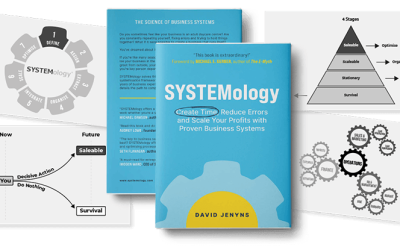
In SYSTEMology, that critical set is called your Minimum Viable Systems (MVS). It works out to about 10 to 15 mission-critical systems per department. For a typical business with six core departments, that is around 42 systems total. Not four hundred. Forty-two.
The MVS is the real tipping point. A lot of readers finish the SYSTEMology book thinking the goal is to document the Critical Client Flow and stop there. The Critical Client Flow is the starting line. The tipping point comes when every department has its minimum viable set documented. That is when systems touch the entire organisation. Every team member has some level of exposure to documented process. And that shift changes the culture of the business.
Where do you start with business systems?
SYSTEMology lays out the 7-step framework used by thousands of business owners to create time, reduce errors, and scale profits. Grab your copy and start building.
Capture First, Improve Later
The final step in the SYSTEMology framework is called Optimise. That surprises a lot of people because most assume improvement should come first. But the whole point of SYSTEMology is system capture: documenting what you are currently doing and making it the repeatable minimum standard.
Methodologies like Lean and Six Sigma are process improvement frameworks. They assume you already have a documented process to improve. Most small businesses do not even know what their process is yet. The work gets done differently every time depending on who is doing it and what crisis just landed.
Huge gains come from simply making things repeatable. When every team member follows the same steps for the same task, you eliminate the variability that creates mistakes, rework, and wasted time. That alone is often enough to shift a business from chaos to consistency. Once you have documented your first system, improving it becomes a much smaller job.

Better Systems Lead to Better Problems
Putting systems in place does not make all your problems disappear. What it does is change the quality of the problems you solve.
Without systems, you answer the same questions from staff over and over. The same client issues keep popping up. The same fires keep breaking out. You are stuck solving low-quality problems on repeat, and the business never moves forward.
With systems and a dashboard tracking each department, you can see exactly where the next bottleneck sits. Not enough leads? Go to work on the lead generation systems. Delivery falling behind? Tighten the operations systems. The business starts telling you where to focus, instead of you guessing.
Gary McMahon at Ecosystem Solutions was working over 100 hours a week before applying SYSTEMology. After documenting his systems, his business saw turnover grow 338%, and net profit increase 180%. Those results came from solving better problems, one system at a time.
Your business is already a system. The question is whether you have identified the subsystems that matter most and made them repeatable. Start with your Critical Client Flow. Build out your Minimum Viable Systems department by department. Capture what is happening now and save the improvement for later. The problems you solve from that point forward will be the ones that actually grow your business.
Ready to get your business systemised in 90 days?
Our team extracts, documents, and implements your core systems for you. No SOPs to write. No project to manage.