What happens when your agency wins more clients than your team can deliver? Most founders do one of two things: turn work away or hire fast and hope for the best. Neither works for long.
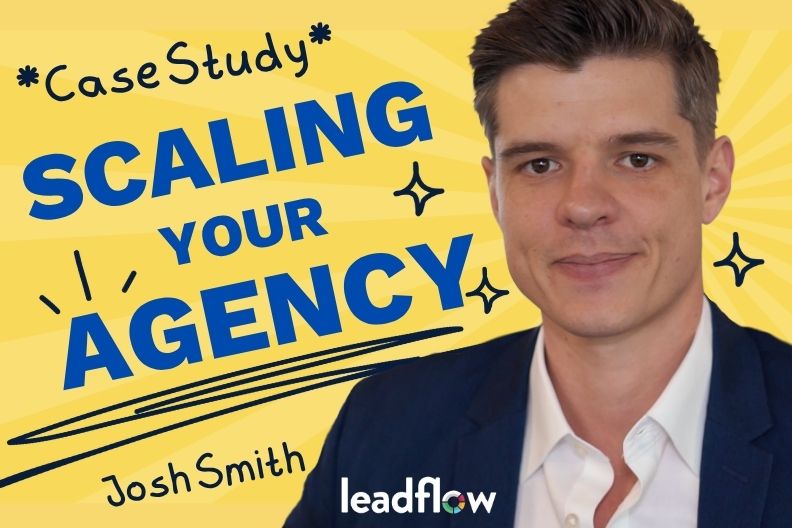
Josh Smith faced that exact problem when building LeadFlow, a lead generation agency specialising in quizzes, scorecards, and assessment tools built on the ScoreApp platform.
With clients ranging from pet food suppliers to lawyers to business consultants, every project was different. And Josh was the only person who could hold it all together. If you want to scale a lead generation agency without burning out or bloating your payroll, Josh’s story is worth reading.
Key Takeaways
- LeadFlow built a repeatable delivery method (the Speed Method) that breaks complex projects into sequential stages with built-in client approvals.
- Hiring a COO to own internal processes freed the founder from being the bottleneck.
- Systems allowed a small team to handle significantly more clients than their headcount suggested.
- The SYSTEMology framework helped Josh separate project management from systems documentation.
- The right hire asks “why” before pressing buttons.
The Breaking Point: When Every Project Lived in Josh’s Head
Josh spent over a decade in lead generation before launching LeadFlow. In the early days, he was the entire operation. A single quiz build could take 8 to 15 hours, and Josh handled every step himself, from strategy to design to tech setup.
That worked with one or two clients. It fell apart with ten. “I have probably periods where I feel like I can think and perform quite well from a systems perspective,” Josh said. “And then other periods where it overwhelms me quite a lot.”
The challenge wasn’t talent. Josh knew his craft. But every client operated in a different industry, with different goals and different audiences. Holding all of that in his head while managing delivery, approvals, and team handoffs was unsustainable. He needed a better way to work, starting with standard operating procedures that his team could follow without him.

Where do you start with business systems?
SYSTEMology lays out the 7-step framework used by thousands of business owners to create time, reduce errors, and scale profits. Grab your copy and start building.
The Decision: Why Josh Listened to the Same Audiobook Three Times
Josh picked up the SYSTEMology book and listened to the audiobook three times. One concept hit harder than the rest: the distinction between project management and systems documentation.
“The systems documentation was like a real light bulb for me,” Josh said. “It’s like what my brain needed to get over some of the roadblocks that I have.”
That distinction reshaped how Josh approached his agency. He stopped trying to manage every project through willpower and started building a repeatable delivery method he called the Speed Method. It broke complex quiz builds into sequential stages, with periodic client approvals built into the workflow. Clients knew what to expect. The team knew what came next. And projects stopped bottlenecking at Josh’s desk.
The other concept that stuck was the Systems Champion role. Josh realised he didn’t have to be the person documenting everything himself. He just needed someone who could take what he’d built and put it somewhere better.

Implementation: What the COO Saw That Josh Couldn’t
When LeadFlow brought on a COO, the business shifted fast. Here’s what changed:
- Challenging the founder’s blind spots. Josh had built the Speed Method for himself. The COO pushed back on the parts that didn’t work for the rest of the team, especially internal handoffs between design, copywriting, and tech roles.
- Exposing the Slack experiment’s limits. Josh had documented the entire business in Slack channels and threads. It looked impressive, but the COO’s verdict was honest: “This is really great, but actually it doesn’t work that well when we work through it.”
- Separating client-facing from internal systems. The Speed Method worked well for client delivery. But internal workflows needed their own structure, built around how the team actually collaborates day to day. Learning to map business processes for both audiences was key.
- Building for the team, not just the founder. Josh admitted this was his biggest weakness: “I think I’m very good at creating something that I can work with. But not necessarily having the right experience to make sure an internal team can take some of those nuanced bits.”
- Questioning before executing. Josh summed up the COO’s value this way: “You shouldn’t just be looking for button presses. You should be looking for people that ask you why they’re pushing those buttons.”

Need one place for all your business systems?
systemHUB is purpose-built to store, organise, and share your SOPs, policies, and training materials with your whole team.
Results: Handling More Clients Than Their Team Size Suggests
The results speak for themselves. With the Speed Method and a small team, LeadFlow now handles far more clients than their headcount would suggest.
“We can take on a lot more clients than what our team would actually suggest that we should,” Josh said. “It’s because we set expectations really well, and the way we break projects down through our Speed Method means we can handle different chunks at different points.”
Instead of tackling each project start to finish, the team manages multiple clients at different stages simultaneously. One client is in strategy while another is in design review and a third is in final tech setup. That staggered approach means no one is overloaded and no project stalls. It’s a practical example of how the right business systems let small teams compete with much larger ones.
The alternative, Josh noted, was the one most agency owners default to: throw more staff at the problem. But more people without better systems just creates a larger, messier operation.
Five Critical Lessons for Scaling a Lead Generation Agency
- Trust the process and start small. “You don’t need a lot of people,” Josh said. “Sometimes you just need an extra one or two to pull the load, and if you’ve got good systems in place, you can punch a lot heavier than your weight.”
- Hire for questions, not just task completion. The right team member challenges your processes before following them. That’s what a strong COO or Systems Champion brings to the table.
- Separate your client system from your internal workflow. What works for client delivery may not work for how your team collaborates behind the scenes. Build both.
- You don’t need to document everything yourself. The Systems Champion concept freed Josh from thinking he had to write every SOP. Delegating that work to the right person speeds things up and produces better results.
- Systems compound over time. Early wins feel small. But over months, the savings in time, errors, and mental load stack up until the effect is hard to ignore.
Ready to systemise your business yourself?
The Business Systems Accelerator gives you systemHUB, step-by-step training, and 90+ templates in one DIY package. Built for teams of 3–40.
For agency owners stuck doing everything themselves, that’s the shift worth making.

Ready to Scale Your Lead Generation Agency?
How much is it costing you NOT to systemise?
Use our free Cost of Chaos Calculator to put a dollar figure on the time, mistakes, and missed growth your business loses every year without documented systems.