Builders understand sequence better than almost any business owner I work with. Nobody pours a slab after the frame is up. Yet the office side of a construction business usually runs backwards. A lead comes in, someone remembers what to do, the handover to site happens by text message, and the owner fills every gap.
I sat with a builder recently who found a tender in his inbox from the previous October. He had flagged it, meant to come back to it, and never did. Nearly a year of forgotten work. The problem was never his ability to build. It was that the business ran on his memory, and memory is not a system.
So which of the hundreds of things a building business does should you write down first? Not the safety manual and not the email signature. The handoffs. This article lists the 15 that matter most, in the order they happen on a job, and shows you how to pick your first three.
Key Takeaways
- Document handoffs, not everything. That is where margin, trust and the owner's time leak.
- Map your Critical Client Flow first. It tells you which three processes to document before anything else.
- Pre-construction decides the build. Qualification, scope capture, estimating and acceptance set the quality of everything after.
- The sales-to-site handover is the single highest-value process in most building businesses.
- Variations and progress claims are where the cash is. Make the decision trail visible before the extra work is done.
- Version one is short: purpose, trigger, owner, steps, proof of completion and a review date. Capture it on video first.
Why Builders Document the Wrong Thing First
When builders decide to get organised, they nearly always start in the wrong place. They write a 40-page safety manual, or they document how to set up a new email signature. Both feel productive. Neither stops the client ringing at 9pm, and neither gets the final invoice out the door faster.
The processes worth documenting first are the handoffs. The moments where the job passes from one person to another and something gets lost. Sales to estimating. Estimating to site. Site to office. Office to bank account. Get those right and the owner can step back. Get them wrong and no amount of documentation elsewhere will save you.
Luke Davies at Davies Construction went through exactly this. The video above is his account of what changed once the business ran on documented systems rather than on him. The full case study is here.
How to Pick the Order: The Critical Client Flow
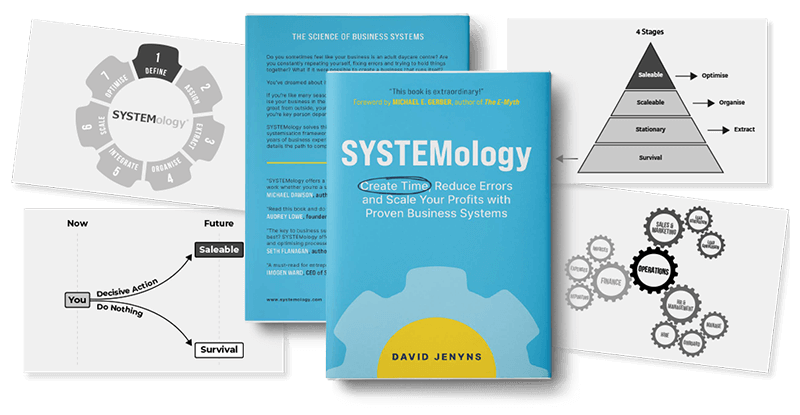
In SYSTEMology we start every build with a Critical Client Flow. It is a one-page map of the journey your client takes with you, from the first enquiry to the final payment and the referral that follows. Seven to twelve stages, no more. You can grab the template here or read the full walkthrough on mapping your processes.
For a builder the flow usually looks something like this.
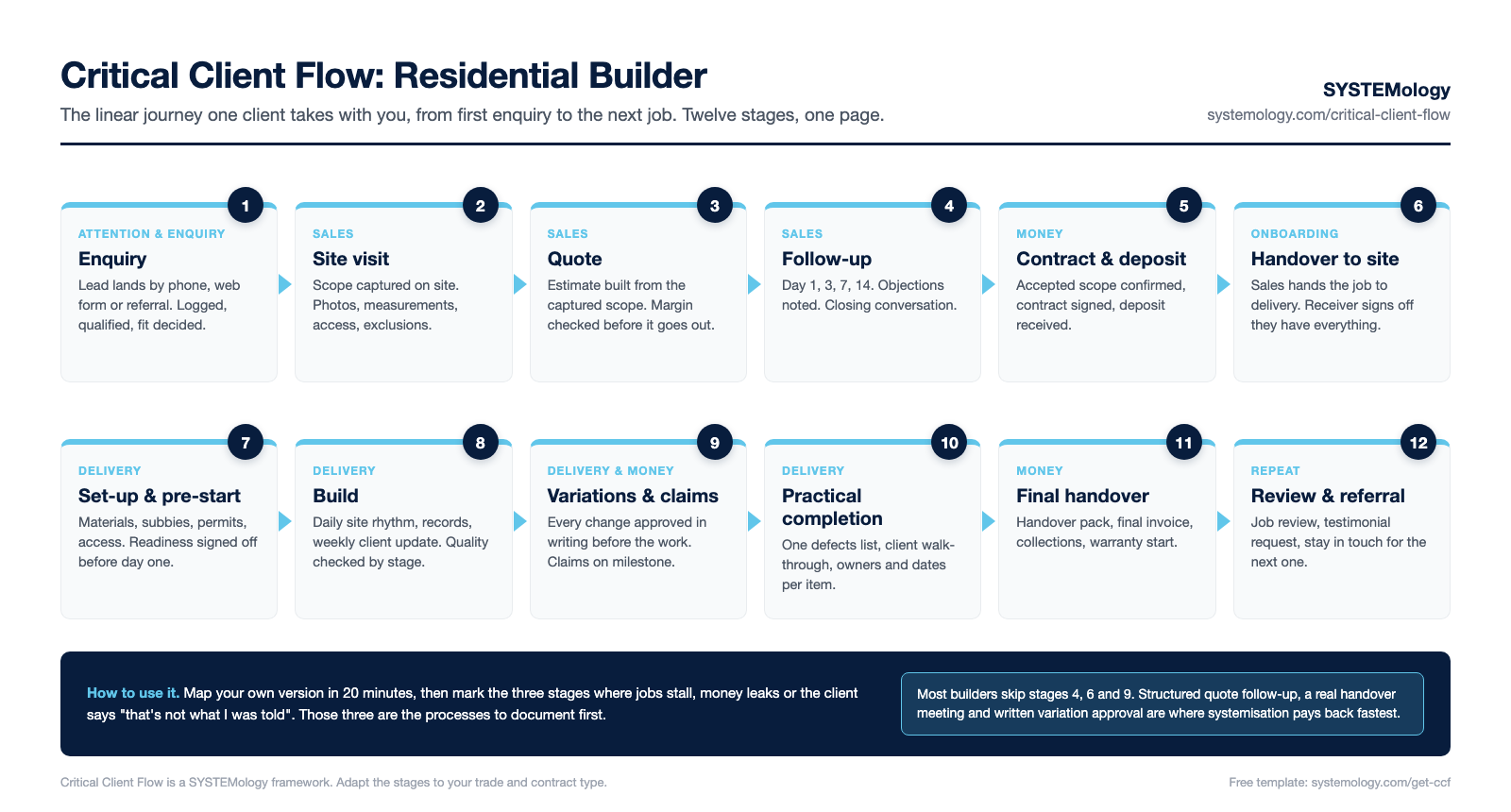
A Critical Client Flow for a residential builder. Twelve stages, one page. Yours will differ by trade and contract type. Map your own with the free template.
Once the flow is on paper, the order to document becomes obvious. You look for three things:
- Where does the job stall? The stage where work sits waiting for one person.
- Where does money leak? Work done that never reaches an invoice. Costs that show up after the job closes.
- Where does the client feel it? The moment they hear "that's not what I was told".
The 15 processes below are the ones that keep coming up when I run this exercise with builders. Treat them as a starting hypothesis, not a rulebook. Your trade, your contract type and your current headache decide the order. Each one gets the same four fields: why it matters, who owns it and what triggers it, what a first version needs, and the sign that says document this one first.
The 15 Processes at a Glance
| Phase | Processes | What it protects | Start here when |
|---|---|---|---|
| Pre-construction | 1. Lead qualification 2. Site visit and scope capture 3. Estimating and quoting 4. Follow-up, contract and deposit | Fit, scope, margin, expectations | You price work you should never have looked at, or quotes keep missing the same items. |
| Job set-up | 5. Sales-to-site handover 6. Procurement and subbie scheduling | A clean start | Site learns about a promise after the work has begun. |
| On site | 7. Mobilisation and pre-start 8. Daily site coordination 9. Client progress updates | Time, quality, communication | The owner is the default dispatcher and the client's first call. |
| Control | 10. Variations 11. Quality and defects 12. Progress claims and job costing | Cash flow and margin | Work gets done that never hits an invoice, or blowouts show up after the job. |
| Closeout | 13. Practical completion 14. Final handover and collections | Reputation and the last dollar | Jobs drift after the major work is done and the final invoice goes out late. |
| People | 15. Onboarding staff and subbies | Consistency as you grow | New people learn by shadowing the busiest person. |
Phase one
Pre-Construction: Processes 1 to 4
Everything that goes wrong on site was usually decided before the job was won. A vague scope becomes a variation fight. A rushed estimate becomes a margin problem. These four processes set the quality of everything that follows.

Lead qualification
Site visit and scope capture
Estimating and quote preparation
Quote follow-up, contract acceptance and deposit
Phase two
Job Set-Up: Processes 5 to 6
This is where the person who won the job hands it to the people who will build it. In most building businesses that handover happens in someone's head, and it is the single biggest source of "that's not what I was told".

Sales-to-site handover
Procurement, subcontractor scheduling and readiness
How much is the handover gap costing you?
The free Cost of Chaos Calculator puts a dollar figure on the rework, missed variations and owner hours a building business loses every year without documented handoffs.
Phase three
On Site: Processes 7 to 9
Once the job is running, the question is whether information flows without the owner carrying it. These three processes are the difference between a supervisor who runs the site and an owner who runs every site by phone.

Mobilisation and pre-start
Daily site coordination and records
Client progress updates
Phase four
Control During the Build: Processes 10 to 12
These three are where the money is. Variations that never get invoiced, defects found late, and job costs that only appear in the accounting software after the job has closed. If cash flow is your pain, start here.

Variations and change orders
Quality inspections and defect escalation
Progress claims, invoicing and job-cost checks
Could your business run a job without you for four weeks?
The Owner Dependency Score takes two minutes and shows exactly where the business still needs you on site, on the phone, or in the inbox.
Phase five
Closeout: Processes 13 to 14
The last ten percent of a job can eat far more than ten percent of the effort. Closeout is not admin. It is the client's last impression of you, and it is where the final dollars either arrive or drift.

Practical completion and defects list
Final handover, final invoice, collections and warranty
Phase six
People: Process 15
The first 14 processes have little value if new people learn by guessing, shadowing the busiest person, or ringing the owner. This one turns the way you work into a repeatable path for anyone who joins.

Onboarding staff and subcontractors
What a First-Version SOP Needs
Do not turn these 15 processes into 15 manuals. In SYSTEMology we call the first pass a Minimum Viable System. It is the shortest version a competent team member can follow on a live job. A short video walkthrough, a checklist and a few lines of context is usually enough for version one.
| Element | The question it answers |
|---|---|
| Purpose | Why does this process exist? |
| Trigger | What starts it? |
| Owner | Who is accountable for it running and being kept current? |
| Inputs | What information, tools, approvals or materials are needed before you start? |
| Steps | What happens, in what order? |
| Decisions | Where does the person use judgement, and when do they escalate? |
| Proof of completion | What shows it was done properly? A photo, a signed form, a status change. |
| Linked resources | Which forms, drawings, checklists or systems support the work? |
| Review date | When will the owner check it still matches reality? |
The fastest way to capture the current version is to record the person who already does it well. Film the site visit. Record the handover meeting. Voice-memo the estimating walkthrough. Then turn the recording into the written steps. We cover the method in how to write SOPs with AI and the seven elements of an SOP your team will follow. The builder's job is to do the work once on camera, not to sit down and write.
The 30-Day Rollout
You do not need all 15 this month. You need three that matter, tested on real jobs, with an owner attached. Here is the sequence I run with builders.
Week one: map the flow and pick three
Map one core client journey with the Critical Client Flow template. Mark the three handoffs costing you the most time, margin or frustration. For most builders that is the handover, variations and progress claims, but let your flow tell you.
Week two: capture the current version
Record the people who already do those three well. Do not improve anything yet. Capture what actually happens today, then turn each recording into a short first-version SOP using the nine elements above.
Week three: assign the owner and put it where the work happens
Every process gets one owner, and it is rarely the business owner. Give the job to a Systems Champion, the person in your team who is organised, cares about it being done right and is not you. Store the processes somewhere the crew can find them on a phone, not in a folder on the office computer.
Week four: test on a live job and fix what breaks
Run the three processes on real work. The job will expose the gaps. Fix them, set a review date, then pick the next three. That rhythm, repeated, builds a business that runs without you in the middle of it.
Start with the map, not the manual.
The Critical Client Flow template is free. Print it, map your twelve stages with the team in 20 minutes, and you will know which three processes to document first.
Not sure which handoff is costing you most? Two more free tools.
- Systems Strength Test: where your systems are strong and where they are missing
- Business Valuation Calculator: what systemisation does to the sale value of a building company
What Real Business Owners Say About SYSTEMology
Systemise Your Business In Weeks, Not Years.
systemHUB gives your crew one place to find every process on their phone, with an owner, a review date and sign-off tracking built in. Free trial, no credit card.
Start your free systemHUB trial →Frequently Asked Questions
What construction business processes should I document first?
Start with the handoffs that decide margin, client experience and cash flow. For most builders that is lead qualification, site and scope capture, estimating, the sales-to-site handover, variations, progress claims and final handover. Map your own client journey first and pick the three most painful gaps rather than copying someone else's library.
How many SOPs does a small construction company need?
Far fewer than you think to start. Map the seven to twelve high-level stages of your core client journey, then write one short SOP for the most important activity inside each stage. Add detail only when a real job shows you where it is needed. Three well-used processes beat thirty nobody opens.
What should a construction SOP include?
Purpose, trigger, owner, inputs, steps, decision points, proof of completion, linked resources and a review date. Keep it short enough to use on a live job and specific enough that a new team member does not need to guess what good looks like. A video walkthrough plus a checklist is a perfectly good first version.
How do I get my crew to actually follow documented processes?
Involve the people who do the work when you capture it, make the process findable on a phone where the work happens, and build it into the job rhythm rather than filing it away. Start with the process that removes a genuine frustration for the crew. Adoption follows when the system makes their day easier, not when it adds paperwork.
Should I document safety, contracts and payment claims?
Yes, those areas need documented controls, but the exact content depends on your trade, state, contracts and regulator. Use this list as an operational starting point, then have the right qualified advisers check safety, legal, employment, tax and contract requirements before you rely on a process for compliance.
What is a Critical Client Flow for a builder?
It is a one-page map of the journey your client takes with you, from enquiry to final payment and referral, in seven to twelve stages. For a builder it usually runs enquiry, site visit, quote, follow-up, contract and deposit, handover to site, build, variations, progress claims, practical completion, final handover, follow-up. It tells you which processes to document first. Read more about the Critical Client Flow here.
What is the fastest way to document construction processes?
Record the person who already does the job well, then turn the recording into written steps. Film the site visit, record the handover meeting, voice-memo the estimating walkthrough. AI tools can turn a transcript into a first draft in minutes. The builder does the work once on camera instead of sitting down to write. Here is how we do it.
Do subcontractors need SOPs too?
They need the parts of your process that touch them: what information they get before booking, what a finished stage looks like, how variations get raised, how they get paid, and how defects get logged. A one-page subbie onboarding process that covers those points saves more arguments than any contract clause.
Do I need software to manage construction SOPs?
Not on day one. A shared folder and a phone camera will get your first three processes captured. You need software once the crew has to find a process on site, once you need to know who has read and signed off on what, and once processes need owners and review dates so they stay current. That is what systemHUB is built for.
This article is an operational starting point, not legal, safety, engineering, tax, employment or compliance advice. Requirements vary by trade, state, contract type and project size. Check current local requirements before relying on any process for compliance.