Here is how systemising usually starts. The business owner is fired up. The systems champion is fired up. And that is the whole list.
Everyone else is polite about it. They nod in the meeting, then go back to doing the job the way they have always done it. So you end up with a folder of beautifully documented processes that nobody opens, plus the uncomfortable thought that you have done all that work for nothing.
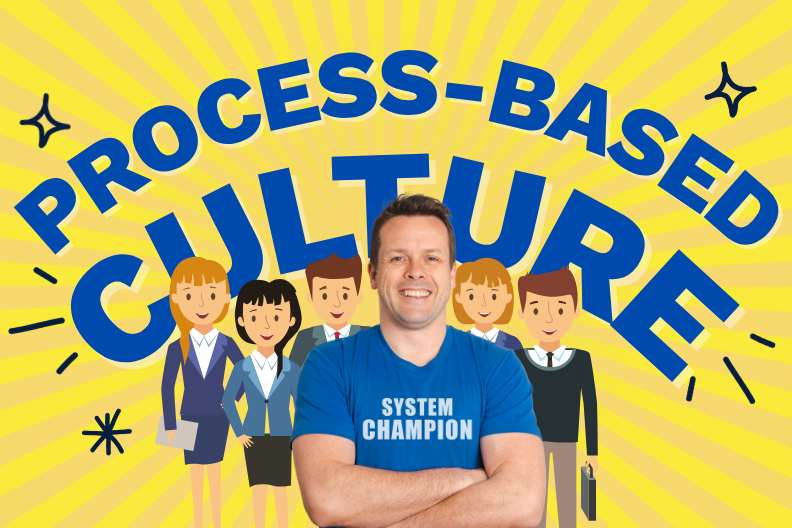
A process-based culture is the other end of that pendulum: not everyone buried in the detail of documenting, but everyone wanting to be involved. This piece walks through the five steps that get you there, drawn from a live training session on team buy-in.
Key Takeaways
- Most systemising starts with two people, the owner and the systems champion, then stalls there.
- You do not need everyone documenting. You need everyone wanting to be involved.
- Start with the people who lean in, not the ones who push back.
- Evidence is what shifts a culture. If you had to prove your business runs on systems, what would you produce?
- Build the onboarding once, so it works for the team you have and the people you hire next.
Why Systemising Stalls at Two People
Ask a room of business owners who has lived through this and the hands go up fast. The owner and the champion are keen. Nobody else is against it exactly, they just have a job to do and systemising looks like extra.
Trying to force the issue feels clunky, because most owners genuinely do not know the best way to show a team that systemising is a win for them rather than a win for the boss. So the work carries on quietly in the background while the business carries on exactly as it was.
That is the real cost. Not the hours spent documenting, but the fact that a system nobody uses is not a system. It is a document.
What Full Buy-In Actually Looks Like
Renee Kelly from Lime Therapy and Caleb Champion came through one of our group trainings. They got to a point most owners would not believe. With a team of 35 to 40 people, team members started asking to join in. Can I help out? I like what we are doing here. Can I be an assistant champion too?
Nobody was dragged. They opted in, because they could see the win for themselves: less chasing, fewer interruptions, a clearer run at their own work. That is what a systems-driven business feels like from the inside. It stops being owner-driven and becomes team-driven.
What you want is a way to take someone who is completely unaware of systemising and bring them on board, quickly, easily and in a way you can repeat. A blueprint, in other words, not a pep talk.
Five Steps to Create a Process-Based Culture
At the early part of this journey there are five things to work through, in order. Onboard the team, uncover who is interested, train those people, show the business you are systemising, then build the process so it repeats.
1. Onboard your team to the idea
Start with a short video. Not a policy, not a presentation, just you explaining that the business is going to start documenting how it does things and why that matters for the people doing the work. Simple is the point. The video is a net. You are about to find out who swims toward it.
2. Uncover who is interested
Watch for the green shoots. Someone replies, asks a question, says that sounds useful for the handover mess we had last month. Those are your people. Go and have the conversation: tell me more about that.
Some will be attracted and some will be repelled. Both reactions are information. Your job at this stage is only to find the first group.

3. Train the people who put their hand up
Give the keen ones somewhere to go. Between your systemHUB account and the training in the Business Systems Accelerator, there is more than enough to take an interested team member from curious to capable without you building a course from scratch.
Put your energy here rather than spreading it evenly across everyone. The people who already want this will carry it further than the people you talk into it.
Somewhere for your team to actually put the systems?
systemHUB gives your champion and your early adopters one place to document, find and follow how the work gets done.
4. Show the business you are systemising
Here is a useful test. If you were in a court of law and had to prove your business was a systems-driven company, what evidence could you produce?
That question turns a vague intention into a visible one. Producing the evidence is a core part of the systems champion's role. Put it under everybody's nose, all the time:
- Reference the system by name in team meetings, rather than explaining the steps again.
- Share each newly documented process as it lands.
- Point out when a problem was solved by a system instead of a scramble.
- Award a monthly MVP to someone who documented a process or improved one.
Find the people who naturally resonate with this, celebrate them and shine a light on the work they are doing. Culture changes by what gets noticed.

5. Build the process so it repeats
Everything above works once. The last step makes it work every time, by turning it into an onboarding process of its own: the video, the conversation, the training path, the first documented system. Run it for the rest of your existing team as they come around, then run the same thing for every new starter in their first week.
That is the difference between a push and a culture. A push needs you. A process does not.
The Team You Have and the Team You Hire Next
Worth separating these two, because they need different handling. Your existing team were almost certainly not recruited with systemising in mind. Nobody asked them at interview whether they liked documenting their work. So with them you go looking for who is already inclined and start there, which is the whole point of getting your team on board in the order described above.
From here on you have an advantage. People who are naturally systems-driven are easier to work with and settle into a systemised business faster, so you can recruit for it deliberately rather than hope for it.
And the ones who are not on board yet? Circle back once the train is moving. Give everybody every chance to jump on and help them on. Be honest with yourself that a few may still choose to stay on the platform, but that is a conversation for further down the line, not the one to start with.
What is the undocumented work costing you?
Put a number on the hours your team loses to questions only you can answer.
Frequently Asked Questions
What is a process-based culture?
It is a business where documenting and following systems is simply how things are done, rather than a project the owner is pushing. Not everyone writes processes, but everyone wants to be involved, so new work gets captured as a matter of course instead of living in somebody's head.
How do you get team buy-in for business systems?
Onboard the whole team to the idea with a short video, find the few people who show genuine interest, train those people first, then make the progress visible through team meetings, shared processes and recognition. Buy-in follows evidence, so give people something real to see before you ask them to commit.
Who should be the systems champion?
Someone already inclined toward order and detail, who has the respect of the team and enough time to do the role properly. In most businesses they emerge rather than get appointed: they are the person who asks the follow-up question after the first conversation about systemising.
What if part of the team never gets on board?
Leave that problem until the momentum is real. Start with the willing, build visible wins, then circle back to the rest with evidence in hand. Give everyone a genuine chance to join in and help them do it. A small number may still opt out. That is a later conversation, not a reason to stall the first one.
Getting your team on board is not a personality contest and it is not about convincing everybody at once. It is five steps, run in order, starting with the people who are already leaning in. Do that and the culture does the convincing for you.
Your business is not broken. It just has not been shown, yet, what it looks like when everybody is in.
Want the whole thing mapped out for you?
Get your business systemised in 90 days, with the team brought along at every step.